
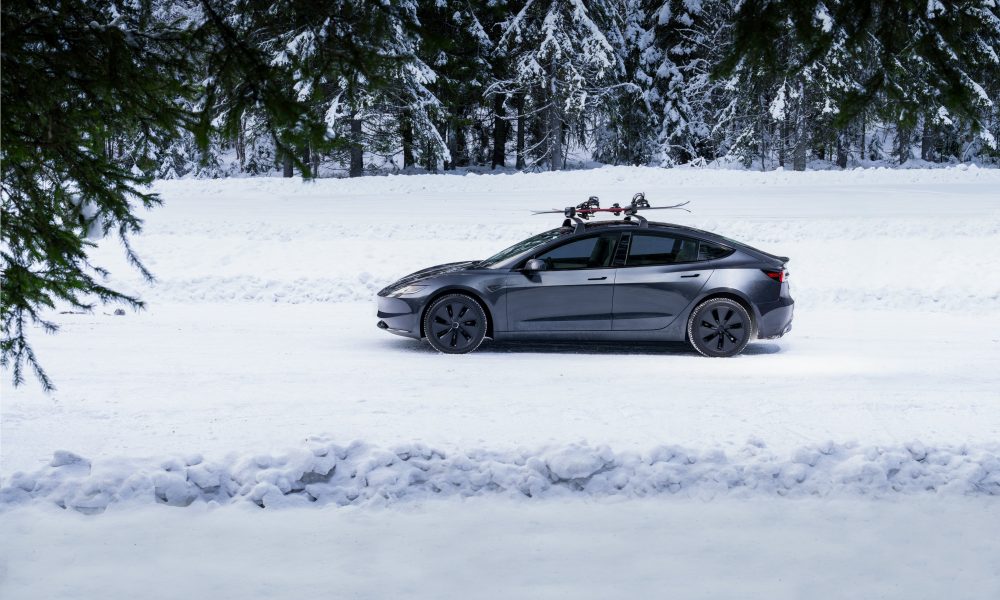


Tesla’s 2026 Summer Update now includes three selectable traction control modes for the Model 3 and Model Y, filling a gap that has existed in those vehicles since their launch. The Model S, Model X, and Cybertruck already had drive modes for varying conditions. The two highest-volume Teslas on the road did not.
The feature offers three settings: Auto for dry pavement, Slippery Surface for rain and ice, and Stuck Assist for snow, mud, or sand. The system resets to Auto at the start of every drive. Owners can find it under Controls, then Dynamics, then Traction Control Mode.
It is a straightforward addition. Traction control modes work by monitoring wheel speed sensors and modulating power delivery to reduce slip. Every major automaker has offered something similar for years, often with far more granularity.
BMW’s xDrive systems, Audi’s drive select, even Hyundai’s terrain modes on the Santa Fe have given drivers this kind of adaptability as standard equipment. That Tesla is only now bringing it to its best-selling cars in mid-2026 says something about the company’s software priorities over the past several years.
Full Self-Driving has consumed enormous engineering bandwidth. Features that legacy automakers baked into their vehicles a decade ago have waited in line.
Tesla did frame the addition partly through the lens of FSD, suggesting that pairing traction control modes with autonomous driving in adverse weather could boost driver confidence. That pitch requires you to accept the premise that FSD handles rain, snow, and ice well enough to trust in the first place. Many owners remain skeptical, and Tesla’s own documentation still advises caution in those conditions.
The Summer Update carries other changes too. Navigation improvements, new wrap customization and sharing options, expanded Tesla app functionality, and what the company calls “gamification” of self-driving round out the release. Tesla announced the update last week and began pushing it to a small number of vehicles on Saturday.
Rollout pace could test patience. The Spring Update moved slowly, and Tesla has signaled that the Summer Update may follow a similarly conservative timeline. Some owners may not see it until late August.
The traction control addition lands during an uneven stretch for Tesla. Shares dropped roughly 19 percent last week after a Q2 earnings report that beat on revenue but missed on profit. Elon Musk spent part of the week telling The Economist that money itself may become irrelevant within a decade, a tough sell for investors watching their holdings shrink in real time.
For Model 3 and Model Y owners who live in climates where snow and ice are facts of life, three traction control modes are welcome. They are also table stakes. Ford offers seven drive modes on the Mustang Mach-E, and Rivian’s R1S has six plus a dedicated off-road suite.
Tesla calling this a feature rather than an overdue correction tells you where the company’s attention has been. The question now is whether owners in Minneapolis and Montreal notice the difference when winter comes, or whether the modes are too basic to matter against what competitors already provide.
The update is live. The real test starts when the roads freeze.

Share this Story