
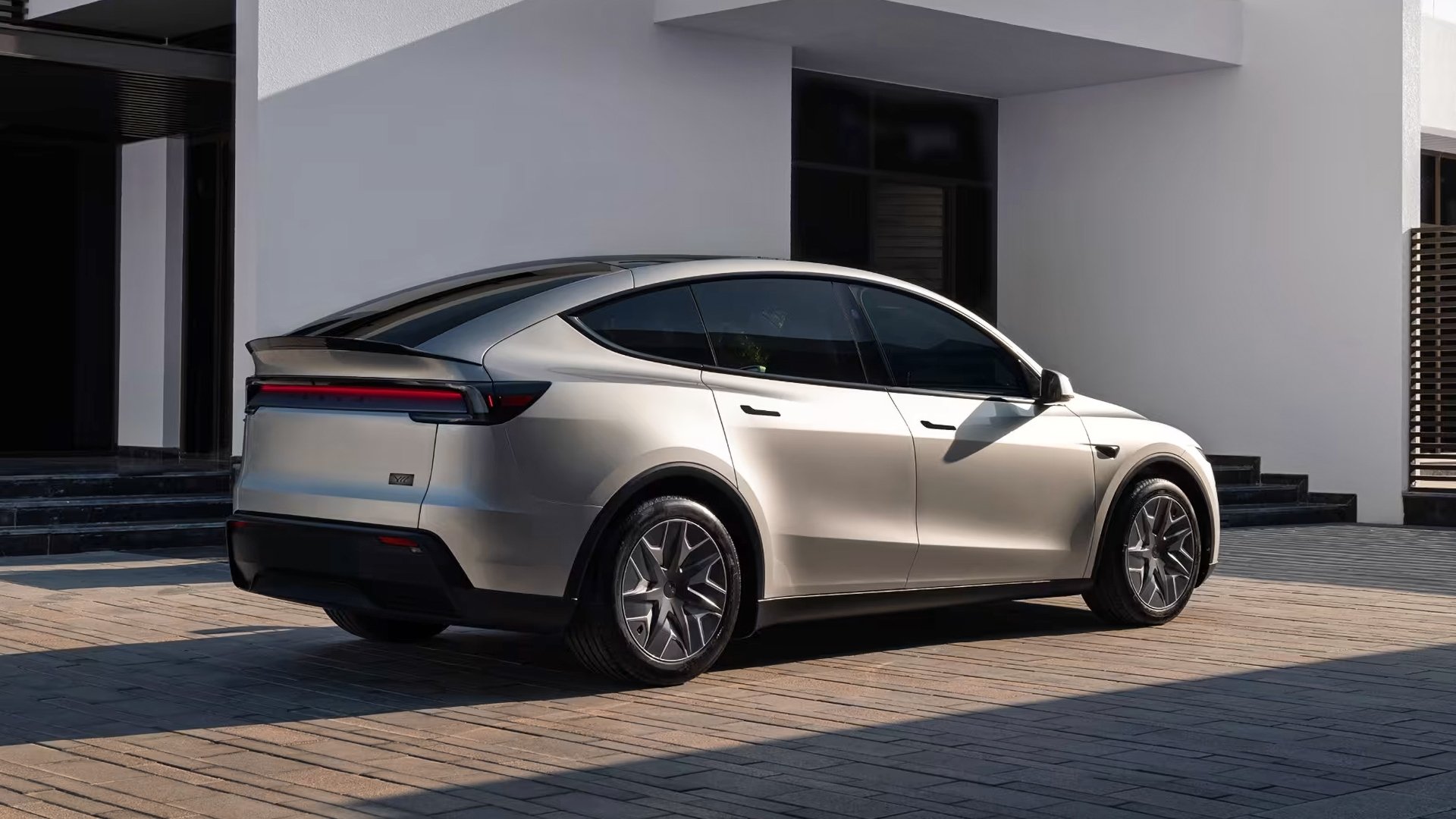


Tesla just put a three-row, long-wheelbase Model Y on sale in the United States, and the timing tells you everything you need to know about where the company’s product strategy actually stands. Rather than replace the Model X — its flagship SUV, discontinued without ceremony — Tesla simply stretched what it already had.
The extended Model Y first appeared in China last year, then rolled into Australia earlier in 2025. Now it arrives stateside as a makeshift answer to the hole left by the falcon-doored SUV that once represented Tesla’s most ambitious engineering. Calling it a replacement is generous. It’s a workaround.
But Tesla doesn’t seem to need ambition right now. It needs volume. And it’s getting it.
The company just posted 480,126 deliveries worldwide for Q2 2025, roughly 80,000 more than analysts had forecast and a 25 percent jump over the prior quarter. Strong sales in China and Europe drove the surge. The numbers represent Tesla’s best quarterly performance in years.
So the calculus is clear: why invest in a low-volume halo SUV when the Model Y, in various configurations, keeps printing money? Stretching a proven platform is cheaper, faster, and far less risky than developing something new. It’s also the kind of move a mature automaker makes — not the disruptor Tesla still claims to be.
The quarter wasn’t all triumph. The first known fatal crash involving a Tesla Semi occurred last week in Nevada when the truck struck a vintage Volkswagen Beetle, killing both occupants. Full Self-Driving isn’t available on the Semi, and the Lyon County Sheriff’s Office said preliminary statements suggest the truck driver may have fallen asleep.
That crash will draw scrutiny to the Semi program at a moment when Tesla’s commercial vehicle ambitions remain largely unproven at scale. The Semi has been trickling into service for years now without the mass production Elon Musk once promised.
Meanwhile, the broader EV ecosystem continues to shift beneath Tesla’s feet. Walmart has built over 70 charging stations with 600 connectors in barely a year, a retail giant muscling into infrastructure that Tesla once had almost entirely to itself. CATL’s vice president flagged mineral mining — not battery processing — as the real bottleneck facing the industry, a constraint that sits upstream of anything Tesla can engineer around.
And at Nissan, CEO Ivan Espinosa insisted the alliance with Renault is “collaborating better than ever,” even as Renault pointedly abstained from a vote to reappoint a longtime Nissan board director. That kind of optimism usually means the opposite is true.
Back at Tesla, the long-wheelbase Model Y is the product that best captures the company’s current identity. It’s not revolutionary. It’s not even particularly exciting. It’s an existing vehicle, made slightly bigger, sold to fill a gap left by a product Tesla couldn’t be bothered to replace properly.
The deliveries number says the market doesn’t care. Nearly half a million buyers in a single quarter aren’t waiting for innovation. They’re buying what’s available, what’s priced right, and what has a charging network already in the ground.
Tesla has figured out that the safest path forward is the most boring one. For a company built on spectacle, that might be the most surprising development of all.
Share this Story