
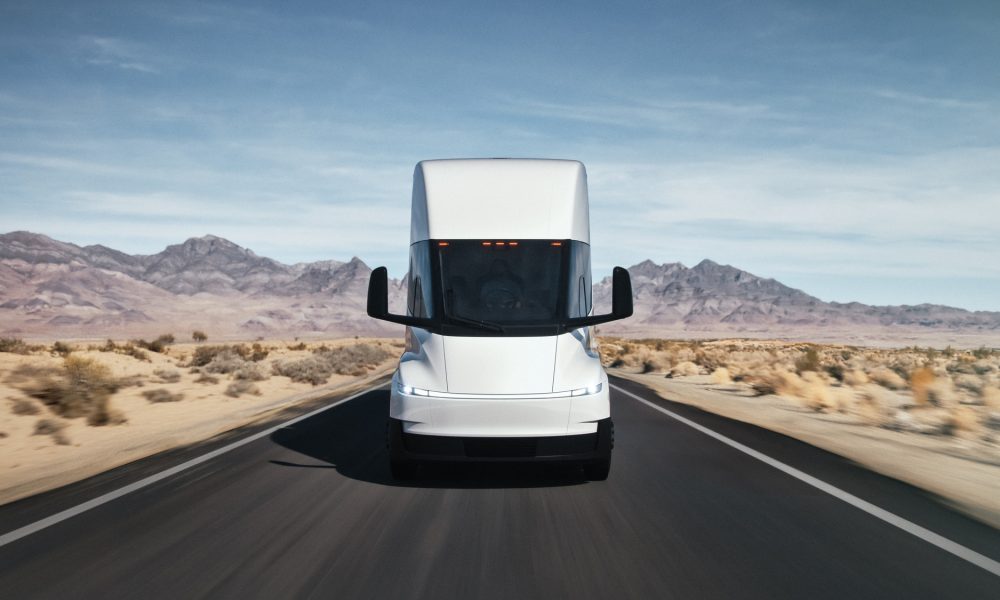


Tesla is running ground truth validation equipment on a Semi in Sunnyvale, California. These are the same sensor rigs it straps to vehicles right before deploying Full Self-Driving software. That’s not a test mule for fun. That’s a truck being prepped for production-ready autonomy.
The timing is no accident. Just days earlier, hundreds of Cybercabs were photographed stockpiled outside Gigafactory Texas, freshly branded with decals and cleared by the EPA with a Certificate of Conformity. Tesla is pushing toward autonomous driving on two radically different fronts: a two-seat robotaxi with no steering wheel, and an 80,000-pound Class 8 truck.
The Semi has been in limited pilot use with PepsiCo and Frito-Lay for years now. It proved the powertrain works. It proved the economics pencil out for short-haul routes. But slapping a validation rig on the roof changes the conversation entirely. Tesla isn’t just selling an electric truck anymore. It’s building a self-driving freight platform.
Ground truth validation trains supervised algorithms by comparing what the car’s AI perceives against verified real-world data. Tesla has done this dance before every major FSD rollout. When the rigs appear, deployment follows.
Federal hours-of-service regulations cap drivers at 11 hours behind the wheel within a 14-hour window. An autonomous or semi-autonomous truck doesn’t get tired, doesn’t need a 30-minute break after eight hours, and doesn’t pull into a rest stop for ten hours between shifts. Even a robust driver-assist system, not full autonomy, could reshape fleet economics overnight.
But Tesla learned hard lessons scaling FSD across its own lineup. The Cybertruck’s elevated camera height threw off models trained on sedans and SUVs. Actually Smart Summon didn’t arrive on Cybertruck until nearly three years after first deliveries. The Semi sits higher still, with completely different blind spots, braking distances, and aerodynamic profiles. Nobody should expect a clean rollout.
The Cybercab push looks further along. Tesla self-certified the vehicle as Level 4 autonomous, and a Texas law effective May 28 permits driverless operation. Without a steering wheel or pedals, there’s no fallback to a human driver, and with only two seats, cramming in a safety monitor defeats the purpose. Tesla is betting it can go fully driverless from day one with the Cybercab, likely by August.
That’s two enormous regulatory and technical gambles running in parallel. One is a lightweight urban robotaxi. The other is a long-haul freight truck. The software architecture underneath is shared, but the edge cases couldn’t be more different. A Cybercab misjudging a crosswalk is one kind of problem. An 80,000-pound Semi misjudging a highway merge is another.
Elon Musk, meanwhile, is publicly sparring with Moody’s over Tesla’s Baa3 credit rating, pointing to $44.7 billion in cash and zero debt. He called the rating “ridiculously low.” That cash pile matters here because autonomy development burns capital at a staggering rate, and Tesla is funding it without debt while most competitors lean on government contracts or joint ventures to stay solvent.
The Semi validation sighting won’t make the same headlines as a Cybercab fleet parked outside a factory. Trucks aren’t sexy. But the freight industry moves $940 billion in revenue annually in the United States alone. Whoever cracks autonomous trucking doesn’t just win a product cycle. They restructure an entire supply chain.
Tesla is now visibly working both ends of that problem. A robotaxi for urban riders. A self-driving truck for interstate freight. The validation rigs don’t lie. The question isn’t whether Tesla is serious about autonomous commercial vehicles. The question is whether the software is ready for something that weighs 20 times more than a Model Y and stops a whole lot slower.
Share this Story