
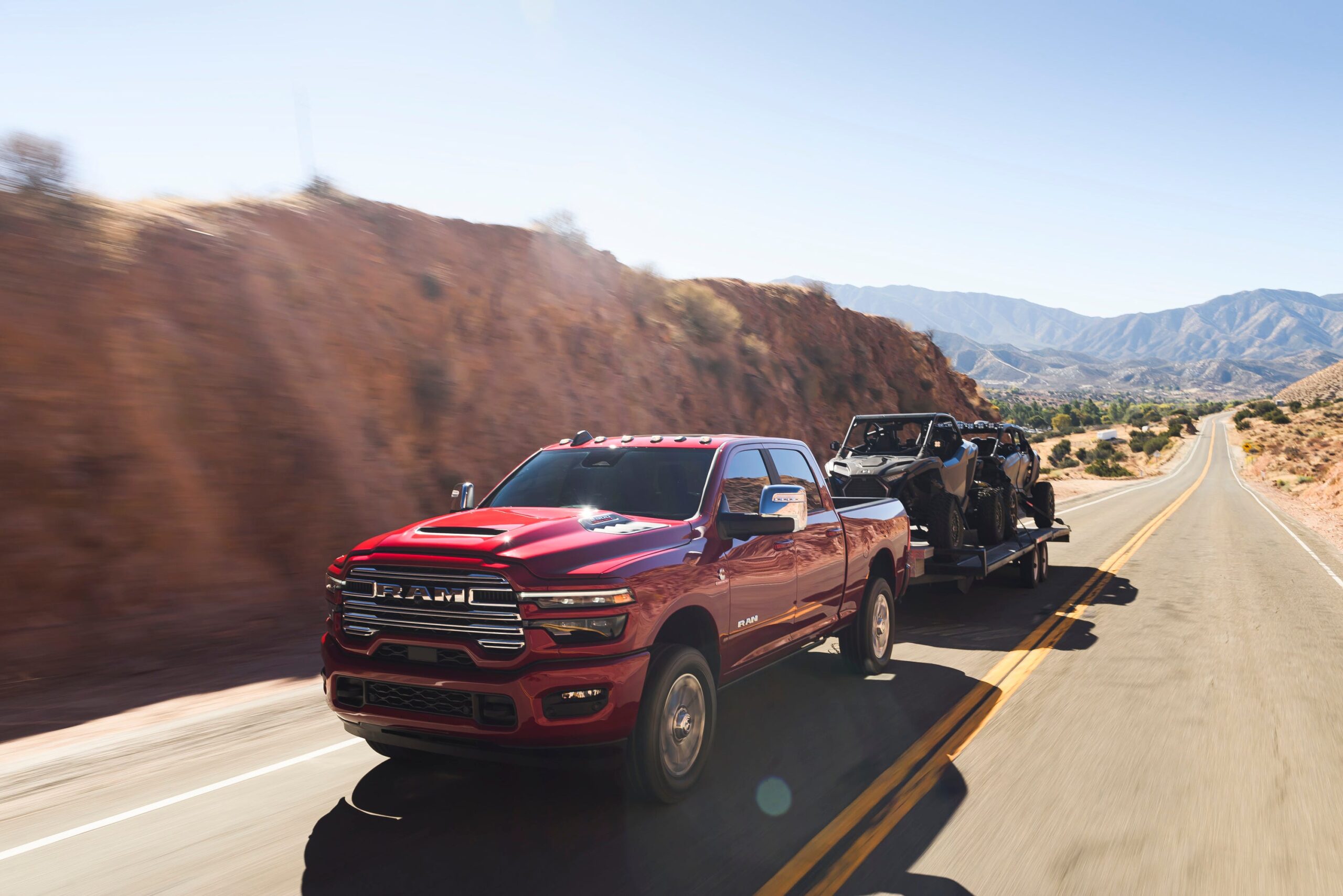


Nearly 13,000 Ram 2500 heavy duty pickups rolled off the line with a speed calibration error that let them drive faster than their tires were ever designed to handle. Stellantis filed the recall with NHTSA on May 7, and the scope covers four model years of trucks built between June 2022 and April 2026. That’s almost four years of production before anyone caught it.
The problem isn’t a wrong tire mounted at the factory, which would be embarrassing enough. Ram programmed the powertrain control module with an incorrect speed governor, allowing the truck to exceed the maximum speed rating of the R-rated tires fitted from the factory. Those tires are rated to 106 mph.
The Ram 2500 is typically governed to around 105 mph, leaving just a single mile-per-hour cushion. Whatever the calibration error allowed beyond that threshold, NHTSA documents don’t specify the overspeed margin.
Tire speed ratings exist for a reason that has nothing to do with marketing. Push a tire past its rated limit and the internal structure heats beyond its design envelope. Delamination, sidewall failure, blowouts — none of these are theoretical concerns on a truck that can weigh over 7,000 pounds before you hook up a trailer.
Stellantis says its internal safety and regulatory compliance team discovered the issue in March 2026. One month later, the company pulled the trigger on a recall. That’s a relatively fast internal turnaround, but it doesn’t explain why the miscalibration persisted across 12,736 trucks spanning nearly four full model years.
Quality systems are supposed to catch parametric errors like this during validation, not during a compliance audit years later.
The fix is straightforward: a reflash of the powertrain control module to apply the correct speed limiter. Every single truck in the recall population needs the update. NHTSA estimates a 100 percent defect rate, meaning this wasn’t an intermittent assembly issue — it was baked into the software from the start.
Stellantis reports no injuries, no warranty claims, and no field reports tied to the defect. That’s either a testament to the fact that very few Ram 2500 owners are running triple digits on public roads, or simply good luck. Probably both.
A heavy duty truck buyer hauling a fifth-wheel through Kansas at 75 mph would never know the governor was set wrong. But a driver merging onto an empty Texas highway with a heavy right foot might find out the hard way.
The recall spans 2023 through 2026 models, though Stellantis notes that trucks with different tire packages or correctly calibrated systems are excluded. Owners should expect dealer notifications in the coming weeks.
This is a solvable problem — a software patch, no parts required, minimal shop time. But four years of trucks leaving the factory with a safety parameter set wrong is a process failure that a reflash doesn’t fully address. It raises the question of how many other calibration values across the Stellantis lineup are assumed correct but never verified against the physical hardware bolted to the vehicle.
Ram will fix the trucks. The harder fix is whatever allowed this to slip through unnoticed since 2022.




Share this Story