
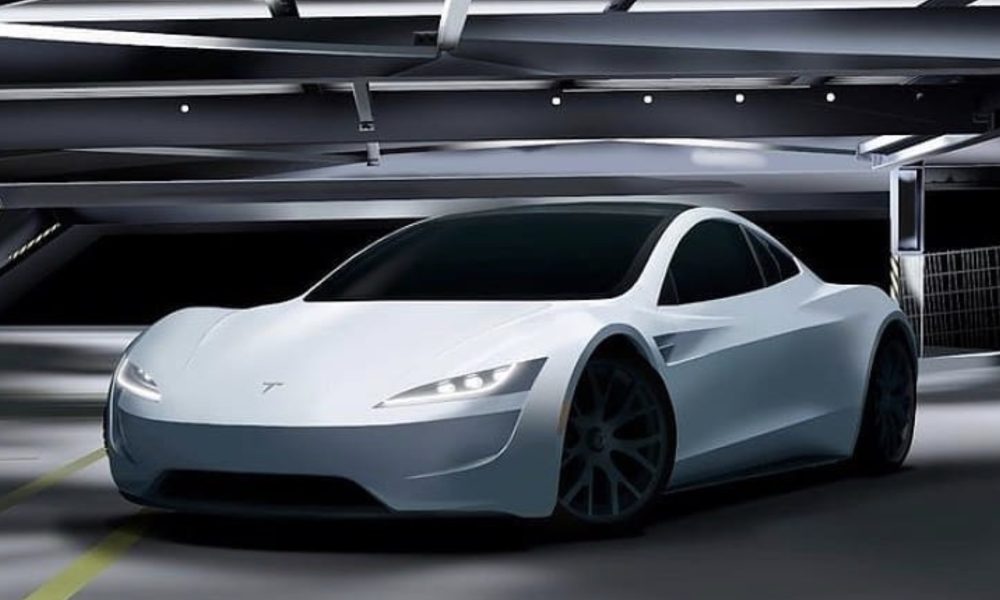


Franz von Holzhausen told a crowd in Austria that the Tesla Roadster unveiling is coming “in a few weeks.” He said it virtually, from a safe distance, which feels about right for a car that has existed primarily as a render and a $50,000 deposit receipt since 2017.
The chief designer’s comments at Tesla Takeover Europe landed just days after The Information reported that the unveiling had slipped again, this time to August. Before that it was May. Before that, April. Before April, it was supposed to start production in 2020. The pandemic got blamed for that one, though COVID hasn’t been a viable excuse for at least three years.
If von Holzhausen’s “few weeks” holds, we’re looking at late June or early July. If the August report is closer to the truth, summer’s end. Either way, nobody who put down fifty grand should be holding their breath.
The specs on Tesla’s website remain spectacular, bordering on theatrical. Under 1.9 seconds to 60 mph, over 250 mph top speed, a 620-mile range, and more than 1,000 horsepower from a tri-motor setup. And the pièce de résistance: an optional SpaceX thruster package that Tesla claims could hit 1.1 seconds to 60 and possibly enable the car to hover.
Cold gas thrusters on a street car. It reads like fan fiction that accidentally made it onto a corporate product page.
The SpaceX package is reportedly going to be part of the unveiling event, which The Information says will happen in Texas. Tesla executives confirmed in May that the Roadster would be manufactured there. Tesla has neither confirmed nor denied any of it.
Last July, Tesla VP Lars Moravy said the team showed Elon Musk “some cool demos” and that “he got a little excited.” That was twelve months ago. Getting Musk excited and getting a car into production are two wildly different achievements.
The Roadster occupies a strange place in Tesla’s lineup. The company is deep into its robotaxi pivot, betting its future on autonomous fleets and AI. The Roadster is the opposite of that thesis — a driver’s car, built for humans who want to feel the road.
Musk himself said on the Moonshots podcast that “safety is not the main goal” and called it “the best of the last of the human-driven cars.” Ferrari CEO Benedetto Vigna made almost identical comments last week about his brand’s future, declaring that Ferrari will never build a fully autonomous car because the whole point is a person behind the wheel. The difference is that Ferrari actually ships its cars.
Tesla has used the Roadster as a halo vehicle for nearly a decade now, proof that the company can dream bigger than crossovers and sedans. It has served that purpose admirably — as a dream. The original Roadster, built on a Lotus chassis, launched Tesla into public consciousness.
This second generation was supposed to cement the company’s performance credentials against Rimac, Porsche, and the growing swarm of electric hypercars that have emerged while Tesla kept pushing dates. Nine years of anticipation creates a problem no unveiling can fully solve. The specs have to deliver, the production timeline has to be real, and the SpaceX package has to be more than a concept bolted onto a show car.
Tesla has conditioned its most loyal fans to expect the extraordinary and accept the indefinite. Von Holzhausen says a few weeks. The record says don’t count on it.
Share this Story