
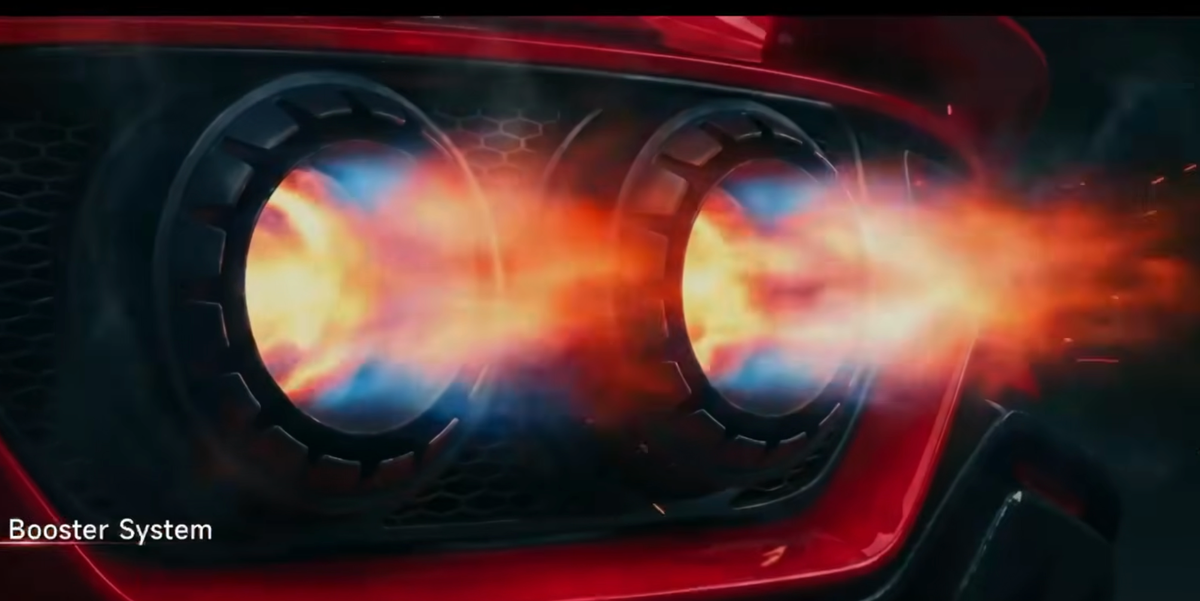


Dreame, a Chinese company best known for cordless stick vacuums and robot mops, just unveiled a sedan it claims can hit 62 mph in 0.9 seconds — with the help of solid-fuel rocket boosters bolted to the chassis. The car debuted not in Beijing, where the auto industry just wrapped a massive show, but in San Francisco. That choice tells you everything about the ambition here, and maybe the delusion.
The vehicle is called the Nebula Next 01 Jet Edition. That name alone should set off alarm bells.
Dreame says the car’s dual solid-fuel rocket booster system responds in 150 milliseconds and generates 100 kilonewtons of peak thrust. For context, that’s nearly half the force produced by the ThrustSSC, the jet-powered vehicle that broke the sound barrier to set the land speed record at 763 mph in 1997. No top speed claim has been made for the Dreame, which is either a sign of restraint or the absence of actual testing data.
Specs beyond the rocket party trick are thin. The company mentions something called “SkyTour Intelligent Chassis Architecture 2.0,” air suspension, and steer-by-wire. There’s also a LiDAR system pitched as enabling fully unmanned autonomous driving. Autonomous capability on a rocket-boosted hypercar is a combination nobody asked for.
Call it what it is: a concept car dressed up as a press event. There’s no production timeline, no pricing, no confirmed powertrain details beyond the boosters, and no indication Dreame has ever built a road-legal vehicle of any kind. The company makes floor care appliances. Good ones, by most accounts. But the distance between a robot vacuum navigating a living room and a rocket-assisted sedan navigating Highway 101 is not trivial.
The inevitable comparison is Tesla’s long-promised SpaceX thruster package for the next-generation Roadster. Elon Musk has been teasing cold-gas thrusters on that car since 2018. The production Roadster itself remains a ghost. If the world’s most prominent EV company can’t get rocket-adjacent tech into a shipping product after nearly a decade of talk, the odds for a vacuum startup are not encouraging.
Still, dismissing the broader pattern here would be a mistake. Chinese companies are flooding into the automotive space from every direction — smartphones, appliances, real estate, batteries. Xiaomi, once known only for phones, now sells a legitimate performance sedan. BYD grew from a battery maker into the world’s largest EV manufacturer.
But the playbook requires execution, not spectacle. Xiaomi spent years building automotive engineering capability before the SU7 hit the road. BYD had decades of battery chemistry expertise before it started stamping body panels. Dreame has shown a flashy render, a dramatic video, and a press release full of claims that would make a propulsion engineer reach for a calculator and a stiff drink.
Debuting in San Francisco rather than Beijing signals the company wants American attention, possibly American customers. Given the current tariff environment — Chinese EVs face duties exceeding 100 percent in the U.S. — that ambition collides head-on with trade reality. Even established Chinese automakers with actual cars in production can’t crack the American market right now.
A sub-one-second sprint time using solid rocket fuel is a headline, not a product. Solid-fuel rockets, once ignited, cannot be throttled or shut off. They are used in missiles and space launch boosters, not daily drivers. The engineering challenges of integrating such a system into a street car — safely, legally, repeatedly — are enormous and entirely unaddressed in Dreame’s announcement.
The auto industry has always attracted outsiders convinced they can reinvent the wheel. Some do. Most don’t. A vacuum company with rockets makes for a great story. Whether it makes for a great car is a question Dreame hasn’t come close to answering.
Share this Story