
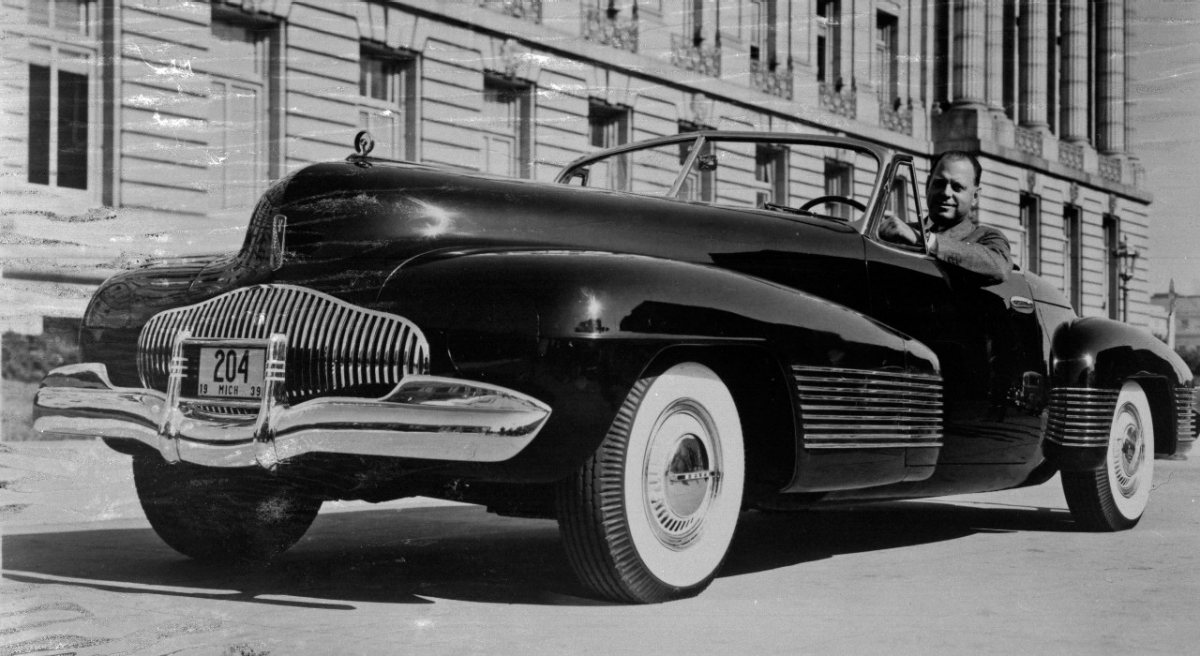


In 1938, George Snyder sketched a swoopy roadster on a Buick Century chassis that looked like it had time-traveled from 1958. Hidden headlights, integrated fenders, a waterfall grille — the Buick Y-Job was so far ahead of its moment that Depression-era audiences didn’t quite know what to do with it. Eighty-eight years later, GM is still chasing the same trick: showing the public a future they didn’t know they wanted.
This week, at the grand opening of GM’s new Advanced Design Center in Pasadena, the company unveiled the GMC HUMMER X concept — a pair of mid-sized SUV and pickup design studies built around the mantra “take nothing but pictures, leave nothing but footprints.” It’s a fascinating pivot for a nameplate that once symbolized military-grade excess.
The HUMMER X concepts are smaller, lighter in philosophy, and designed for off-road enthusiasts who, as GM Executive Director of Global Advanced Design Andrew Smith puts it, “are conscious of their impact and want to tread lightly.” They also showcase a new additive manufacturing process called FLEX FAB, developed with GM’s advanced engineering and manufacturing teams.
Smaller, greener, 3D-printed. Not exactly what the original H1 crowd had in mind.
But that’s the whole point of a concept car, and GM knows this better than anyone because the company literally invented the practice. Harley Earl, the Hollywood custom-car designer hired by Alfred Sloan in 1927 to lead the industry’s first dedicated styling division, created the Y-Job as a rolling argument that design could drive desire. Before Earl, car bodies existed to keep rain off passengers. After Earl, they existed to make people dream.
Earl’s Art and Colour section — yes, spelled the British way — pioneered clay modeling, embedded stylists alongside engineers, and eventually spawned the Motorama traveling shows that turned concept cars into spectacle. The 1951 Le Sabre, with its fighter-jet DNA, launched a decade of space-age fantasy. Every manufacturer on the planet eventually followed GM’s lead.
Smith breaks modern GM concepts into four categories: previews of near-production vehicles, precursors tied to specific future models, vision entries exploring new market segments, and true concepts with no production intent whatsoever. The lines blur. The Cadillac CELESTIQ started as pure design inspiration until GM President Mark Reuss saw a scale model and demanded it be built.
That kind of executive lightning strike is rare, but it’s exactly the reaction concept cars are engineered to provoke.
The HUMMER X sits in murkier territory. GM calls them “design studies” — a careful hedge. There’s no announcement of production intent, no platform confirmation, no timeline. But shrinking the HUMMER footprint while emphasizing sustainability and modularity reads like market research in fiberglass and carbon fiber.
GM also revealed that the Buick Electra Orbit concept exists only as a digital creation — no physical car at all. That’s the modern evolution of the concept-car tradition: from the Y-Job touring New York in 1940 to a vehicle rendered entirely in pixels, consumed on screens rather than show floors.
Smith frames the purpose simply: “A concept car needs to stimulate conversation about the brand.” He’s right, but the conversation has changed. In Earl’s era, concept cars sold optimism to a nation emerging from war and depression. Today, they’re strategic signals — testing public appetite, justifying design budgets, and giving engineers a target beyond the next quarterly report.
The HUMMER X concepts tell us GM sees a future where off-road capability doesn’t require a 9,000-pound truck. Whether that future arrives in a showroom or stays frozen in Pasadena as a designer’s beautiful what-if is the question GM isn’t answering yet.
Eighty-eight years after the Y-Job, the game hasn’t changed. Build something impossible, show it to the world, and see who bites.





Share this Story