
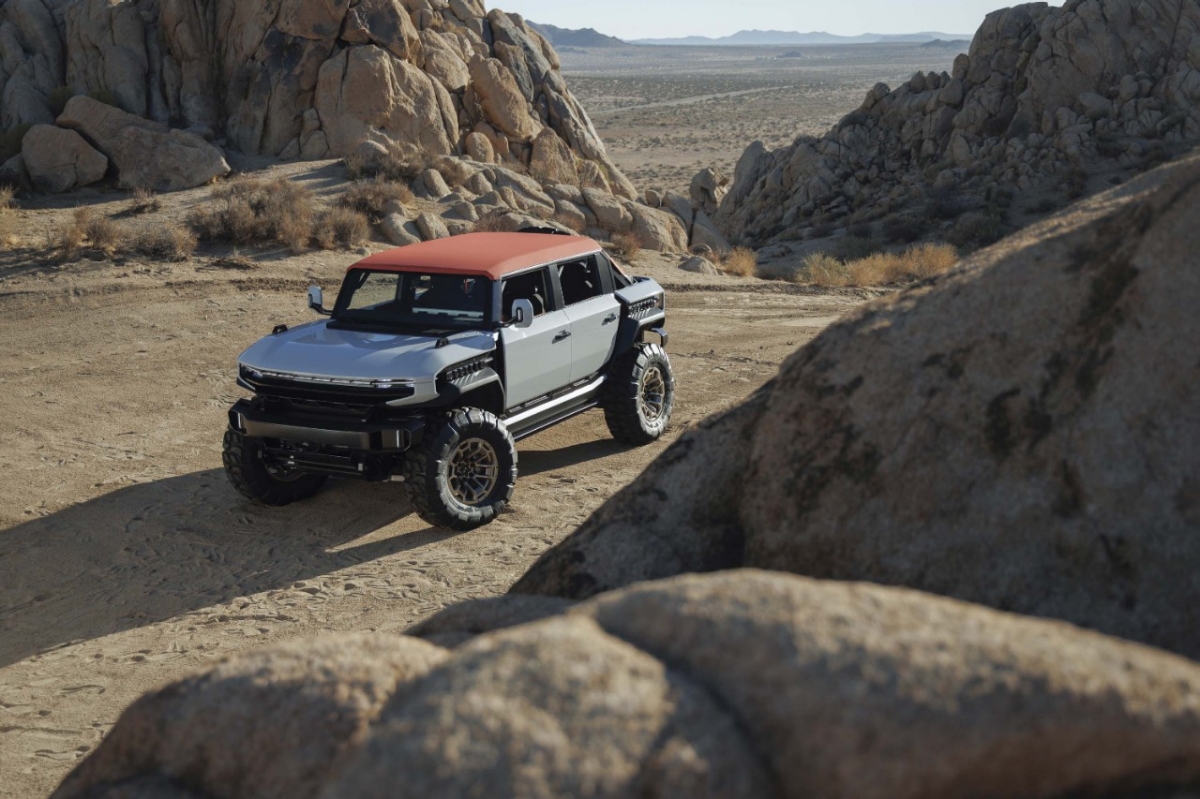


General Motors cut the ribbon on a 148,000-square-foot advanced design studio in Pasadena, California, and christened the space with two concept vehicles that won’t see a single dealer lot: the GMC Hummer X pickup and SUV.
The concepts are mid-size electric rock crawlers built on a modular platform, stuffed with ideas GM wants to test but isn’t ready to sell. That distinction matters. The original Hummer EV — a 9,000-pound full-size beast — arrived to polarizing reviews and sluggish early sales before GM recalibrated pricing and production.
The X concepts shift the formula dramatically: smaller footprint, lighter ambitions, and a sustainability pitch built around recyclable mono-materials and snap-fit assembly.
The SUV stretches 188 inches on a 116-inch wheelbase. The truck runs 207 inches on a 131-inch wheelbase. Both sit 80 inches wide with over 13 inches of ground clearance, 37- and 35-inch Goodyear tires respectively, Multimatic shocks, beadlock wheels, and approach angles steep enough — 44 degrees on the SUV — to embarrass most production off-roaders.
None of it is headed to production. GM is explicit about that. So what is the Hummer X actually for?
It’s a technology demonstrator for something GM calls FLEX FAB — a flexible manufacturing process that eliminates traditional stamping dies in favor of small-batch, on-demand metal forming. Think 3D printing logic applied to body panels. Fifty-seven percent of each concept’s structure uses this process, which enabled the flat-topped, laser-welded aesthetic that defines both vehicles.
If FLEX FAB scales, it could change how GM builds low-volume or customizable vehicles. That’s the real story hiding inside these concepts.
The Pasadena campus spans three buildings and houses about 100 designers, sculptors, fabricators, and artisans. It replaces GM’s previous SoCal design outpost and joins a global network of advanced studios in Detroit, the U.K., and Shanghai. The facility is purpose-built for clay modeling, fabrication, and digital collaboration — the full toolkit for dreaming up vehicles that live 10 to 20 years in the future.
Bryan Nesbitt, GM’s VP of Global Design, leaned heavily on the Southern California mystique during the reveal. “Film, art, architecture, aerospace, technology and the remarkably diverse topography create an unparalleled canvas,” he said. GM’s design DNA runs through Hollywood — Harley Earl, the company’s first design director, built custom cars for movie stars before inventing the clay modeling process the industry still uses a century later.
Hussein Al Attar takes over as Pasadena studio director, replacing Brian Smith, who returns to Michigan to rejoin the Corvette design team. Smith left his mark on the Hummer X with a design brief distilled into a trail runner’s creed: “Take nothing but pictures, leave nothing but footprints.” The team embedded that philosophy into Easter eggs throughout the concepts, including Morse code imprinted on the floor and tire treads that spell out the project’s mantra.
The concepts also introduce the Hummer HUB, a connected app suite that includes a scout drone capable of flying ahead on trails, feeding real-time terrain data back to the vehicle, and docking itself when idle. It’s the kind of feature that sounds like science fiction until you remember that DJI drones already do most of this for $2,000.
GM is clearly trying to gauge appetite for a smaller, more accessible Hummer — one that doesn’t weigh as much as a municipal bus and doesn’t start north of $80,000. The mid-size EV off-road segment is still wide open, with only the Jeep Recon and a handful of startups circling the space.
Whether GM pulls the trigger on a production version depends on what FLEX FAB can deliver at scale and whether the economics of a mid-size electric off-roader pencil out in a market still wrestling with EV pricing. For now, the Hummer X is a concept that asks the right questions. The answers will come from Pasadena.





Share this Story