
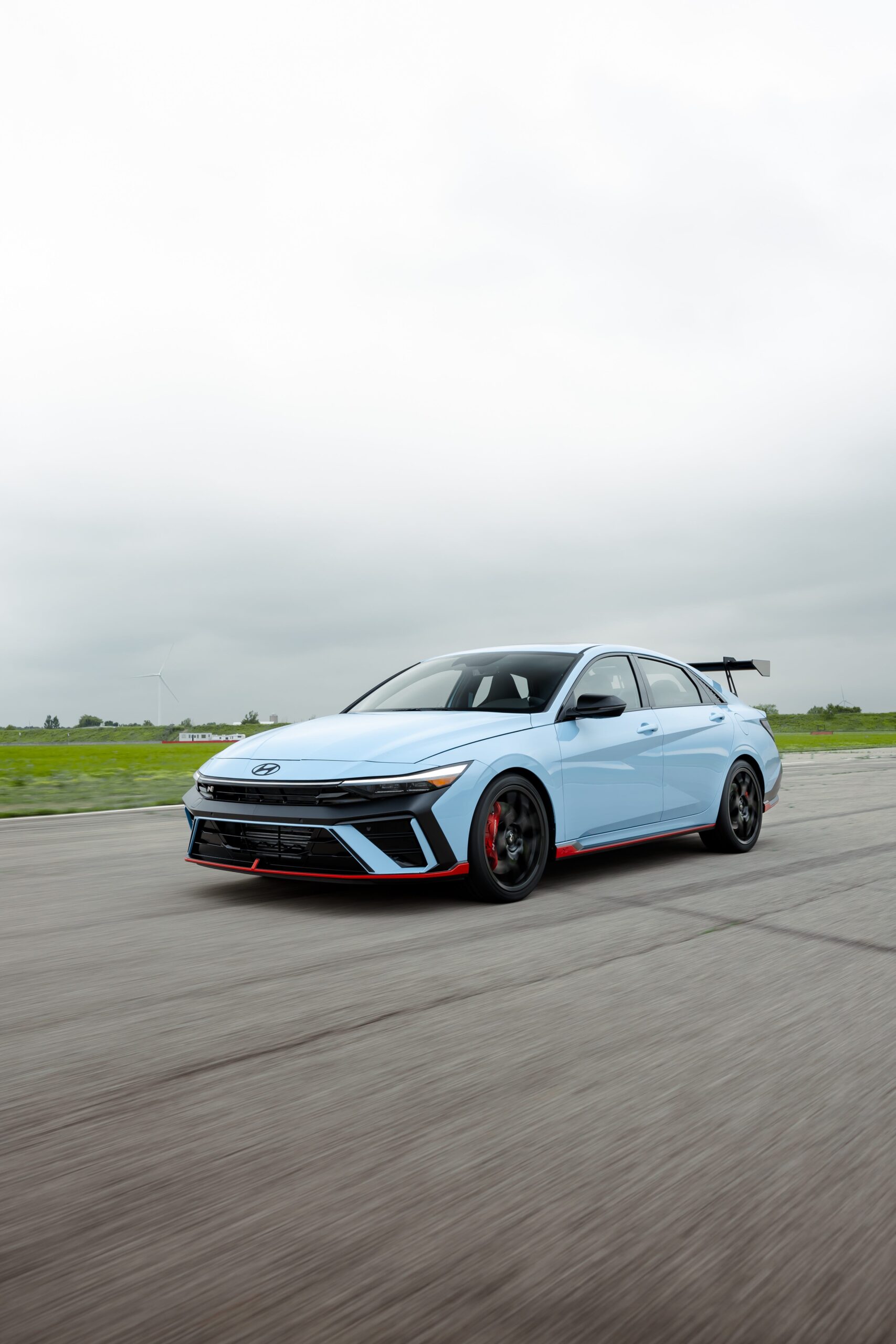


The 2026 Hyundai Elantra N TCR Edition starts at $39,250 before destination for the six-speed manual. The dual-clutch transmission bumps that to $40,750. Add the $1,245 freight charge and you’re looking at $40,495 and $41,995 out the door, respectively.
Those numbers land like a grenade in the affordable performance sedan segment. The Honda Civic Type R stickers at roughly $48,000. The Toyota GR Corolla base sits just above $41,000.
Hyundai is undercutting both while throwing hardware at the car that neither rival includes at any price. The TCR Edition isn’t a sticker pack. It gets four-piston monobloc calipers with two-piece front rotors, an adjustable carbon fiber swan-neck rear wing, 19-inch forged alloy wheels, and Alcantara wrapping damn near everything your hands touch.
Blue seatbelts, aluminum sill plates, TCR-specific puddle lamps, and dedicated badging round it out. Try pricing that parts list through aftermarket channels. You’d blow past $4,150 — the premium over a standard Elantra N — before you even got to the brake upgrade.
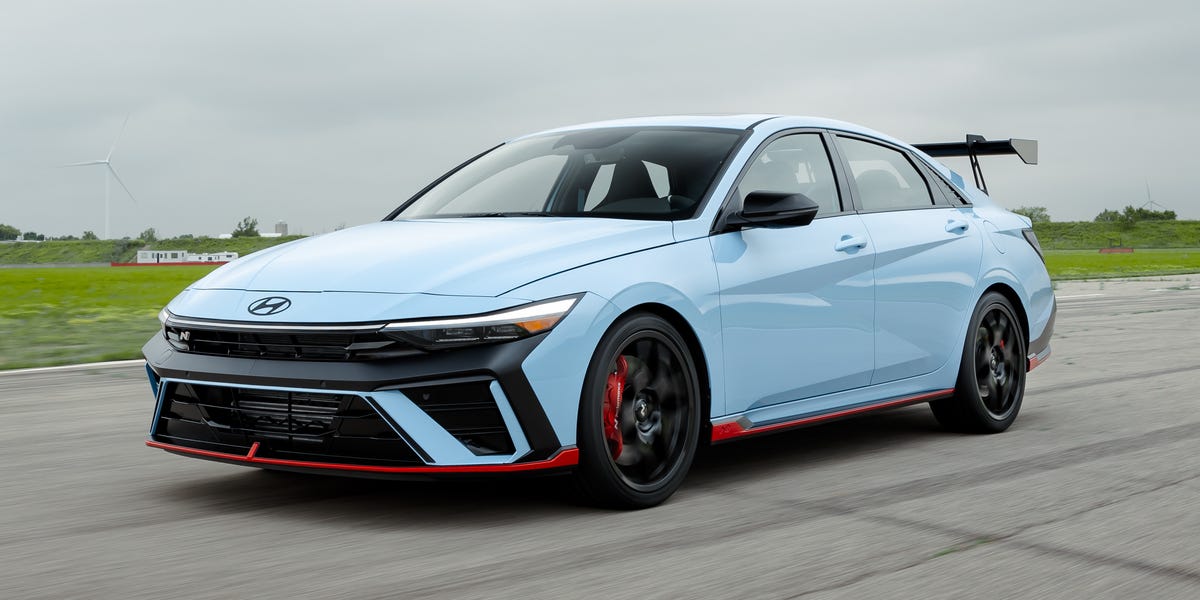
The car exists to celebrate six consecutive Hyundai TCR Manufacturers’ Championships in the IMSA Michelin Pilot Challenge series. That’s not a marketing invention. Six straight titles is dominance, and Hyundai is smart enough to bottle some of that credibility into a street car while the winning streak still means something.
Production will be limited, though Hyundai won’t say how limited. Performance Blue is the only color you can have, which is either a charming constraint or a dealbreaker depending on your tolerance for being told what you want.
Early track impressions from journalists who’ve driven pre-production cars suggest the upgrades are substantive, not cosmetic theater. The enhanced brakes and forged wheels with more aggressive rubber make the TCR Edition a legitimate entry point for track day participation.
Then there’s the wing. It is enormous. Hyundai insists it’s functional, generating real downforce, but the visual impact borders on theatrical. You will be seen, and whether that’s the point or the price of admission depends on your relationship with subtlety.
The manual transmission costing $1,500 less than the DCT is a small but telling detail. Hyundai is rewarding the purists instead of penalizing them. That’s a philosophy Honda and Toyota have quietly abandoned as take rates push both companies toward prioritizing automated gearboxes.
Hyundai also announced an N Performance Parts catalog alongside the TCR Edition, offering forged wheels, a more restrained carbon fiber rear wing, carbon fiber mirrors, and various Alcantara interior pieces for existing Elantra N and Ioniq 5 N owners. The company says the catalog will expand after launch. It’s a shrewd play: build the ecosystem, lock in the community, sell parts to people who already bought your car.
A decade ago, nobody would have believed a Hyundai sedan could stand toe-to-toe with the Type R on price, equipment, and racing pedigree. The TCR Edition doesn’t just stand toe-to-toe. It undercuts Honda by more than $7,500 while offering race-derived brakes and a carbon fiber wing that Honda doesn’t.
The collector angle might sound ambitious for an Elantra, but limited production, a single color, and a championship connection have a way of aging well. If dealer markups don’t torpedo the value proposition, the TCR Edition could be the performance bargain of 2026. It’s the clearest signal yet that Hyundai’s N division isn’t playing for respect anymore — it already has it.


Share this Story