
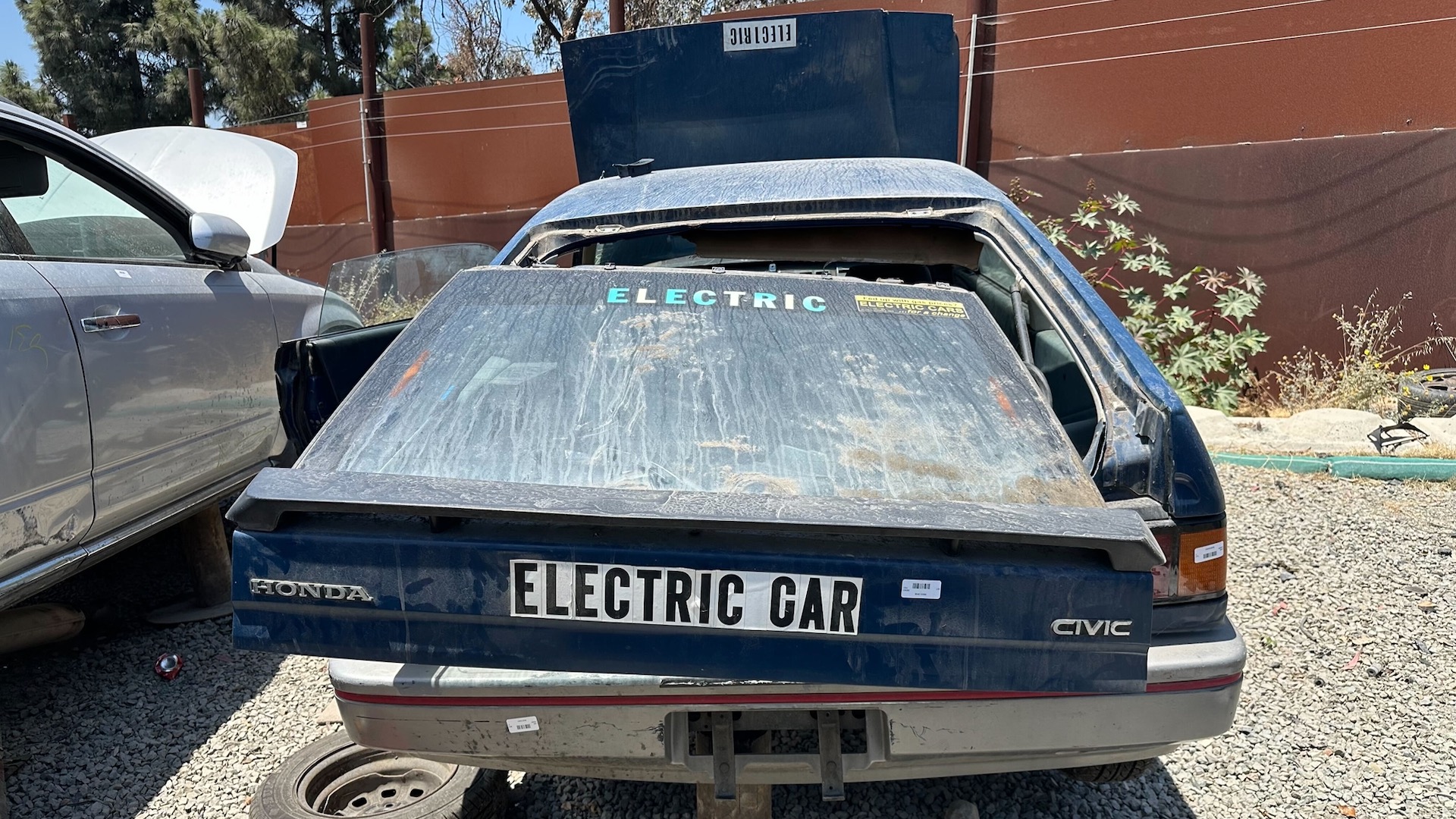


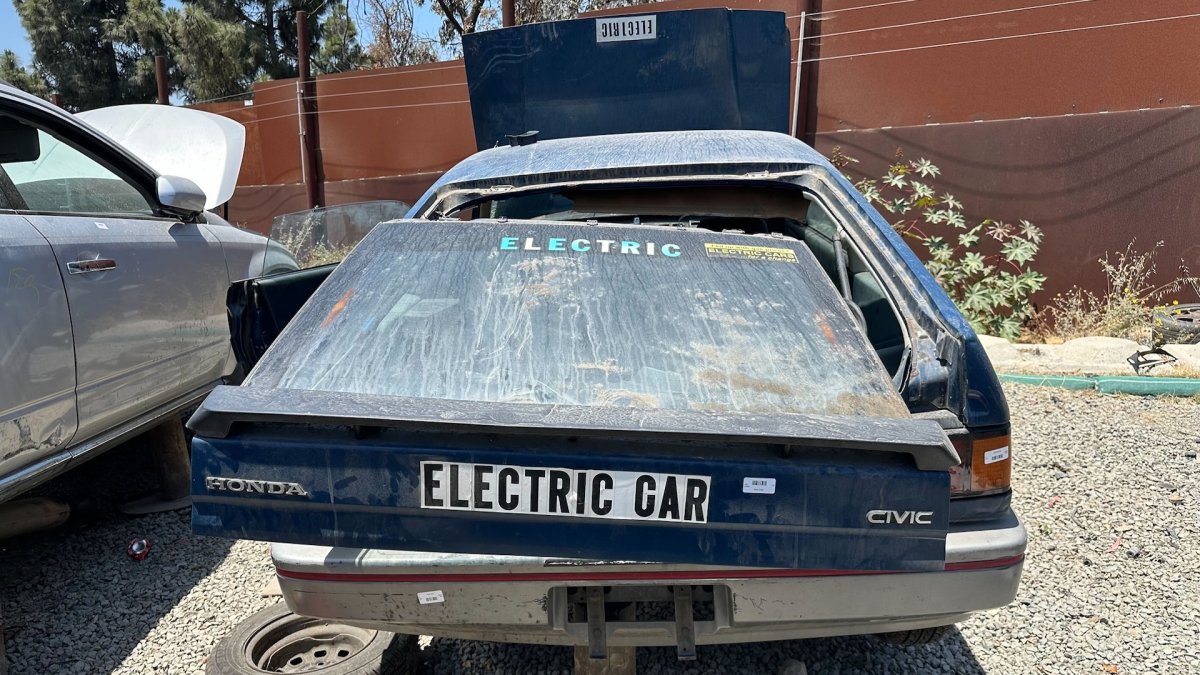
A first-generation Honda CRX, converted to electric power by some anonymous tinkerer years before Tesla shipped its first Roadster, turned up rusting at a Pick Your Part salvage yard in Chula Vista, California. Its battery pack sat behind the seats. EV decals adorned the body, and a sticker about gas prices — still relevant — clung to the paint.
The car is dead. The idea behind it never was.
A friend of The Drive spotted the CRX and documented its remains. The conversion was clearly a garage-built affair, not a corporate project. Control electronics had been crammed into every available cavity.
The onboard charger was a K&W BC-20, a unit that pops up repeatedly in DIY EV conversion forums from the early days of the hobby. This was someone’s weekend project, someone’s obsession, built with whatever parts the pre-lithium era could offer.
That matters because the mainstream narrative around electric cars has been thoroughly sanitized. Tesla gets credit for starting the revolution. Nissan gets a nod for the Leaf.
But decades before either existed, a scattered tribe of hobbyists was pulling combustion engines out of cheap hatchbacks and bolting in electric motors. Companies like the Electric Vehicle Association sold converted Ford Fairmonts to the federal government. A Sears department store — yes, Sears — once offered an electric Fiat 128 conversion called the XDH-1 that became the first EV to climb Pikes Peak.
Nobody has identified a commercial CRX conversion kit, which makes this particular car even more interesting. Somebody looked at a lightweight, aerodynamic two-seater and saw the obvious: it was a perfect EV donor.
Honda itself reached the same conclusion. According to the company’s own history, its first EV development team — formed in 1988 — built a prototype based on the second-generation CRX. That car made a laughable 26 horsepower but wore an aluminum body and acrylic windows to offset battery weight.
The lessons fed directly into the Honda EV Plus, a tiny compliance hatchback built in the 1990s to satisfy California’s zero-emission mandate. Then Honda walked away. Rather than develop a second EV, it repurposed leftover EV Plus chassis for its first FCX hydrogen fuel-cell vehicles.
Hydrogen and hybrids consumed the company’s attention for the next two decades, even as the Model S and Leaf proved battery-electric cars could sell at meaningful volume.
Honda’s belated return to EVs — the ambitious 0 Series — was supposed to change the narrative. It has been canceled for the U.S. market. Honda blamed the policy environment, noting that tariffs and shifting incentives make this a bad time to sell electric cars in America.
The excuse is convenient. The pattern is not new.
Meanwhile, some anonymous builder in Southern California had already solved the equation with a first-gen CRX, a mail-order charger, and a lot of fabrication work. No government mandate required. No billion-dollar platform investment. No focus groups.
The car ended up at a junkyard, which is where most cars eventually end up. But its existence is a stubborn reminder that the EV movement was never a top-down corporate invention.
It started in garages, with people who understood that an electric motor, a battery pack, and a light car were all you really needed. The big automakers are still figuring that out. Some of them are actively trying to forget it.
Share this Story