
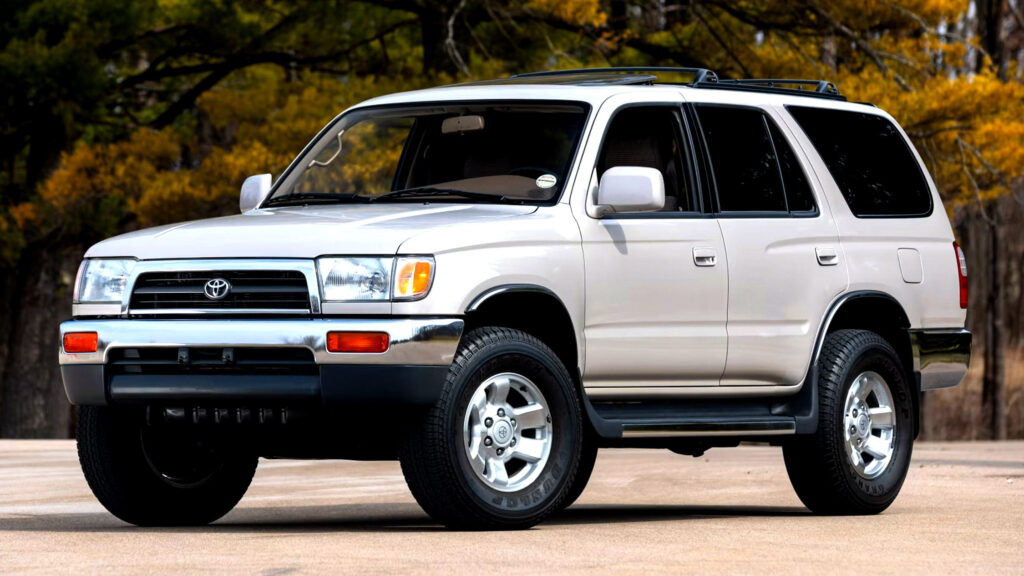


Somebody walked into Mecum’s Indianapolis auction last week and paid $52,800 for a 1996 Toyota 4Runner SR5. A brand-new 2026 model, with nearly 100 more horsepower and three decades of engineering advances, starts at $43,665.
The math doesn’t work unless you understand what’s actually being bought.
This wasn’t a restomod or an overlanding fantasy rig draped in accessories. It was a bone-stock, Desert Dune Metallic third-generation 4Runner showing 6,954 miles on its odometer. The original Dunlop Grandtrek tires, thirty years old, were still mounted.
The oak sport cloth seats looked like nobody had ever sat in them. The frame could have passed for fresh off the assembly line.
Under the hood, the 3.4-liter 5VZ-FE V6 sat untouched, producing its factory 183 horsepower through a four-speed automatic and dual-range four-wheel drive. The stereo still played cassettes. There was no Bluetooth, no lane-keep assist, no adaptive cruise control.
Just a power sunroof, running boards, alloy wheels, and the kind of mechanical honesty that doesn’t exist in showrooms anymore.
The 2026 4Runner SR5, by contrast, runs a turbocharged 2.4-liter four-cylinder making 278 horsepower, shifts through an eight-speed automatic, and offers hybrid power and a full suite of modern driver-assistance tech. It is better in every measurable way — safer, faster, more efficient, more capable.
And yet somebody paid $9,000 more for the old one.
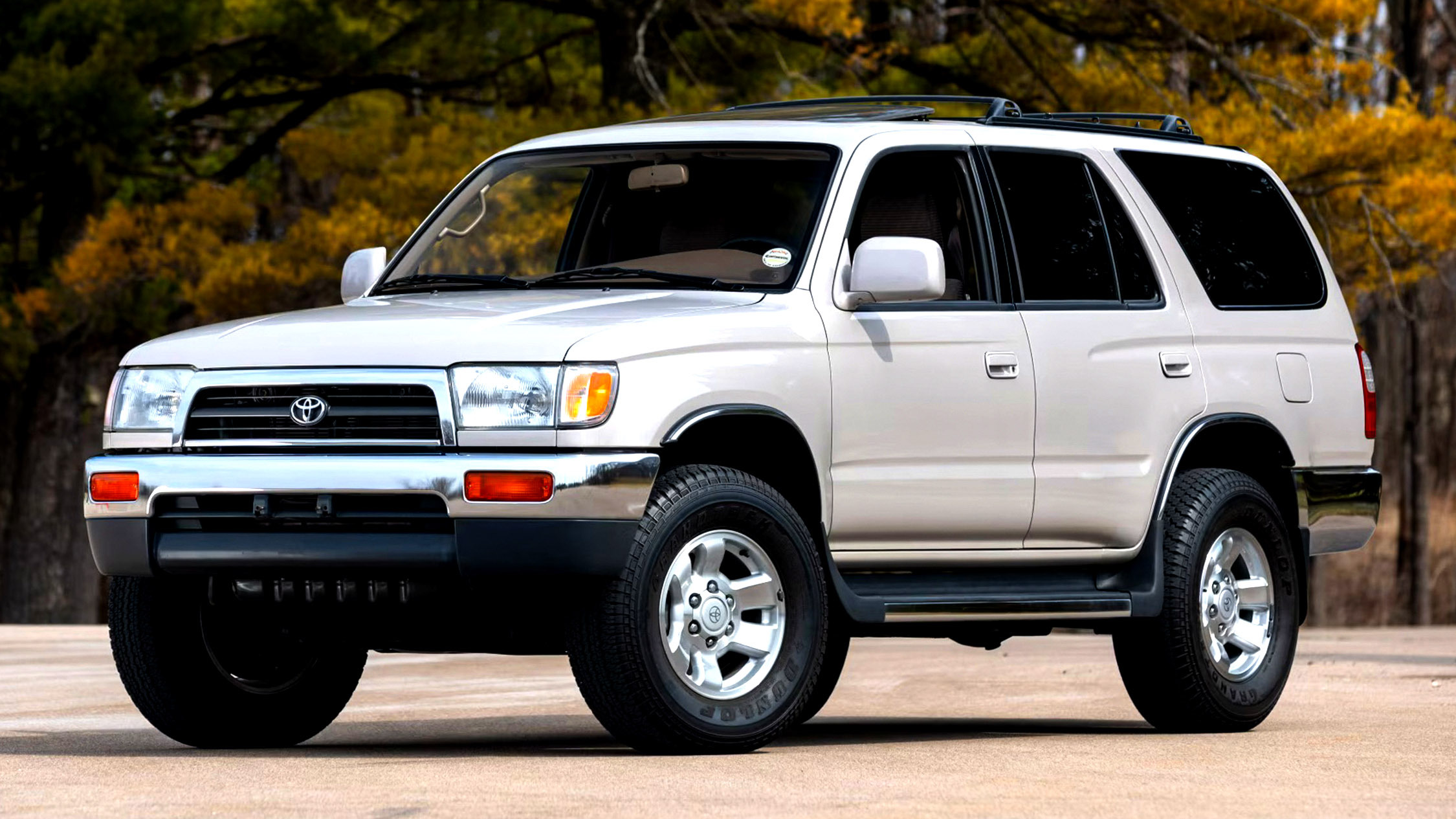
The third-generation 4Runner has become a cult object precisely because these trucks were never supposed to survive in this condition. They were built to be used hard — hauled through mud, salted roads, and camping trips that left the carpets smelling like wet dog. Finding one with under 7,000 miles is like finding a hammer that was never swung.
The collector market for clean, original Japanese SUVs from the 1990s has been building heat for years. Land Cruisers broke through first, with 80-series examples routinely clearing six figures. The 4Runner is following the same trajectory, trading on the same formula of body-on-frame toughness, mechanical simplicity, and a design language that aged far better than anyone at Toyota probably expected.
There’s a deeper current running through sales like this. The new 4Runner is a fine truck, but it’s also a computer on wheels, loaded with software, sensors, and turbo plumbing that will age very differently than a naturally aspirated V6 bolted to a ladder frame.
Buyers chasing these time capsules aren’t just paying for nostalgia. They’re paying for comprehensibility — a vehicle they can understand completely by opening the hood.
Was $52,800 a rational purchase? Not if you need a daily driver. But the buyer wasn’t shopping for transportation. They were buying the rarest version of a truck that millions of people loved to death — the one that somehow escaped being loved at all.
The 4Runner’s reputation was forged by trucks that were driven into the ground and kept running anyway. This one was barely driven at all. That contradiction is exactly what made it worth more than its modern replacement.

Share this Story