


Three hundred Cybercabs are now running paid rides in Austin. That is an eightfold increase in 30 days, according to Tesla’s own Robotaxi account, and Dallas is next on the list. Tesla AI chief Ashok Elluswamy confirmed the expansion city over the weekend.
But scaling hardware is the easy part. The harder job is convincing passengers to sit in a two-seater with no steering wheel, no mirrors, and no driver, and feel okay about it.
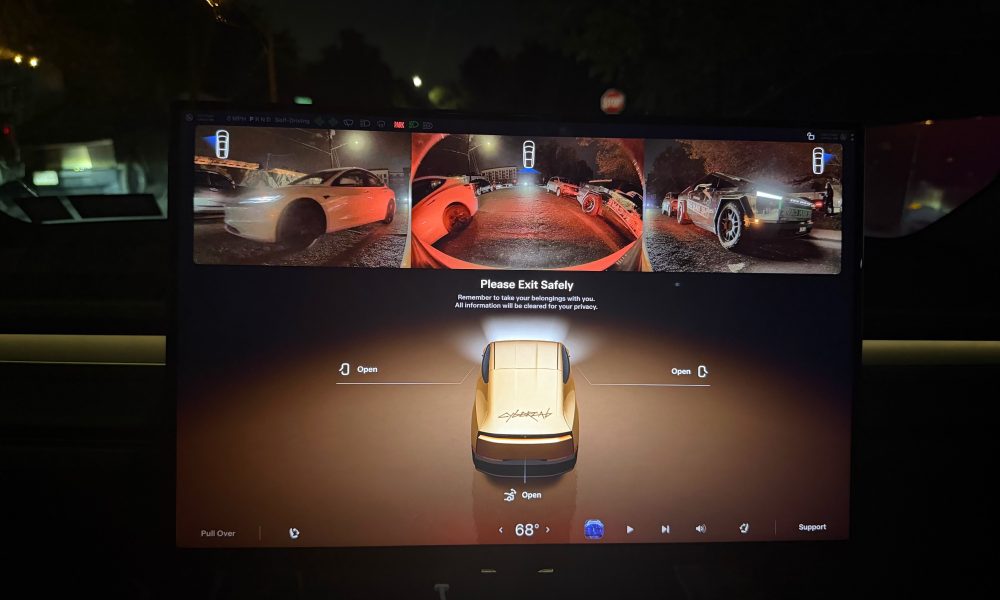
That tension surfaced Friday night on X. Cybercab rider Dan Burkland posted photos of the cabin screen after an evening trip, complimented the interface, and made a single request: let passengers pull up the rear and side repeater cameras on demand. He called it “peace of mind.” Tesla UI engineer Evan responded simply: “In development.”
It is a small feature. It is also a revealing one. The Cybercab has no rearview mirror because it has no driver who needs one.
The cameras are already mounted on the vehicle, feeding data to the autonomy stack. But riders cannot see through them. In a conventional car, even a backseat passenger can glance at a mirror. In a Cybercab, you sit in a sealed pod and trust the machine.
Tesla has been gathering feedback like this since paid service launched. In September, the company sent riders a survey asking them to rate the touchscreen, the app, and the cabin, and to rank which features they wanted most. Camera access fits the profile of something Tesla can push through a quick over-the-air update without a press event.
The fleet growth makes these small trust signals urgent. Texas DMV records show 319 registered Cybercabs, up from 169 just weeks ago. More vehicles in more cities means a wave of first-time riders who have never sat in a driverless car.
Every one of them will have a moment where they wonder what is behind them and have no way to check.
Tesla is also playing offense on the safety narrative. This week, the company’s main X account shared dashcam footage of FSD Supervised braking mid-intersection to avoid a T-bone collision. The owner said they had assumed the cross-traffic would stop and would not have reacted fast enough on their own.
Tesla amplified the clip to its 24.8 million followers. Ashok Elluswamy wrote that Tesla’s self-driving system “reacts to other people cutting into your path with super-human response times.” The company has cited figures showing FSD Supervised is 4.1 times less likely to crash than manual driving across 100 million European kilometers.
Those numbers are aimed at regulators as much as riders. Eight EU countries have approved FSD Supervised, but the bloc-wide vote originally scheduled for October 6 slipped to December at the earliest. NHTSA’s deadline for Tesla’s sworn answers on Cybercab certification is October 30.
The regulatory calendar and the fleet expansion are on a collision course. Tesla is putting cars on the road faster than governments can write rules for them. That has been the company’s preferred strategy for a decade.
Letting a nervous passenger tap a button and see what the car already sees costs Tesla almost nothing to build. But it acknowledges something the company rarely says out loud: the technology is only as useful as the public’s willingness to sit in it. Three hundred Cybercabs need three hundred times as many people willing to climb in, close the door, and ride without a steering wheel to grab.
The camera feature has no release date. Tesla’s pattern with Cybercab software has been to push updates quietly between rides. Riders may simply open the screen one morning and find the option waiting.

Share this Story