
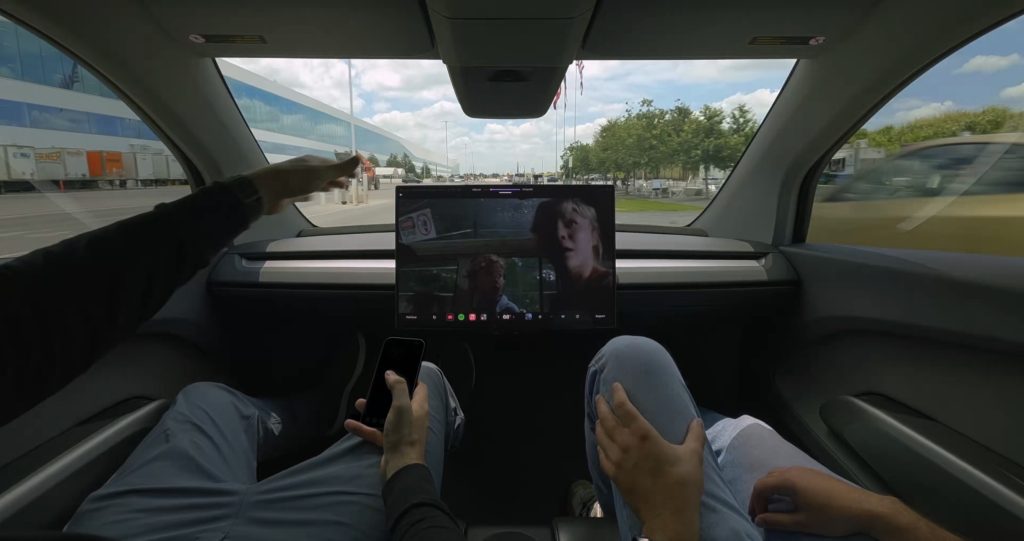


Tesla posted a video Friday announcing that employees at Giga Texas were riding in its steering wheel-less, pedal-less Cybercab. Then the company pulled it down, re-uploaded a scrubbed version, and hoped nobody noticed. Too late.
The original clip showed passengers watching movies and adjusting climate controls inside a vehicle with zero manual inputs. No steering wheel, no pedals, no fallback. It was the first public proof that Tesla’s purpose-built robotaxi had moved beyond engineering mules with hidden controls and into something resembling actual autonomous passenger service.
The re-upload stripped those interior shots and softened the title. Tesla never explained why.
The timing is deliberate. Last month, Tesla self-certified the Cybercab for SAE Level 4 autonomy in Texas, which clears the legal path for fully driverless operation without a safety driver. Employee shuttle runs at Gigafactory Texas are the obvious next step before opening the service to paying customers, which Tesla says will happen late this year or early 2027.
Meanwhile, a Texas building permit filed under project number TABS2025022006 reveals Tesla is fitting its Austin robotaxi hub at 5900 East Ben White Boulevard with Supercharger cabinets, an equipment inspection system, and a cleaning robot. That robot is the same robotic arm Tesla teased in January 2025 with the caption “This robot sucks.” The arm swaps between vacuum, trash pickup, and surface wipe attachments to turn a cabin around in under two minutes.
That matters because every idle minute between rides is lost revenue. No autonomous fleet operator has cracked high-speed automated cleaning at scale.
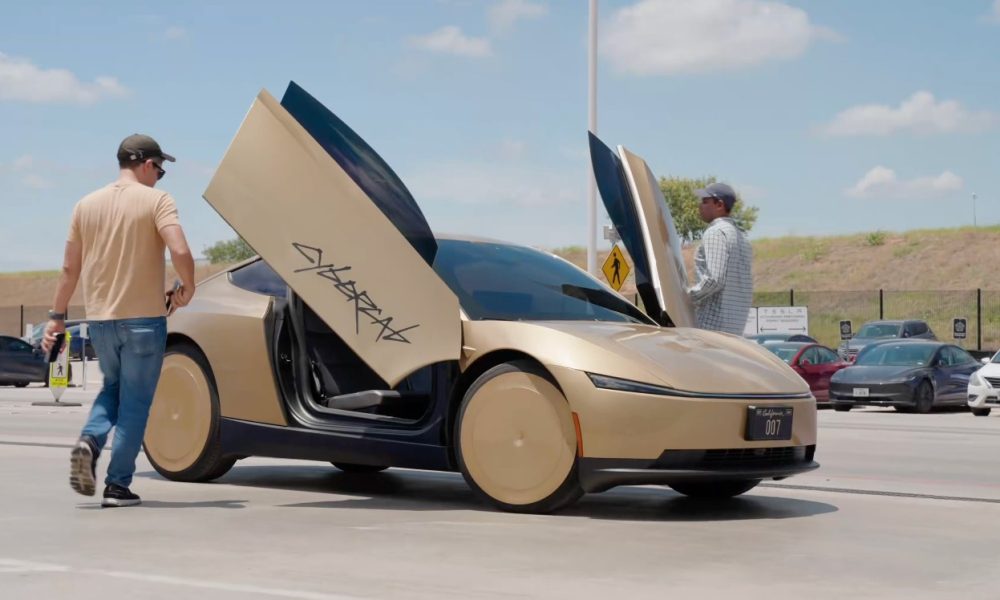
The Ben White facility sits about 12 miles from Giga Texas and is shaping up as the nerve center for Tesla’s Austin fleet operations. Cybercabs would drop a passenger, route themselves to the hub, charge, get cleaned by robot, pass automated inspection, and redeploy without a human touching anything. That is the closed-loop infrastructure that separates a technology demo from an actual business.
Tesla’s broader robotaxi program, which launched in Austin with supervised Model Y rides in mid-2025, has already expanded to Houston, Dallas, the San Francisco Bay Area, and most recently Miami. The company reported 480,000 vehicle deliveries in Q2, crushing Wall Street estimates by more than 15 percent. Jefferies bumped its price target to $400 from $375 on the strength of that quarter and Tesla’s expanding autonomous footprint.
But here is the strange part. Tesla had genuine news, arguably the biggest Cybercab milestone to date, and fumbled its own announcement. Posting employee ride footage, pulling it, and reposting a sanitized version suggests either an internal communications breakdown or last-minute legal caution about showing too much before regulatory sign-off is fully buttoned up.
Either way, the scrubbed details are now all over the internet, making the edit pointless.
The Cybercab program has real momentum. Engineering vehicles have been running on public roads in Austin and Silicon Valley since March. The cleaning infrastructure is being permitted and built. The Level 4 certification is in hand, and employees are riding in production-intent vehicles with no controls.
What Tesla still lacks is the discipline to let the milestones speak for themselves. Posting and deleting footage of a breakthrough achievement turns a confidence-building moment into a credibility question, one that competitors like Waymo, which has been running fully driverless rides in multiple cities for years, never have to answer. The hardware story is compelling. The communications story is a mess.
Share this Story