
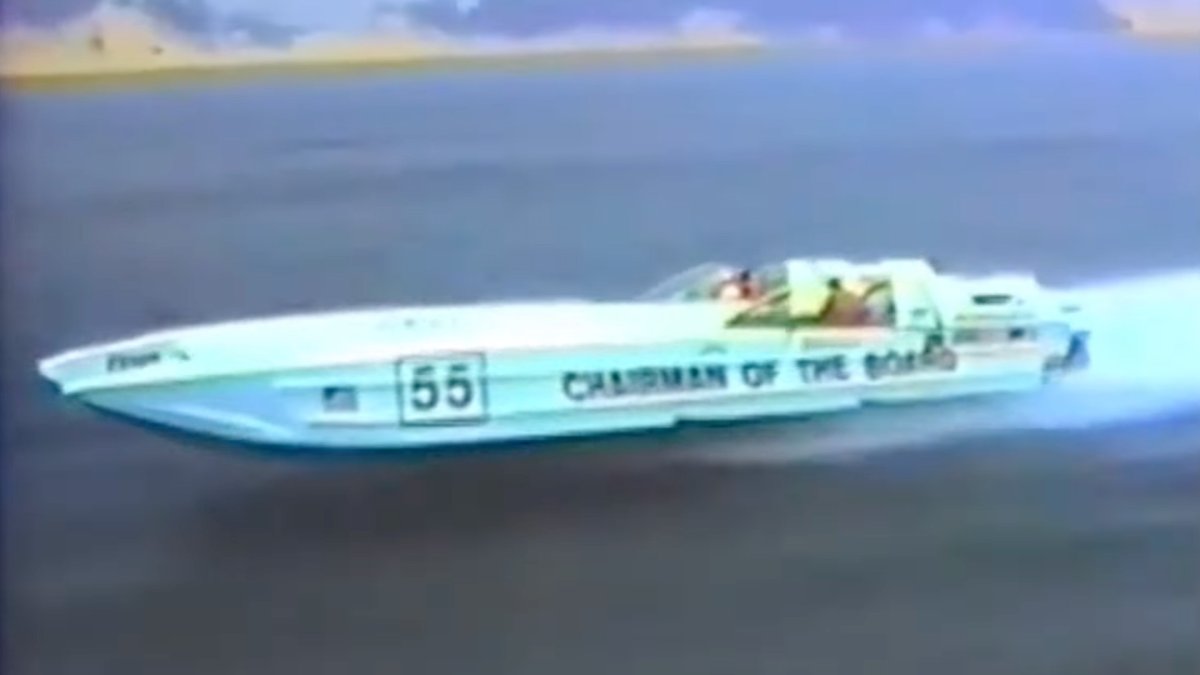


Ferruccio Lamborghini famously wanted nothing to do with racing. That story has been told a thousand times. What hasn’t been told nearly enough is that his company spent two decades dominating a motorsport that had nothing to do with asphalt, pit lanes, or checkered flags.
Lamborghini’s V12 was a terror on the water. It started in 1967, just four years after the brand launched. Ferruccio had a Riva Super Aquarama fitted with a pair of V12s derived from the road car engine.
That boat was a one-off, a rich man’s toy, nothing more. But it planted a seed.
By 1982, Lamborghini had developed a dedicated marine V12, an 8.0-liter naturally aspirated monster producing up to 720 horsepower. Two of those engines were bolted into a 38-foot monohull racing boat named Miura, because of course it was. In 1984, that boat won its first championship.
Through the 1980s, the golden era of offshore powerboat racing, Lamborghini built two distinct V12 specifications. The L804 displaced roughly 8.2 liters with a 60-degree vee configuration mirroring the road car architecture. It made 880 horsepower but tipped the scales at 793 pounds despite aluminum construction.
The L900 was larger at 9.3 liters, but ran carburetors instead of fuel injection and was tuned for durability over outright power, producing 770 horsepower. That engine was aimed at luxury yacht owners who wanted longevity, not podiums.
The racing versions kept winning. Ten world titles eventually. The campaign extended well past Lamborghini’s own golden era as a carmaker, with the Spirit of Norway boat collecting championships into the early 2000s powered by those same Italian twelves.
Here’s the irony that makes this story so rich. Enzo Ferrari built road cars to fund his racing habit. Ferruccio Lamborghini built cars specifically to one-up Ferrari, supposedly because he was insulted by Enzo’s dismissive attitude toward customers.
Lamborghini swore off the track. Yet his engines ended up competing anyway, just in a theater nobody in the car world was watching closely.
The marine program eventually wound down. Lamborghini’s last notable foray into boats came in 2020 with the Tecnomar for Lamborghini 63, a collaboration with Italian Sea Group that borrowed styling cues from the Sián FKP 37. But the engines in that yacht were MAN units, not Lamborghini’s own.
The in-house V12 marine program was long dead by then. The road car V12 itself has a complicated legacy. The original architecture, born as a 3.5-liter for the 350 GT, grew in displacement and gained fuel injection over the decades.
It survived in various forms until 2011, when the Aventador introduced a second-generation V12. That engine has now given way to hybridization with the Revuelto.
A YouTube video from the channel Véhicule recently dragged this chapter of Lamborghini history back into the light, and it deserves the attention. Offshore powerboat racing in the 1980s was loud, dangerous, and fueled by exactly the kind of excess that made Lamborghini’s road cars famous. The fit was natural.
Ferruccio Lamborghini never wanted to race against Ferrari. He just never said anything about racing against Cigarette boats.


Share this Story