
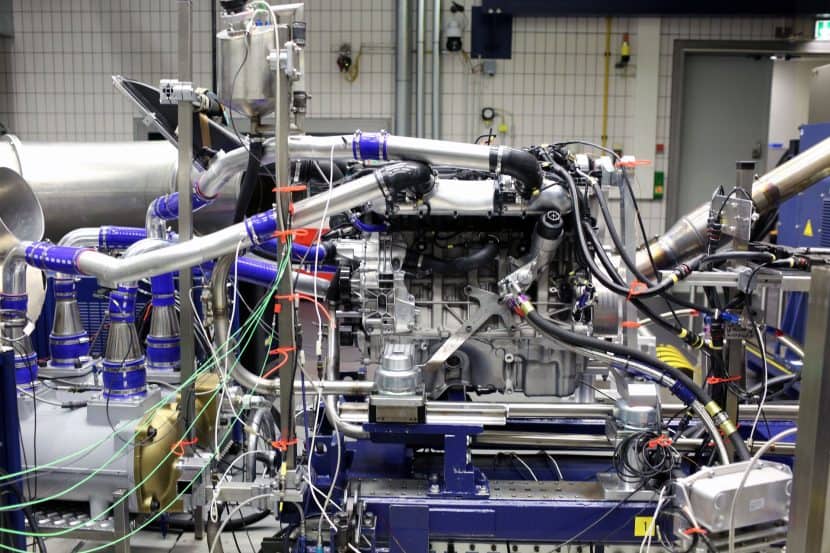


Part number 05748334245KT. That’s all it takes to order a genuine BMW Motorsport P58 racing engine — the same 3.0-liter twin-turbo straight-six that powers the M4 GT3 — from Turner Motorsport or ECS Tuning, listed right alongside oil filters and wheel bolts. A hundred grand, no team affiliation required.
The P58 is not some creation built in a clean room by engineers who’ve never seen a road car. It starts life as the S58, the same inline-six found in every G80 M3 and G82 M4 Competition rolling off dealer lots. Same aluminum block and head, same connecting rods and pistons.
BMW Motorsport didn’t reinvent the bottom end. They kept what survived 100,000-mile warranties and rebuilt everything else for a different kind of survival — 24-hour endurance stints at full throttle.
The divergence is surgical. The road car’s wet sump gets thrown out for a dry-sump system with engine-mounted oil tanks and an integrated oil-to-water heat exchanger, because oil starving away from the pickup in a sustained 2G left-hander kills engines. One throttle valve becomes two, and the charge-air cooling setup is entirely motorsport-specific.
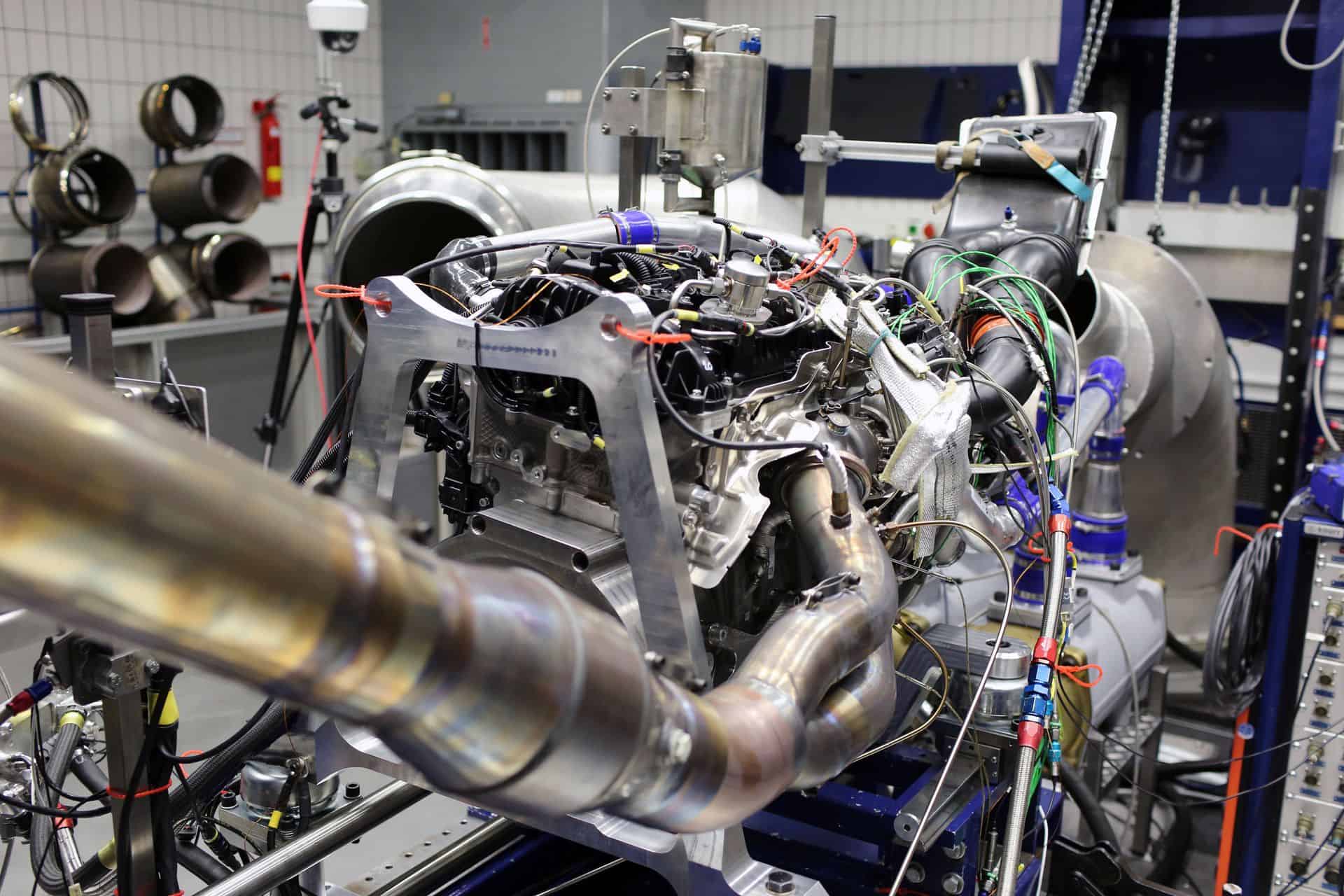
Then there’s the mounting angle. BMW tilted the P58 differently in the GT3 chassis compared to the S58’s orientation in the road car, though the company has never disclosed by how much. That single change cascades through the entire package — new oil pan geometry, new scavenge routing, purpose-built intake and exhaust manifolds because the factory S58 plumbing no longer lines up.
The result: up to 590 horsepower and 516 lb-ft of torque, though what actually shows up on any given weekend depends on Balance of Performance regulations in whatever series the car enters. BMW also claims the P58 is roughly 80 pounds lighter than the 4.4-liter P63 V8 it replaced from the old M6 GT3 program.
The naming convention tells its own story. BMW Motorsport swaps the “S” prefix for a “P” whenever a production M engine gets rebuilt for competition. The S63 V8 became the P63 for the M6 GT3, the S65 from the E92 M3 became the P65 for GT racing, and the P58 follows that lineage — bringing BMW’s inline-six back to top-tier GT competition after nearly a decade of V8 power.
The P58 debuted in June 2021 at the Nürburgring Endurance Series and remains the heart of the updated M4 GT3 EVO that BMW rolled out for 2025. Along the way, it powered the car to BMW M Motorsport’s first-ever FIA World Endurance Championship class victory — a one-two LMGT3 finish at the 2024 6 Hours of Imola.
Most manufacturers treat their race engines like state secrets, bolted deep inside homologated chassis and accessible only to factory-aligned teams with the right handshake. BMW put a part number on theirs and dropped it into the same retail pipeline where weekend warriors buy camber plates. You still need roughly half a million dollars for the M4 GT3 chassis to bolt it into, so this isn’t impulse-buy territory.
But the gesture is telling. It says BMW believes the S58 architecture is robust enough that its race derivative doesn’t need to hide behind exclusivity. The pistons and rods are the same ones in your neighbor’s M3, and the magic is in the oiling, the breathing, and the angle — engineering choices, not unobtanium.
That a factory race engine can exist as a catalog line item, sandwiched between genuine BMW accessories, says more about the S58’s fundamental design than any press release ever could.
Share this Story