
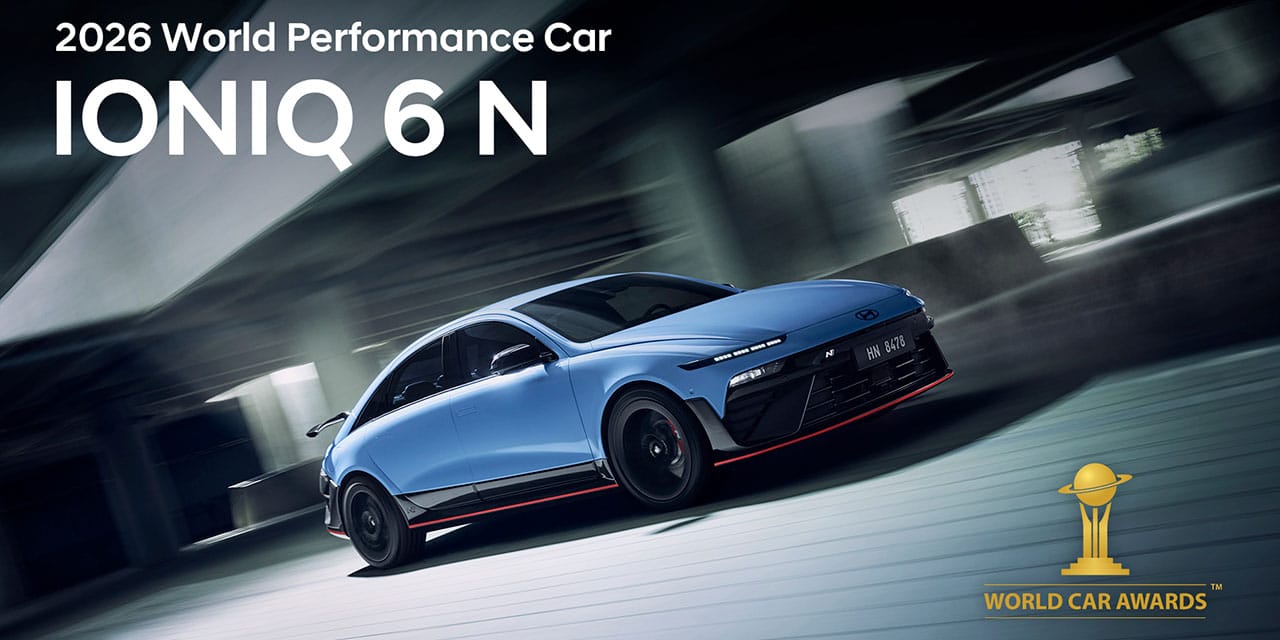


The Hyundai IONIQ 6 N just beat the BMW M2 CS and Chevrolet Corvette E-Ray for the 2026 World Performance Car title at the New York International Auto Show. Let that sink in. A Korean electric sedan topped a twin-turbo BMW and a hybrid Corvette, and it’s the second time in three years Hyundai has pulled this off.
The IONIQ 5 N took the same award in 2024. Add the Kia EV6 GT’s win in 2023, and Hyundai Motor Group now owns three consecutive World Performance Car trophies. The company that was selling cheap Excels in the 1990s is now the dominant force in a category that used to belong to Porsche and Ferrari.
The finalists this year tell the story. The BMW M2 CS and Corvette E-Ray made the top three. The Land Rover Defender OCTA and Mercedes-AMG GT 63 Pro rounded out the shortlist.
Every one of those cars has either a storied racing lineage or a fanbase that would have laughed at a Hyundai badge five years ago. Nobody’s laughing now.
Manfred Harrer, who heads Hyundai Motor Group’s R&D division and spent years at Porsche before jumping ship, laid out the engineering philosophy in blunt terms. “Driving pleasure matters most,” he said. “To figure out if we nailed it, we need to get up early and get behind the wheel.” No algorithms, no focus groups, just seat time.
The IONIQ 6 N’s trick is that it refuses to behave like a typical EV. Its N e-Shift system replicates the mechanical rhythm of a dual-clutch transmission, giving drivers shift points to hit rather than a single unbroken surge of torque. The N Active Sound+ system creates auditory feedback tied to power delivery.
These are deliberate, arguably stubborn decisions. Hyundai’s engineers are grafting the sensory language of combustion cars onto electric hardware because they believe the human connection matters more than ideological purity.
The chassis work underneath is where the real conviction lives. Rather than isolating the driver from road imperfections, the suspension telegraphs surface texture through the steering column. It’s the opposite approach from most EV manufacturers, who treat silence and smoothness as the entire point.
The press quotes from major outlets read like love letters. Car and Driver said “the 6 N feels like a sports car.” Top Gear’s reviewers admitted “you keep forgetting that it’s electric entirely.” What Car? in the UK called it “the best car of its kind” and gave it Best Electric Performance Car at their 2026 awards.
Before the awards circuit, the IONIQ 6 N made its dynamic debut at the 2025 Goodwood Festival of Speed, a venue where credibility is earned in front of the most unforgiving audience in motorsport. It also picked up a 2026 iF Design Award, because apparently the thing looks as good as it drives.
Hyundai N’s motorsport roots keep feeding the road car program. The brand runs the eN1 class, the world’s only one-make racing series for production-based EVs. It set records at Pikes Peak.
The RN24 rolling lab, built on IONIQ 5 N bones, pushes the power electronics further toward the edge. This isn’t a marketing exercise bolted onto a compliance car. It’s a pipeline.
Joon Park, Hyundai N’s vice president, accepted the award with the kind of statement that sounds corporate until you consider the context. “We are not just building fast EVs; we are engineering the future of the ‘fun to drive’ experience,” he said. Three years ago, that would have drawn smirks. After three consecutive World Performance Car wins, it reads like a simple statement of fact.
The old guard — BMW, Chevrolet, Mercedes, Porsche — built performance empires over decades of internal combustion dominance. Hyundai just walked into that world with battery packs and fake shift points and took their trophy. Three times in a row.
Share this Story