


Volvo’s head of engineering has a name for the sinking feeling EV owners get when they plug in at a fast charger and watch the bill climb past twenty bucks. Anders Bell calls it “Hot Dog Anxiety” — you duck inside the convenience store, grab a snack, come back to your car, and realize you just paid $25 for what amounts to the most expensive hot dog of your life. It’s a quirky, very European label for a problem that’s becoming harder to ignore.
The math is straightforward and unforgiving. Charging a 2022 Tesla Model Y from 20 to 80 percent on a home Level 2 charger costs roughly $8.18 for about 159 miles of range. That same charge at a Supercharger during peak daytime rates — around $0.50 per kWh — runs north of $21.
Gas for the same distance in a 30-mpg car costs about $24 at current prices. The gap between fast charging and gasoline has narrowed to pocket change. And if gas prices drop, the gap disappears entirely.
Bell made the remarks while discussing the upcoming Volvo EX60, which can charge from 10 to 90 percent in just 16 minutes on a 350-kW charger. That’s genuinely impressive hardware. But speed doesn’t solve the cost problem — it might even obscure it. The faster the charge, the less time you spend thinking about the price. Until you see the receipt.
Average U.S. electricity now runs $0.194 per kWh, up sharply from $0.134 in 2020. Demand on the grid is climbing, driven partly by data centers, and current energy policy isn’t helping. Fast-charging operators have to recoup the enormous cost of Level 3 equipment, and they’re doing it on the backs of road-tripping EV drivers who have no other option.
This is where the conversation keeps getting stuck. The industry pours billions into ultra-fast charging networks and celebrates each new speed milestone, while the fundamental economic advantage of electric vehicles — cheap fuel — only holds true if you can plug in at home overnight. For the millions of Americans who rent apartments, park on the street, or lack garage access, that advantage evaporates.
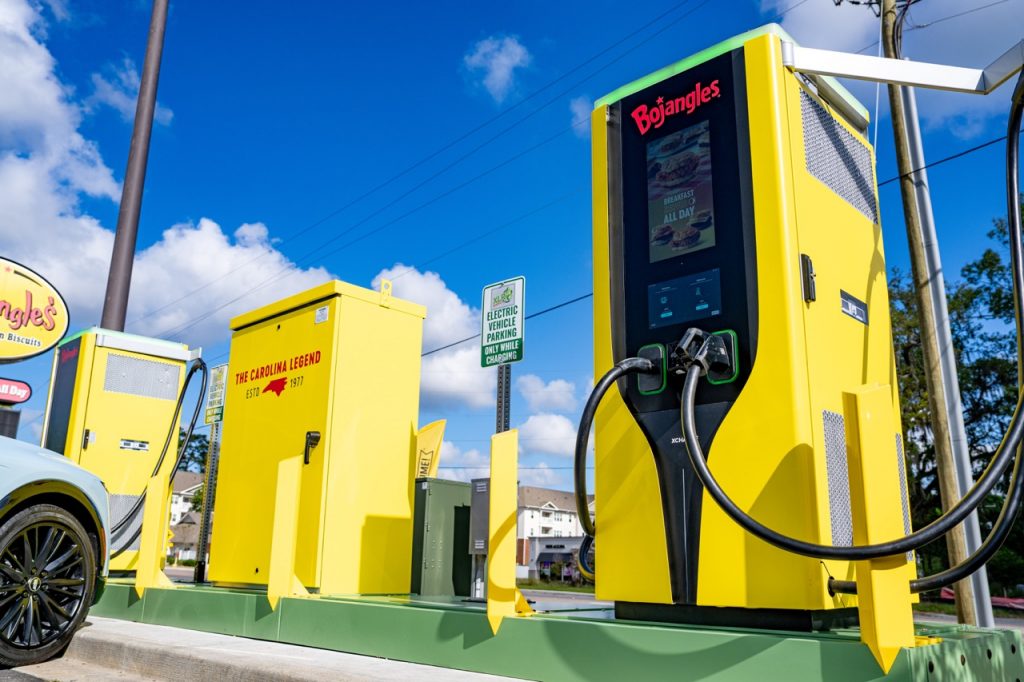
Bojangles, the Southern fried chicken chain, just announced it’s adding fast chargers at locations starting in Savannah, Georgia. It joins a growing list of food and retail outlets betting that EV drivers will spend money while they wait. That’s a fine business model for Bojangles. It doesn’t do much for the driver staring at a $25 charging session tacked onto a $6 biscuit combo.
Bell’s comments came alongside a broader discussion about battery strategy at Volvo. After the collapse of European battery startup Northvolt, the company has become what Bell calls a “cell omnivore,” sourcing cells from whoever offers the best deal. The rollback of Inflation Reduction Act credits has loosened the penalty for using Chinese-sourced materials — there’s no tax credit left to lose. South Korean cells appear to be the likely landing spot for American-market EVs.
None of that addresses what happens at the charger itself.
The industry’s dirty secret is that expanding slow, cheap, overnight charging at apartments, workplaces, and public garages would do more for EV adoption than shaving another two minutes off a fast-charge session. Every EV owner who charges at home already knows the economics work. Every renter watching from the sidelines knows they don’t.
Hot Dog Anxiety isn’t really about hot dogs. It’s about the moment an EV driver realizes that the fueling experience they were promised — cheaper, cleaner, simpler — comes with an asterisk the size of a Supercharger bill. And no amount of fried chicken is going to fix that.

Share this Story