


Land Rover built a 626-horsepower Defender and priced it at nearly $200,000. Two independent tests confirm the same unsettling conclusion: the thing actually works.
The Defender Octa stuffs a twin-turbocharged 4.4-liter V8 into a vehicle with the aerodynamic profile of a garden shed and a wading depth of over three feet. It weighs roughly as much as a small asteroid. And it rips to 100 km/h in four seconds flat, which places it in the company of sports sedans that weigh a thousand pounds less and don’t come with a full-size spare tire bolted to the tailgate.
Car and Driver’s test revealed a telling quirk: under full throttle, the nose lifts so aggressively that you find yourself staring above the horizon, Hummer EV-style. That’s not a handling trait you engineer into a luxury SUV on purpose. It’s a byproduct of cramming absurd power into a tall, heavy box and letting physics sort out the details.
The secret weapon is the 6D Dynamics active air suspension, a system that has no right delivering the composure it does. Over frost-heaved pavement, potholes, and expansion joints, the Octa stays eerily controlled. On 33-inch off-road rubber, testers say it could genuinely embarrass vehicles on a circuit — a sentence nobody should have to write about a Defender, and yet here it sits in multiple road-test reports.
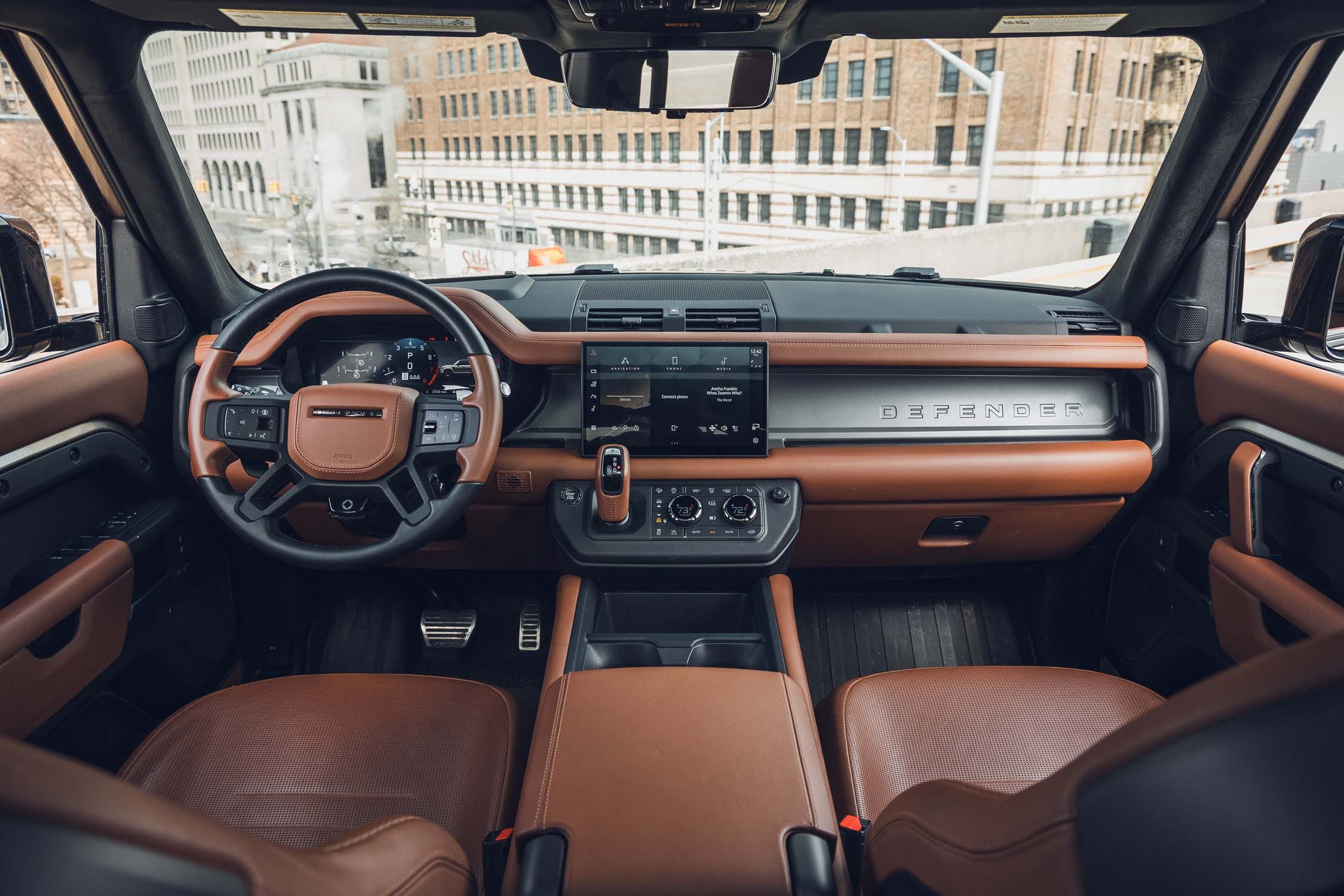
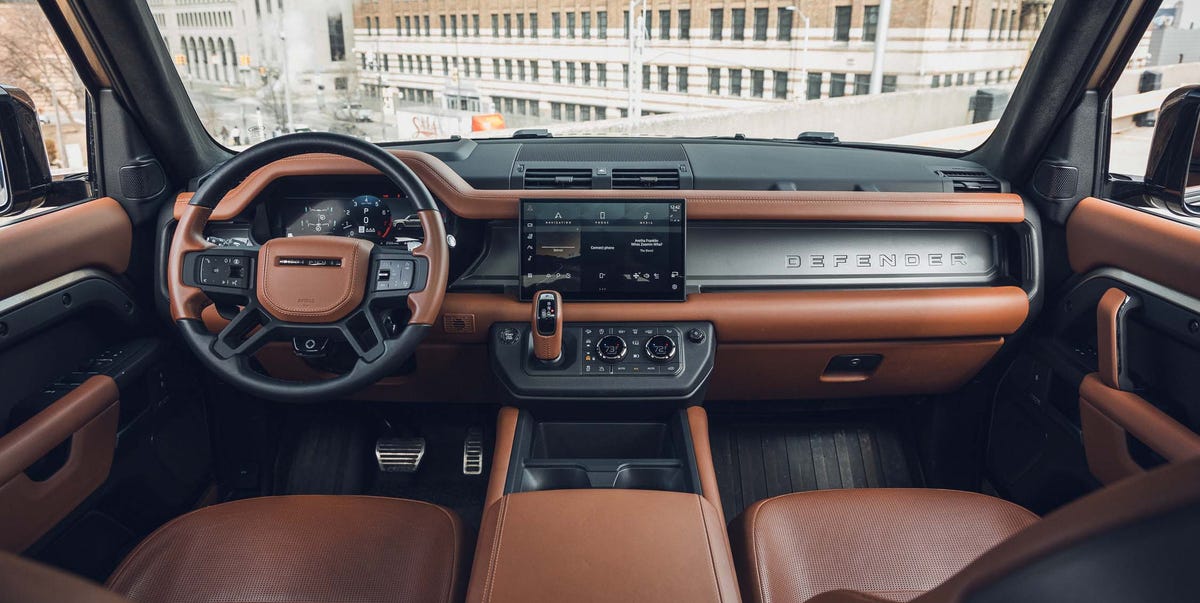
Inside, the contradiction deepens. Car and Driver notes the cabin is the same as any high-spec Defender 110. The gauge cluster is unchanged. The only real identifier is a small button at the bottom of the steering wheel — which, to the annoyance of several editors, is not even shaped like an octagon.
For nearly $200,000, you get performance-styled seats with good support, a handsome two-tone leather interior, and carbon fiber trim. It’s well-executed, but the Octa doesn’t scream its price tag from the dashboard. It whispers it through the gas pedal.
The eight-speed automatic is trigger-fast. A two-speed transfer case, four-wheel torque vectoring, and the full Terrain Response system remain. Oversized brakes try to contain the consequences of 626 horsepower pushing roughly 5,800 pounds of British aluminum.
The active exhaust hits a muscular note without terrorizing the neighborhood at 6 a.m. Fuel economy is, charitably, catastrophic. The official mixed figure sits at 14.2 liters per 100 km in Canada, but real-world consumption trends closer to 16.5.
Nobody shopping a $195,000 off-roader will care, but the number is a useful reality check on what this vehicle actually is: a monument to excess wrapped in a utilitarian costume.
Then there’s the elephant. Land Rover’s reliability reputation follows the Octa like a billing dispute. Tires, brakes, and servicing on a vehicle this specialized will be eye-watering. One reviewer’s advice on buying a used Octa was blunt: think thrice.
The competitive landscape is telling. A Mercedes-AMG G 63 starts at $249,000 in Canada with less horsepower and a shallower wading depth. The Ford Bronco Raptor costs half as much but produces barely two-thirds the power. The Octa occupies a niche that didn’t exist three years ago — ultra-capable off-roader, track-adjacent performer, six-figure luxury statement — and it fills that niche by being excessive in every measurable dimension.
A base 2026 Defender 110 starts around $81,000. The Octa First Edition costs $195,000. That $114,000 delta buys you a V8, wider fenders, active suspension, carbon trim, and the privilege of owning a vehicle that makes no rational sense and doesn’t care.
The market for machines like this isn’t built on logic. It’s built on desire. And the Octa, flawed and brilliant and ruinously expensive, generates that in quantities its competitors can’t match.
Share this Story