
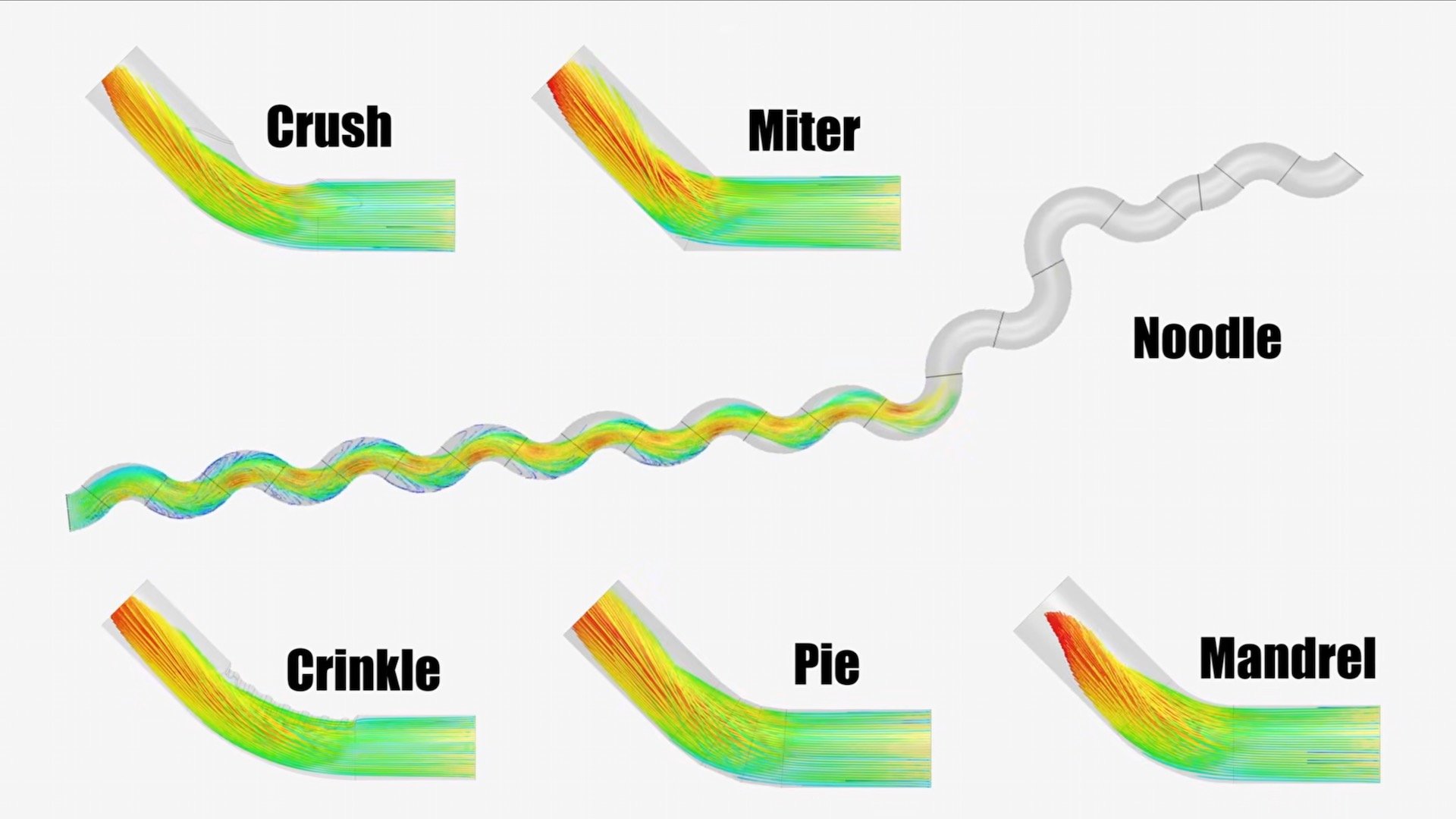


A YouTuber bolted seven different exhaust systems onto a Mitsubishi Lancer Ralliart, strapped it to a dyno, and the results undercut nearly every exhaust upgrade sales pitch you’ve ever heard. The power difference between the best and worst configurations? Less than five horsepower.
Justin from The Fabrication Series channel set up the experiment with a mandrel-bent exhaust as the control. It laid down 144.8 horsepower averaged across three pulls, with 1.42 psi of back pressure and 101.4 decibels of noise. Every other configuration was measured against it.
The cheap crinkle bends you find at auto parts stores, the ones exhaust snobs love to mock, made virtually identical power. Back pressure climbed to 1.71 psi, but the horsepower number barely moved. The crinkle setup was actually a full decibel quieter, likely because its aluminized steel absorbed more sound than the stainless mandrel pipes.
Crush bends made with a basic tubing bender told a similar story. The team tried oversizing the tubing so the crushed sections would match the diameter of the straight pipe. Both versions, 2.0-inch and 2.2-inch, actually produced about one horsepower more than the mandrel control. The budget approach beat the standard.
Miter joints and pie cuts, which eliminate bends entirely by welding angled straight sections together, tied for the highest output at 146.3 hp. That is 1.5 horsepower over mandrel. You would never feel that in the seat of your pants.
Then came the absurd one. An exhaust made entirely of curved pieces, a noodle pipe that looked like it was routed by someone having a very bad day. Back pressure doubled to 2.83 psi.
Thermal imaging showed exhaust gases crawling through it, with dramatic temperature drops from inlet to outlet. The pipe was two feet longer than any other setup. And it lost just 0.4 horsepower to the mandrel system.
Straight pipes after the catalytic converter, predictably, made the most power at 149 hp and the most noise at nearly 111 decibels. No bends, no muffler, no restrictions, no mystery there.
The real data point is back pressure. It varied enormously across the seven setups, from 1.42 psi to 2.83 psi. On a turbocharged four-cylinder making under 150 horsepower, that variation translated to almost nothing at the wheels.
On a bigger engine pushing serious volume through the exhaust tract, those pressure differences would scale up. The percentage losses would compound.
That scaling is the catch everyone glosses over when sharing dyno results from a small displacement test mule. A five percent back pressure increase on a 700-horsepower V8 hits different than on a Lancer Ralliart. The physics don’t change, but the stakes do.
What this dyno session really exposed is how much money gets spent chasing fractions. Mandrel-bent exhaust systems can cost three to five times what a crush-bent setup runs. Custom pie-cut fabrication pushes the bill even higher.
For most street cars, the thermal camera footage was more interesting than the power numbers. The Lancer kept making roughly the same power no matter what was bolted underneath it.
The exhaust industry has built an entire pricing hierarchy around bend quality, and a YouTuber with a dyno and a thermal camera just showed the emperor is wearing very expensive pants for almost no reason. At least on a four-cylinder daily driver. Whether those numbers hold on something with real displacement and forced induction remains the test nobody has run yet.

Share this Story