
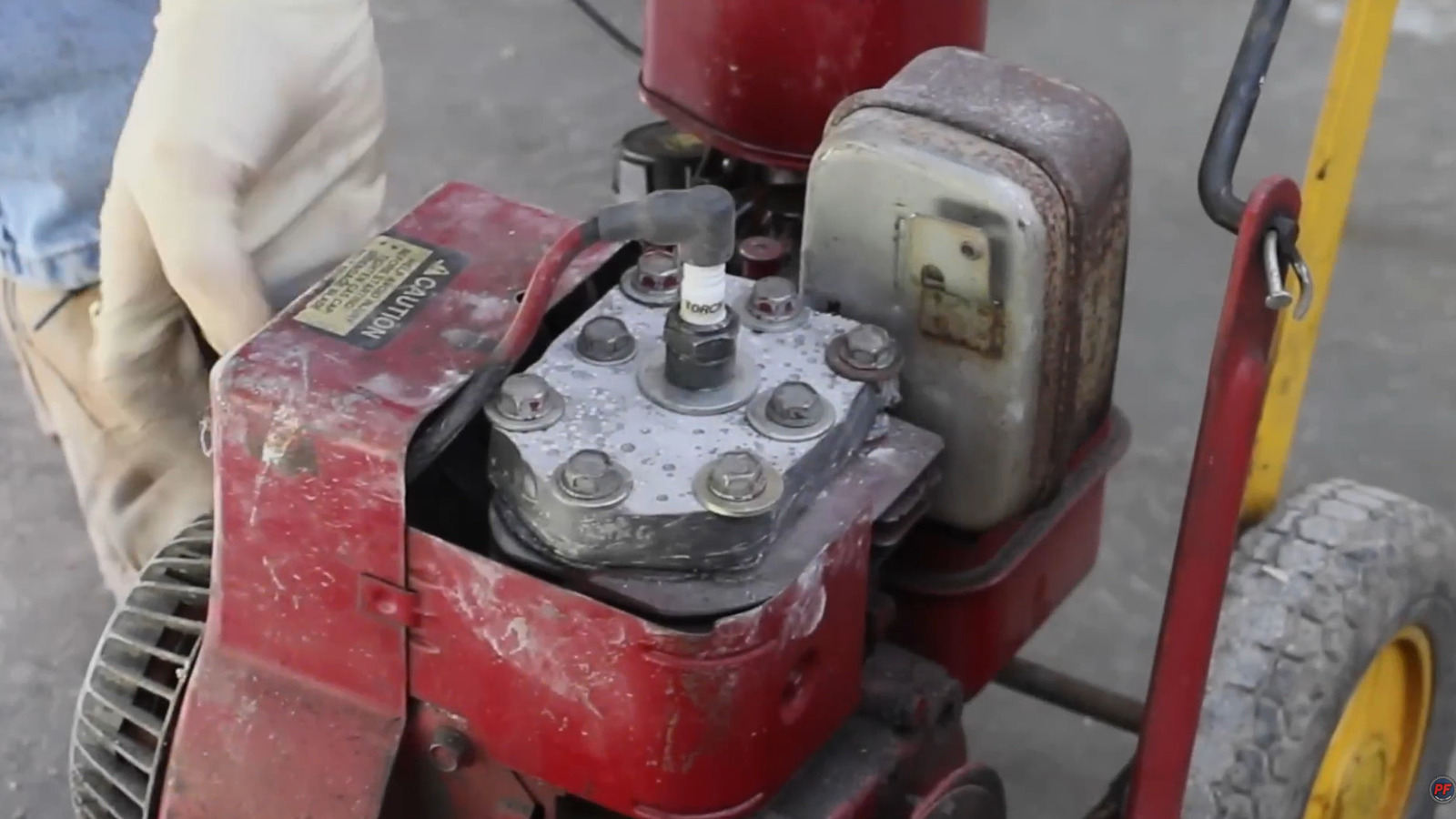


Some questions aren’t meant to be asked. Whether you could replace an aluminum cylinder head with twenty ounces of cold weld epoxy is one of them. But the lunatic behind Project Farm on YouTube went ahead and asked it anyway — and then actually pulled it off.
The experiment, which surfaced a few years back and continues to circulate among gearheads who love watching shade-tree engineering pushed to its absolute limits, is as straightforward as it is absurd. The goal: cast a functional lawnmower engine cylinder head using nothing but J-B Weld two-part epoxy, bolt it onto a running engine, and see if the thing would fire and stay alive for more than sixty seconds.
It started with four full tubes of the silver epoxy and four matching tubes of hardener — roughly twenty fluid ounces of the stuff. That entire batch was mixed together and poured into a crude form to approximate the shape of a stock cylinder head, then left to cure for several days to reach maximum hardness.
Once the epoxy brick had fully set, the real work began. The hardened block was mounted in a makeshift jig and run through a belt sander on both sides to achieve flat mating surfaces. Using the original cylinder head as a template, eight bolt holes were drilled through the new head on a drill press to match the engine block’s mounting pattern. A ninth hole was drilled and tapped dead center to accept a spark plug.
Then came the most delicate part. Using the cylinder head gasket as a guide, a rough combustion chamber was hand-machined into the underside of the epoxy head. These reliefs are critical — without them, the engine’s valves can’t open and close, which means no air gets in and no exhaust gets out. No gas exchange, no combustion. No combustion, no running engine.
It’s basic four-stroke stuff, but getting it right in a material never designed for this application required patience and a willingness to accept imperfection.
With the head bolted down and a spark plug threaded in, the moment of truth arrived. The engine fired. And it kept running. For over a minute, a single-cylinder lawnmower engine operated with a cylinder head made entirely from hardware store epoxy.
Would it have kept going? That’s the tantalizing question Project Farm didn’t fully answer. The test ended after proving the concept, without pushing the setup to catastrophic failure.
If forced to guess, the most likely point of failure would be the spark plug threads stripping out of the soft epoxy under heat and vibration, killing ignition instantly. Without the cooling fins found on a stock aluminum head, heat buildup would also become a serious problem in short order. Epoxy and sustained high temperatures are not friends.
There’s no practical takeaway here for anyone working on an actual vehicle. Nobody is going to replace a blown head on their daily driver with a brick of J-B Weld, and if you’re thinking about it, stop. This was a small industrial single-cylinder engine running under no load — about as gentle an application as internal combustion gets.
But that’s not really the point. The point is that someone looked at a tube of epoxy and a broken lawnmower and thought, “What if?” That kind of reckless curiosity is what makes garage engineering so compelling.
It’s not always useful. It’s rarely advisable. But watching someone prove that a $20 tube of cold weld can temporarily do the job of a machined aluminum casting is the kind of content that keeps the wrenching community alive and entertained.
If nothing else, Project Farm proved that J-B Weld’s marketing team has been underselling their product for years. The stuff held compression, survived combustion, and kept a spark plug in place long enough to make a running engine. That’s more than some factory parts can claim after a few hard years on the road.






Share this Story