
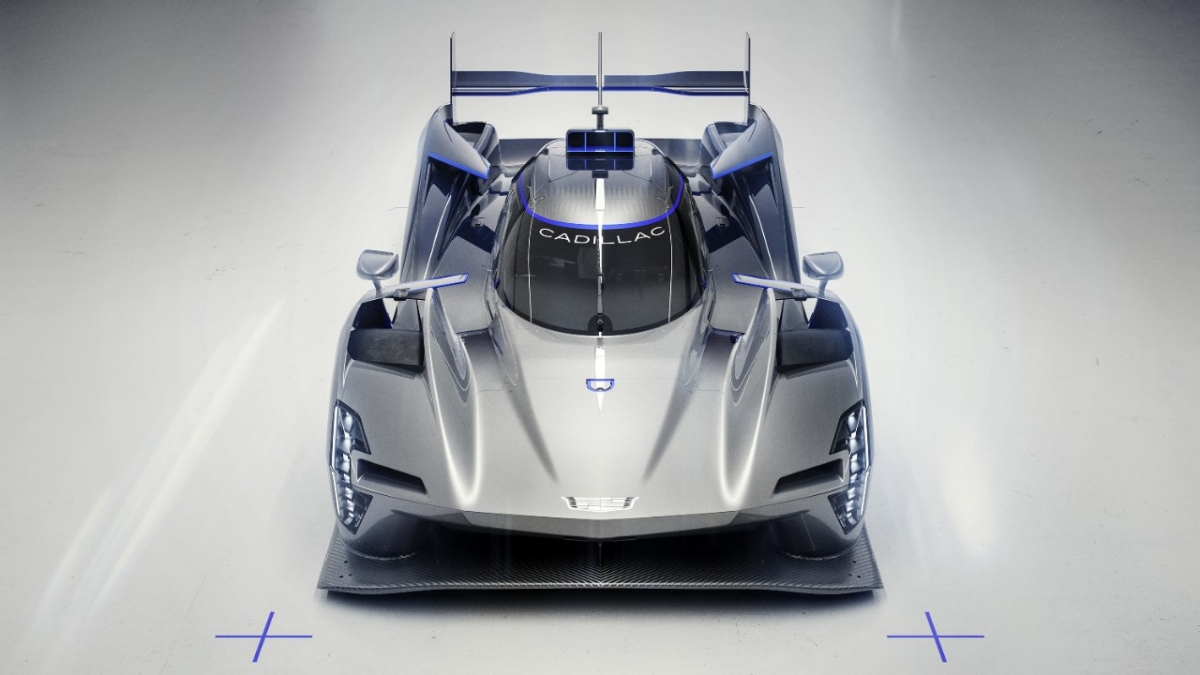


Cadillac just unveiled the V-ONE concept, a track-only machine that shares its carbon fiber tub, bodywork molds, and 5.5-liter naturally aspirated V-8 with the championship-winning V-Series.R prototype racer. It produces 830 horsepower. It targets lap times within 10 percent of the actual race car.
And it is, per the fine print, “not available for sale.” Read that again. Not available for sale.
So what exactly is this? A halo car with no dealership? A branding exercise wrapped in hand-painted silver-to-Caspia-blue livery? Or a signal that Cadillac is dead serious about joining the ultra-exclusive hypercar-for-the-track club currently occupied by Aston Martin, Porsche, and Toyota with their own LMDh and LMH client programs?
The bones are real enough. The V-ONE rides on a Dallara-built carbon tub identical to the one racing at Le Mans and Daytona. The engine, a flat-plane-crank 5.5-liter V-8, takes 160 hours to hand-assemble at a facility in Pontiac, Michigan by career race engine builders.
Cadillac Racing engineers recalibrated the hybrid system so a single driver can operate it without a pit crew whispering in their ear. Since no sanctioning body governs combined output here, the electric motor acts as pure boost. Hit a button on a straight and get 134 extra horsepower on demand.
“I couldn’t even imagine that,” said Sean O’Shea, Cadillac’s LMDh Propulsion Manager. “These things are already so fast.”
The interior went through 36 steering wheel iterations. A GT3-style seat replaces the tighter racing bucket for better visibility. Blue accents echo the exterior gradient, which itself references the day-to-night shift of an endurance race.
Every exterior surface was shaped by hand rather than left as raw carbon. That was a deliberate decision by Dominic Najafi, Executive Director of Global Cadillac Design, to ensure the reflections and highlights read as luxury rather than pure function.
The V-ONE also debuts a new V-Series logo and a wheel design Cadillac says will preview future production V-Series models. That detail matters more than the concept itself. It suggests a design language migration from race car to showroom, which is the oldest trick in the motorsport marketing playbook and still one of the most effective.
Cadillac positions the V-ONE as the performance bookend to the CELESTIQ, its hand-built electric flagship sedan. “The CELESTIQ represents ultimate luxury, the V-ONE represents ultimate performance,” Najafi said. Cadillac wants you to believe it can play at both ends of the spectrum, that the brand stretching from a $300,000-plus electric sedan to a prototype-based track weapon makes it more credible, not less.
The tension is obvious. Cadillac has a race car that wins. It has a concept that proves the technology transfers to a more usable package.
It has the manufacturing infrastructure in Pontiac. It has Dallara building chassis. And yet the footnote says you cannot buy one.
Toyota sold its GR010 road car. Porsche is building the Mission X. Aston Martin delivered the Valkyrie. Every serious racing brand eventually monetizes the halo. Cadillac built the car, painted it, furnished the interior, and then stamped “concept” on the press release.
The real question is not whether the V-ONE is fast. It obviously is. The question is whether Cadillac has the nerve to put a price tag on it and let the market decide if a seven-figure American hypercar deserves to exist alongside the Europeans.
The hardware says yes. The disclaimer says not yet.
Share this Story