
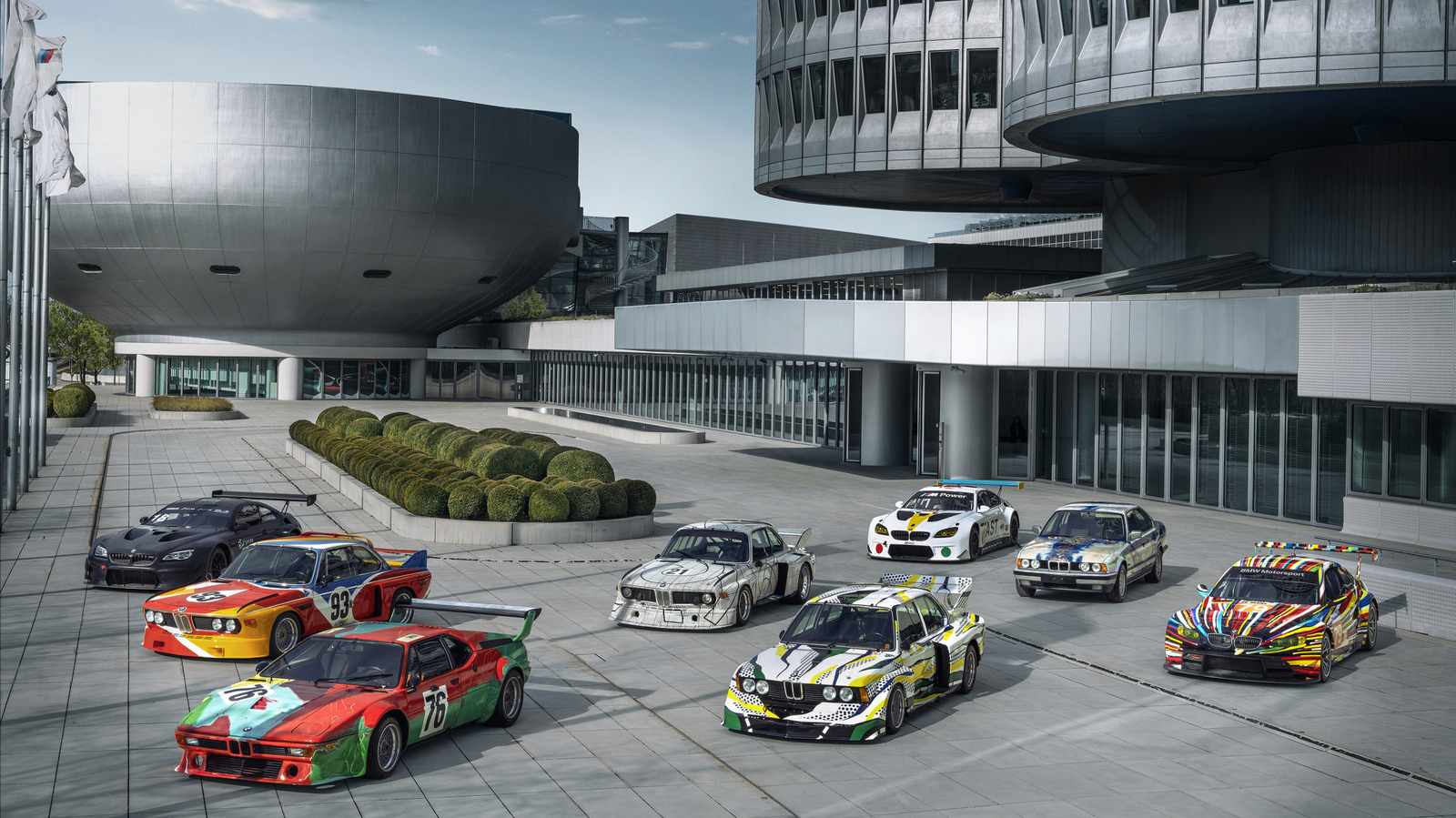


Fifty years and 20 cars. That’s the math behind what BMW is calling a once-in-a-lifetime gathering this summer in Munich, where every Art Car the automaker has ever commissioned will sit under one roof for the first time in the program’s history.
The exhibition, titled “BMW Art Cars — 20 Artists, 50 Years of Innovation. Reunited at BMW Welt,” runs July 29 through August 31. It caps a global tour that started in late 2024 at the Wits Art Museum in Johannesburg and hopscotched through museums, car shows, and festivals across Europe, Asia, and even Pebble Beach before a February stop at Retromobile in Paris.
The whole thing started because a French racing driver had taste. Hervé Poulain, who doubled as an auctioneer, convinced Alexander Calder to paint a 1975 BMW 3.0 CSL for that year’s 24 Hours of Le Mans. Calder, then 77, applied his trademark bold primaries and minimalist geometry to the body.
The car didn’t finish the race. It didn’t need to. The livery became the story, and Calder died the following year, making the 3.0 CSL his final artwork.
That single act of creative ambition opened a pipeline that ran through five decades of contemporary art royalty. David Hockney, Roy Lichtenstein, Jeff Koons — all took their turns bending metal into canvas.
Andy Warhol’s contribution remains the one most people can name, and not just because of the artist. The car underneath was a BMW M1 Group 4, one of the most beautiful mid-engine machines ever built. Warhol wanted to capture speed itself, saying that when a car moves fast enough, “all the lines and colors become a blur.” The M1 backed up the art with substance, finishing second in class at the 1979 Le Mans.
Then there are the oddities that make a collection like this more than just a greatest-hits reel. The 2007 BMW H2R, designed by Danish-Icelandic artist Olafur Eliasson, is a hydrogen-powered concept wrapped in a translucent shell made of steel and ice. Actual ice.
It almost never appears in public because keeping it intact requires precise climate control. It looks less like a car and more like something dredged from the deep ocean floor, which is exactly why it’s worth seeing in person.
BMW did not invent the idea of artists painting cars. That tradition stretches back further than most enthusiasts realize. But the company stuck with it for half a century, commissioning work from artists whose pieces hang in MoMA and the Tate, and then occasionally sending those painted machines out to race.
That persistence created something no other manufacturer can match — a coherent body of work that bridges automotive engineering and fine art without embarrassing either discipline.
The Munich exhibition is free to attend at BMW Welt, though specific ticketing details haven’t been fully outlined. Given that several of these cars spend most of their lives in climate-controlled storage, the odds of all 20 sharing a room again anytime soon are slim.
For anyone within striking distance of Munich this summer, the window is five weeks. For everyone else, the Art Cars will scatter back to their respective resting places, and the wait for a reunion starts over — presumably for another 50 years.


Share this Story