
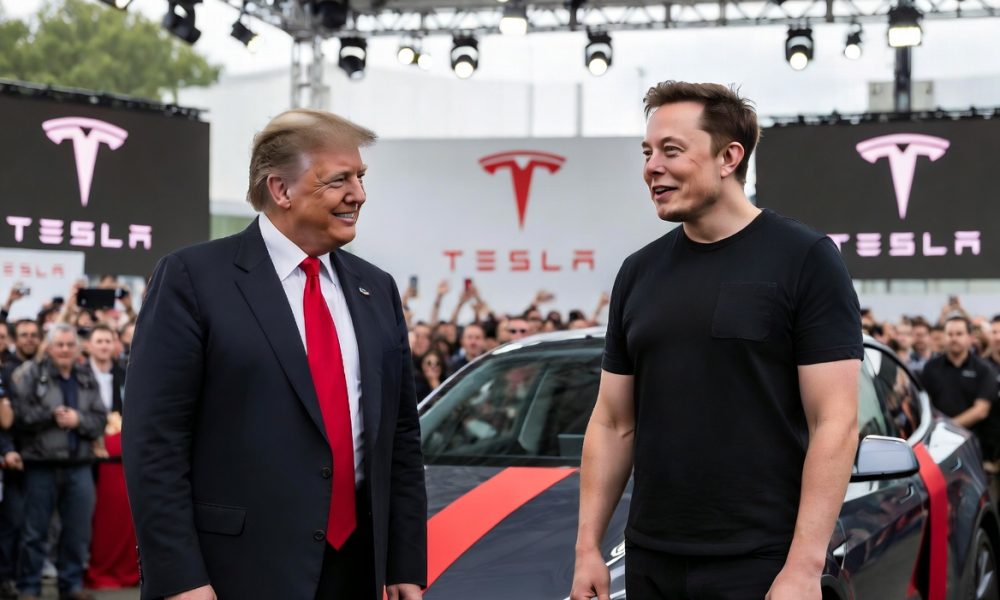


Tesla bumped its Model S and Model X Signature Edition delivery event from May 12 to May 20 after Elon Musk accepted a seat on President Trump’s diplomatic delegation to Beijing. The reason is simple: you can’t host a farewell party at the Fremont factory when the host is halfway around the world negotiating trade policy with Xi Jinping.
The 350 buyers who secured one of the last Model S or Model X units ever built — 250 sedans and 100 SUVs, priced at $159,420 each — received a follow-up email asking them to reconfirm attendance and download fresh QR codes. Travel and hotel costs remain on their dime. Tesla offered no apology for the shuffle, just a new date.
The China trip is no sideshow. Trump’s delegation reads like a Fortune 10 dinner party: Tim Cook, Larry Fink, Kelly Ortberg from Boeing, and senior executives from Goldman Sachs, Blackstone, Citigroup, and Meta. The agenda spans trade, AI, export controls, Taiwan, and the Iran conflict — every friction point between Washington and Beijing compressed into a single summit.
Musk’s presence on that list says more about his current standing than any press release could. Eighteen months ago he was publicly feuding with Trump after a messy departure from the Department of Government Efficiency. Now he’s riding on Air Force One to the most consequential diplomatic meeting of Trump’s second term.
The reconciliation isn’t hard to decode. Tesla generated roughly a quarter of its global revenue from China last year. Musk needs favorable trade terms, stable rare earth supply chains, and continued access to the Shanghai Gigafactory.
Trump needs corporate heavyweights who can sit across from Chinese counterparts and talk numbers. The mutual usefulness outweighs whatever personal grudges lingered from 2025.
Back in Fremont, the delayed event carries its own symbolic weight. The Model S rolled off that line in 2012 and turned Tesla from a curiosity into a legitimate luxury automaker. The factory floor where it was built is being converted to manufacture Optimus humanoid robots.
Fourteen years of automotive history replaced by bipedal machines — that transition deserves a proper send-off, even if it has to wait a week.
The Signature Editions themselves are designed as collector pieces. Finished in Garnet Red, each comes with a one-year no-resale agreement giving Tesla right of first refusal. At $159,420, they’re priced to mark the occasion rather than move volume. These aren’t cars for commuters. They’re artifacts.
The rescheduling also lands during a busy stretch for Tesla’s broader business. California regulators recently confirmed the exact battery specs for the Semi — 822 kWh for the Long Range, 548 kWh for Standard Range — as high-volume production ramps at the Sparks, Nevada facility. Tesla just booked a 370-unit, $100 million Semi order.
And for the fourth consecutive year, S&P Global Mobility named Tesla the top brand for owner loyalty, with a 59 percent share of U.S. EV sales in Q4 2025.
Against that backdrop, pushing a delivery event by eight days barely registers as a disruption. But it does crystallize something about Tesla in 2026: the company’s trajectory is now inseparable from Musk’s political entanglements. A farewell to the car that built the brand gets bumped because its CEO is doing diplomacy in Beijing.
The 350 Signature Edition buyers will get their cars on May 20. The Fremont line will go quiet for the last time. And Musk will have spent the intervening days in rooms where tariffs, chip restrictions, and geopolitical leverage are the real currency — decisions that will shape Tesla’s next chapter far more than any commemorative paint job.
Share this Story