
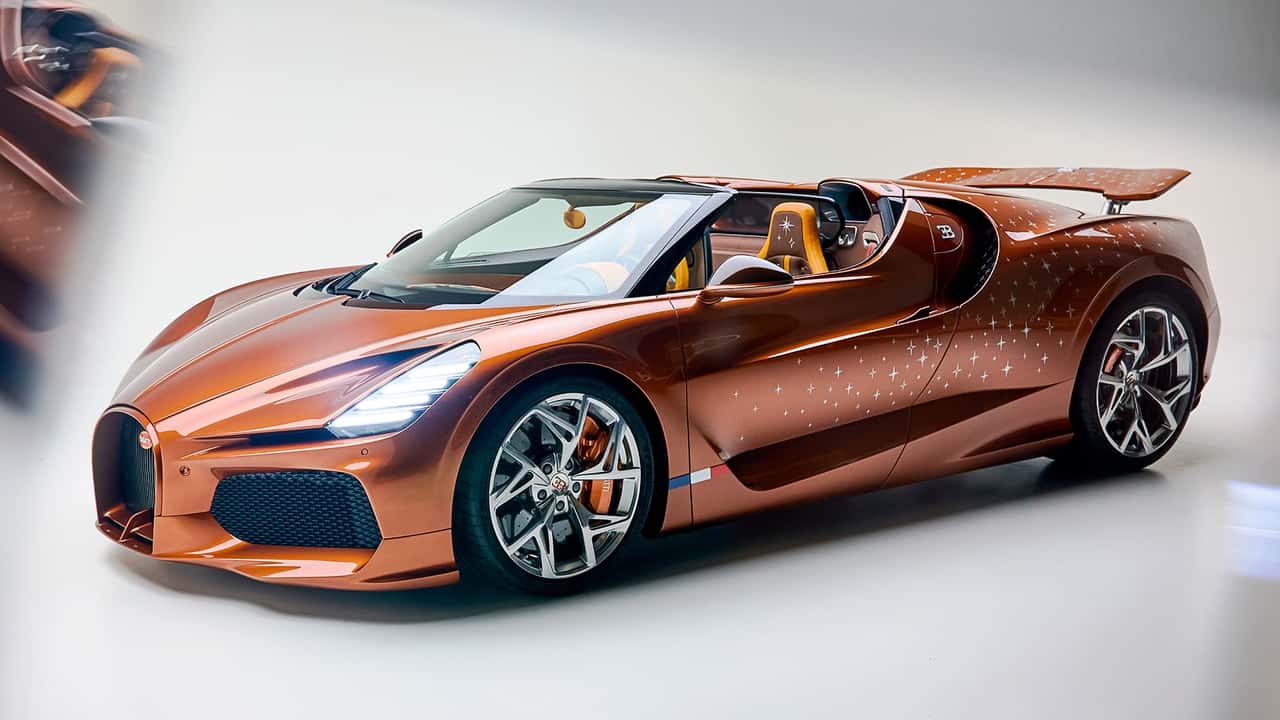


A silver rose sits encased in the gear shifter. It was 3D-scanned from a real flower, then faithfully recreated in precious metal. That single detail tells you everything about where Bugatti’s Sur Mesure program has landed — somewhere between coachbuilding and couture jewelry, with a children’s book as its muse.
The car is called “Le Retour du Jeune Prince,” and it’s a one-off W16 Mistral commissioned by a longtime Bugatti collector who also happens to be a writer. His own literary work continues the story of Antoine de Saint-Exupéry’s “The Little Prince,” and he wanted a car that reflected both the original tale and his personal connection to it. He walked into the Molsheim atelier in October 2023 and sat down with Jascha Straub, head of the bespoke division. What emerged is less an automobile and more a 1,600-horsepower illuminated manuscript.
The exterior wears a custom palette of copper and bronze that shifts under changing light, designed to mimic moonlight reflecting off the earth. The horseshoe grille was resculpted with new 3D lines that follow the hood’s flow. Brake calipers are finished in copper, and wheel centers carry color-matched “EB” emblems.
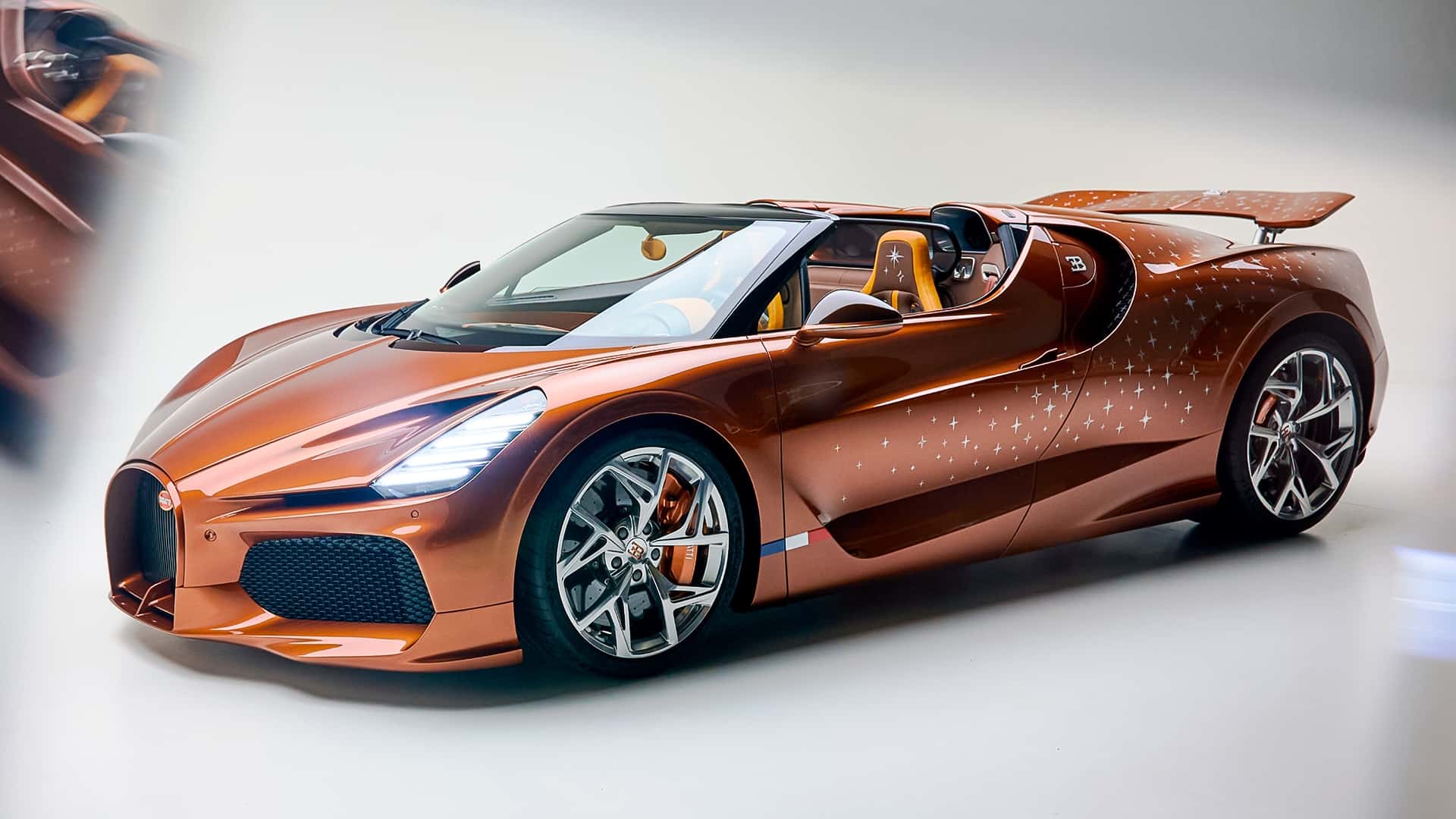
Then there’s the paint itself. On the rear quarters and atop the rear wing, individual silver stars were hand-painted into the finish through a painstaking layering process. It’s not a wrap. It’s not a decal. Each star was built up by hand.
When the active rear wing deploys — either at high speed or under heavy braking — a hidden scene on the wing’s underside reveals itself. It’s a reinterpretation of the prince meeting the fox, one of the book’s most iconic moments.
Pop the engine cover and you’ll find custom engravings of the story’s characters worked directly into the 8.0-liter W16. That engine, the last of its breed, still pushes 1,600 horsepower through a seven-speed dual-clutch gearbox to all four wheels. The Mistral was already limited to 99 units. This one stands alone.
Inside, two leather shades — “Terre d’Or” and “Driftwood” — divide the cabin between luminous beige and earthy brown. The moon is embroidered into the door panels, surrounded by star motifs that cascade across the cockpit to the headrests. The center console features exposed brown carbon fiber detailed with yet more stars.
And then there’s that shifter, with its impossible little rose, the symbol at the heart of the original story.
Bugatti’s design chief Sabine Consolini translated the collector’s narrative into the visual concept, and it shows a level of interpretive ambition that most automakers wouldn’t attempt. This isn’t a themed livery. It’s a car where every surface carries a reference, every material choice serves a story, and the engineering itself becomes a canvas.
The Mistral already represented an ending — the W16’s final bow after more than two decades of defining the hypercar class. Wrapping that farewell in a fable about loss, memory, and the things we hold precious is either the most sentimental thing Bugatti has ever done or the most commercially savvy. Probably both.
No price was disclosed, which in this world means the number would make you uncomfortable. The standard Mistral already commands north of $5 million. A one-off with this level of handwork, from the star-by-star paintwork to the silver-cast botanical jewelry in the console, exists in a category where cost simply isn’t part of the conversation.
What Bugatti has built here is a proof of concept for its Sur Mesure program — proof that if you arrive in Molsheim with a story and a checkbook, they will bind it in carbon fiber, stitch it into leather, and engineer it to do 249 miles per hour. Whether that’s art or excess depends entirely on how you feel about a children’s book riding shotgun in a quad-turbo hypercar.


Share this Story