
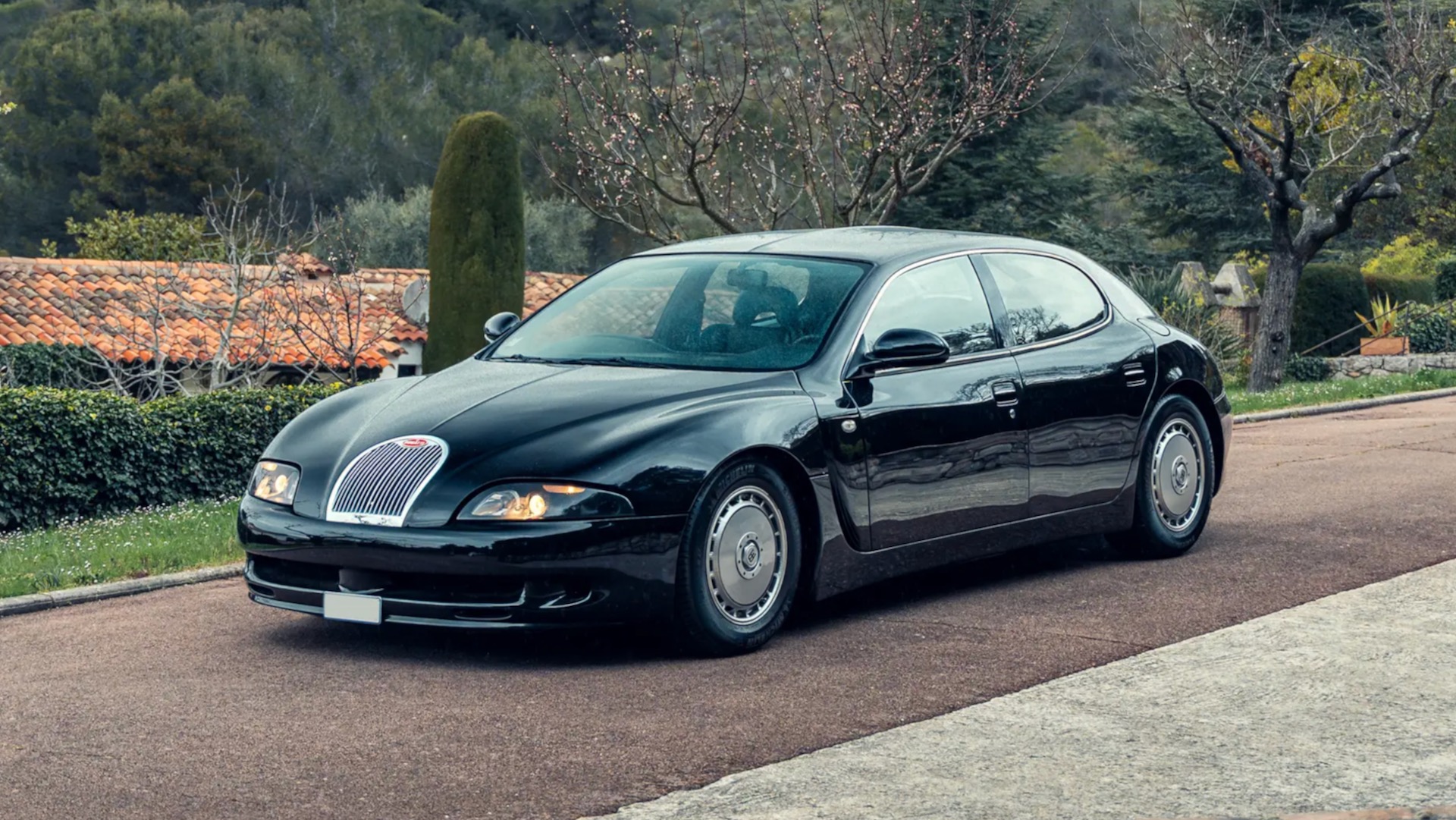


Romano Artioli’s 1990s Bugatti revival burned bright and fast. The EB110 supercar shocked the world, then the company collapsed in 1995, leaving behind a trail of unfinished ambition. The most tantalizing piece of wreckage: the EB112, a four-door luxury sedan that never made it to production.
One of just three examples ever assembled is heading to RM Sotheby’s Monaco auction on April 25, carrying an estimate of 1.5 to 2 million euros. That’s roughly $1.7 to $2.3 million — half the price of a new Bugatti Tourbillon, for a car that arguably tells a more interesting story.
The EB112 was Artioli’s attempt to do what Ettore Bugatti himself once did: build everything from race cars to limousines. Think of it as a spiritual successor to the Type 41 Royale, reimagined for the carbon-fiber age. Giorgetto Giugiaro penned the body, and unlike the EB110’s aggressively modern look, the sedan wore its heritage openly.
A full-size horseshoe grille. A split rear window nodding to the Type 57 Atlantic. Wheels inspired by the Royale’s alloys. Even the accompanying umbrella carried a miniature of Rembrandt Bugatti’s famous elephant sculpture as its handle.
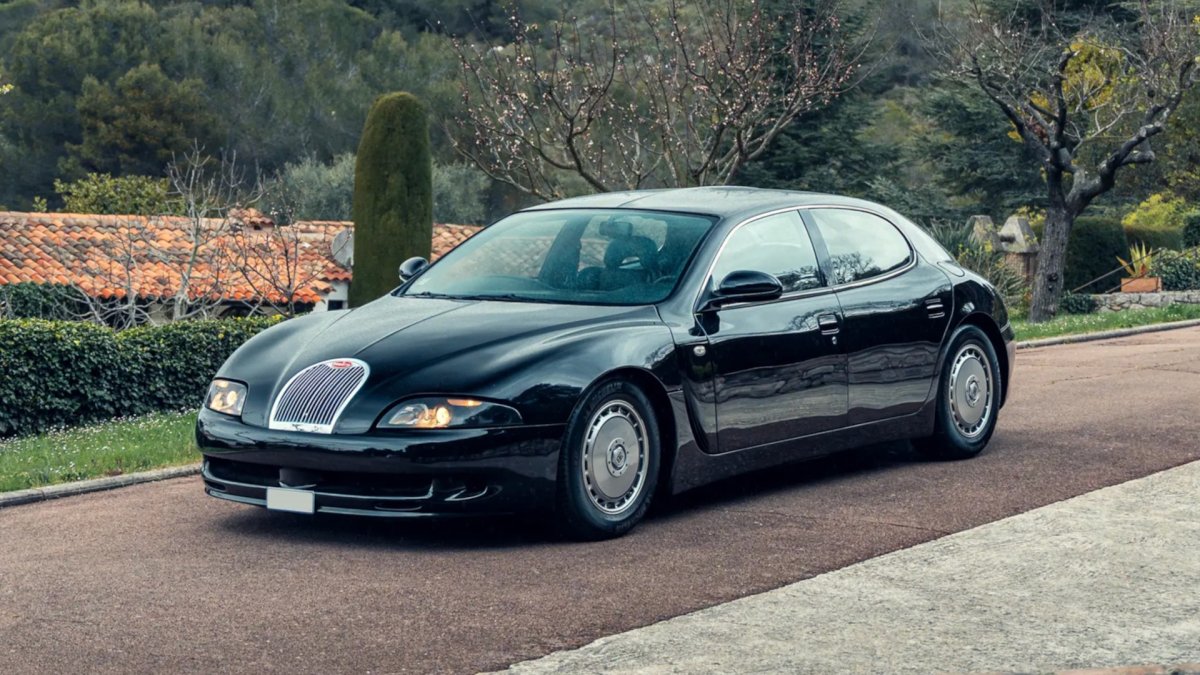
Underneath the elegant sheetmetal sat serious engineering. The carbon-fiber monocoque was derived from the EB110’s chassis, reworked to accept a front-mounted 6.0-liter naturally aspirated V12 producing 460 horsepower and 435 pound-feet of torque. A six-speed manual gearbox and all-wheel drive with a 38/62 front-rear torque split completed the package.
Bugatti claimed 0-62 mph in 4.3 seconds and a 186-mph top speed. For a leather-lined four-seater built in the early 1990s, those numbers were absurd. Artioli himself called it “an incredible car, a delight to drive” that handled “like a go-kart.”
The world never got the chance to verify that claim at scale. When Bugatti Automobili went bankrupt, only one drivable prototype and two styling models existed. Several partially completed chassis gathered dust.
Enter Gildo Pallanca Pastor, a Monegasque businessman who bought the company’s remaining assets primarily for EB110 racing spares. He got the unfinished EB112 components as part of the deal and eventually had two complete cars built from that cache.
This auction lot is the second of Pastor’s two cars, which is why it carries a 1999 build date despite the company having died four years earlier. Pastor kept it registered in Monaco, drove it occasionally through the Principality’s streets, and parted with it in 2015. The odometer reads just 388 kilometers — about 241 miles.
The current owner spent over €37,000 on a thorough mechanical overhaul in 2021 and 2022, covering brakes, suspension, catalytic converters, tires, and a separate engine rebuild. The provenance is airtight: two owners from new, service documentation on file, and a display stint at the Schlumpf Collection in the mid-2000s.
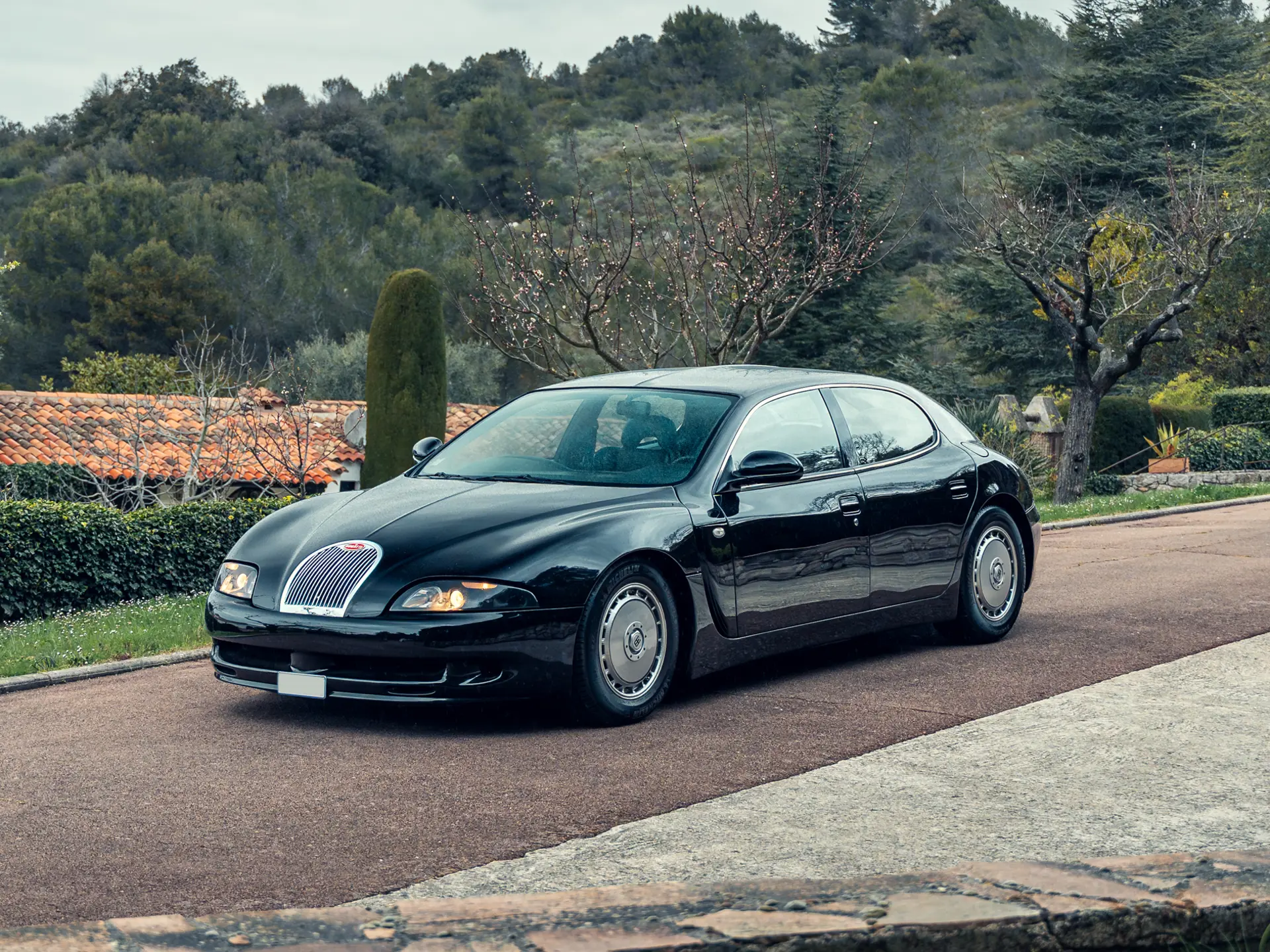
Of the three EB112s in existence, the Geneva show prototype lives in ItalDesign’s collection and the first Pastor-completed car sits in private hands. This is the only one likely to surface publicly anytime soon.
Here’s the quietly damning detail buried in this story. Volkswagen Group bought Bugatti’s name, poured billions into the Veyron and Chiron programs, commissioned Giugiaro to sketch the EB218 concept, and developed the 16C Galibier sedan study. None of it led to a production four-door.
The largest automotive conglomerate in Europe couldn’t finish what a small Italian entrepreneur started — and what a Monegasque racing enthusiast assembled from leftover parts in a garage. The EB112 remains the only modern Bugatti sedan ever completed. Three decades on, it still has no successor, and that tells you everything about how hard it is to build a car like this.



Share this Story