
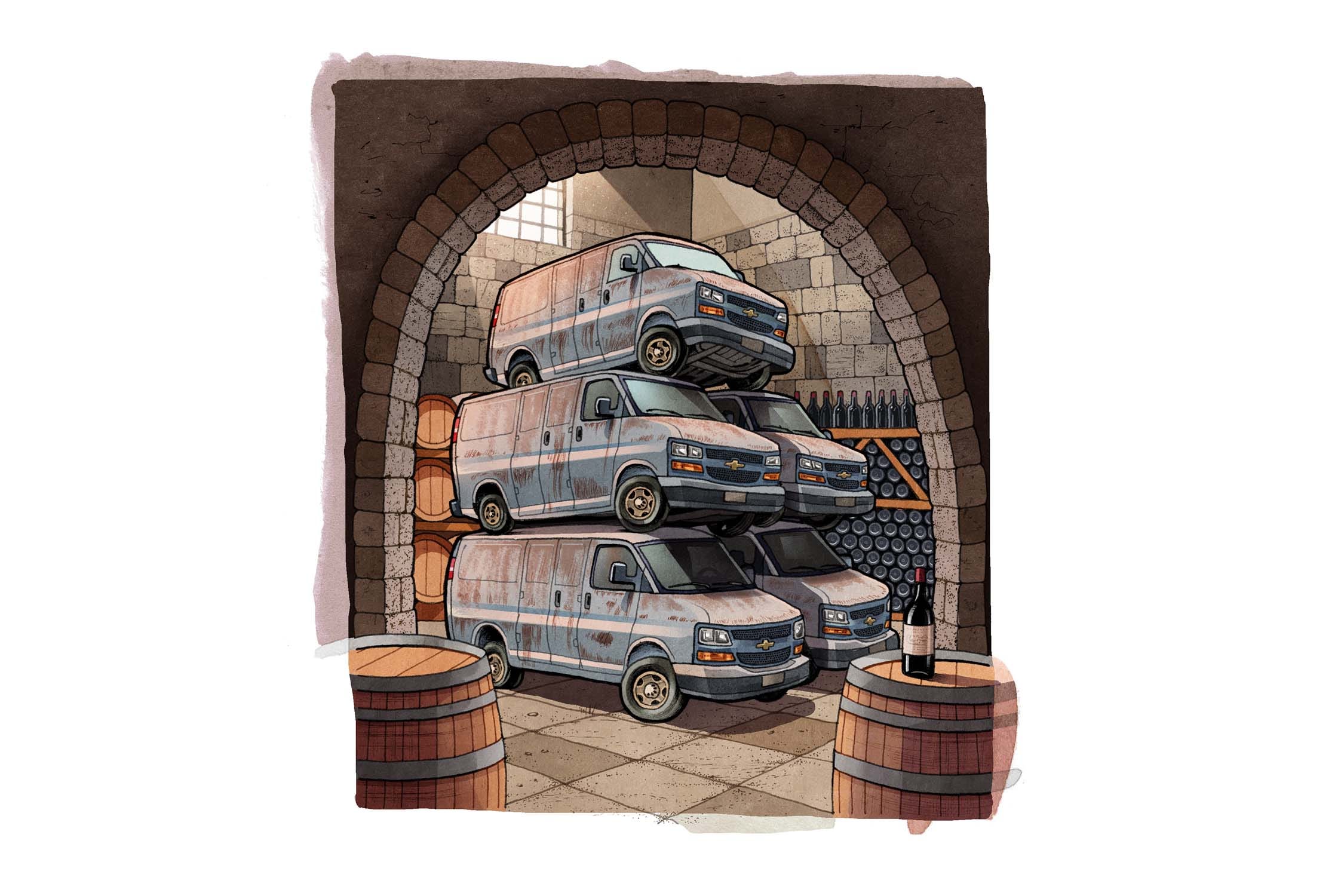


A 2022 Chevy Express 2500 still comes with a physical key, HVAC knobs connected to what one owner describes as feeling like “a distant bowl of pudding via frayed bungee cords,” and a standard equipment list that proudly includes “trim panels” — no adjective, no qualifier, just trim panels. It has been in production, fundamentally unchanged, for 30 years.
This is not a nostalgia story. This is a survival story.
The Express was supposed to be dead by now. General Motors had its replacement lined up: BrightDrop, the electric commercial van division that was going to drag GM’s fleet business into the future. BrightDrop launched with fanfare, secured a massive FedEx order, and positioned itself as the answer to an electrified last-mile delivery world.
Then GM killed it. The vans didn’t sell in volume. The economics didn’t pencil. The future blinked.
And the Express, with its body-on-frame architecture dating to the Clinton administration, just kept rolling off the line in Wentzville, Missouri.
More than three million Expresses and their GMC Savana twins have been sold. That volume, accumulated over three decades with virtually zero advertising spend, tells you everything about what commercial buyers actually want versus what corporate strategists think they should want.
The diesel version is particularly telling. The current 2.8-liter Duramax four-cylinder makes 181 horsepower and 369 pound-feet of torque, modest numbers for a van rated at 8,600 pounds gross vehicle weight. But it returns 22 mpg in real-world use.
When the Express debuted in 1996, its available diesel was a 6.5-liter V-8 making just 190 horsepower. Three decades of progress netted nine fewer horsepower from less than half the displacement and dramatically better fuel economy. That’s the kind of incremental improvement that doesn’t make press releases but keeps accountants happy.
For buyers who want theater, there’s a 401-horsepower 6.6-liter gas V-8 option. For buyers who want to move product from warehouse to restaurant without thinking about the van at all, there’s the diesel. The latter is so rare that when one journalist’s friend went looking, he found exactly one for sale within 200 miles.
The Express’s longevity puts it in rare company. The air-cooled Porsche 911 survived the 928. The Mustang outlasted the Probe. In each case, the corporate successor — sleeker, more advanced, more “correct” by the engineering metrics of the moment — failed to dislodge a product whose core appeal was never about sophistication.
GM doesn’t even bother listing creature comforts on the Express spec sheet because there effectively aren’t any. The bumpers are described as “front and rear, black.” The steering wheel is urethane.
The gap between the passenger compartment and cargo bay is wide enough to snake a vacuum hose through, which has proven useful for fishing out locked-in keys. This is not a vehicle designed to impress. It is a vehicle designed to be ignored, in the best possible sense.
The BrightDrop debacle exposed a fundamental miscalculation that extends well beyond GM. Automakers have spent the last five years telling commercial fleet operators that electrification is inevitable and imminent. Fleet operators, who answer to spreadsheets rather than sentiment, looked at charging infrastructure, uptime requirements, and total cost of ownership and kept ordering Expresses.
Chevy doesn’t advertise the Express because it doesn’t need to. The van sells itself to people who buy vehicles the way they buy paper towels — on function, price, and availability. No configurator. No lifestyle branding. No Super Bowl spot.
Thirty years without a redesign isn’t a failure of imagination. It’s a market verdict, rendered millions of times over, that the most sophisticated product doesn’t always win. Sometimes the one that just works does.

Share this Story