
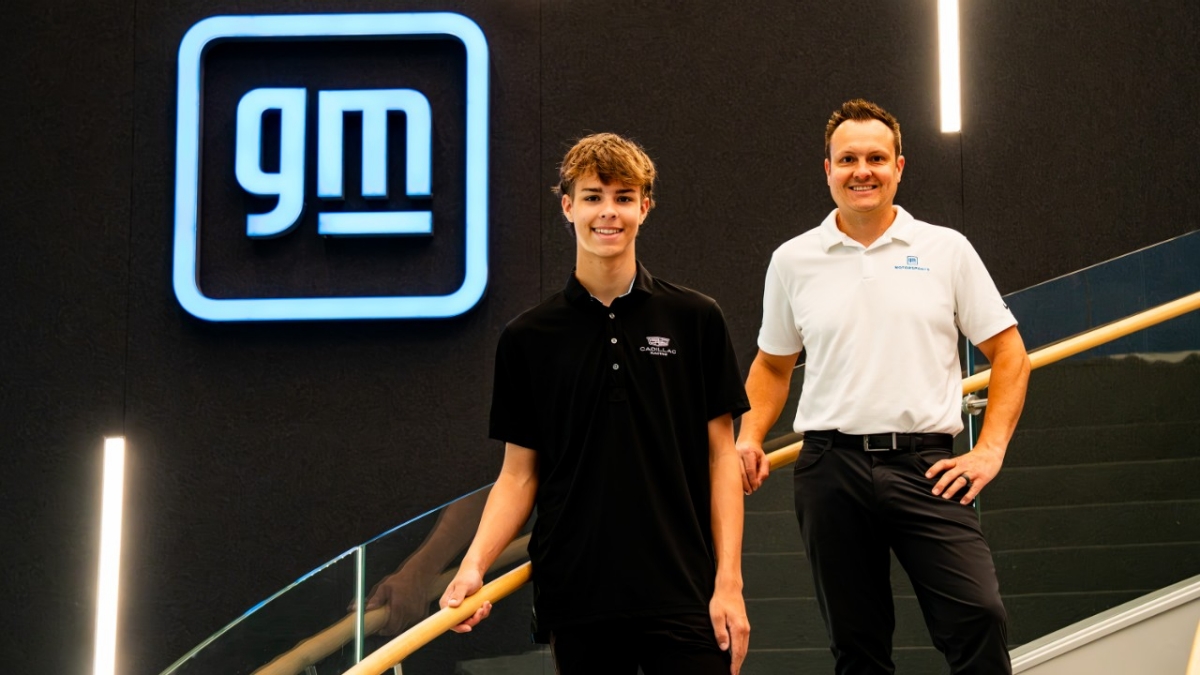


Aiden Price was 14 years old and sitting in class when his father’s boss called with a question that sounds like fiction: Could the kid skip school to audition as a simulator driver for the Cadillac Formula 1 Team?
Within 15 minutes of climbing into the driver-in-the-loop simulator at GM’s Charlotte Technical Center, the team had its answer. They asked him to come back the next day. Now 15, Aiden is enrolled in online high school and running virtual laps alongside Indianapolis 500 winner Simon Pagenaud and former F1 driver Pietro Fittipaldi.
His father, Greg Price, is GM Motorsports’ Design and Manufacturing Manager. The elder Price oversees the physical components that make up the Cadillac MAC-26 F1 car. His son tests those components in the digital world before they exist in the real one. The two sometimes pass each other in the halls of the Charlotte facility without stopping.
This isn’t a feel-good corporate anecdote. It’s a window into how the newest team on the Formula 1 grid is trying to close the gap on operations that have been doing this for decades.
Formula 1 restricts official practice to roughly three hours at each track before race day, even less during Sprint weekends. Testing outside Grand Prix events is tightly regulated. For an 11th team with zero institutional knowledge of these circuits, simulator time isn’t a luxury. It’s oxygen.
That’s how the Cadillac MAC-26 Formula 1 car was developed,” Greg Price said. “Every single detail was built in simulation, and from there, it went to the UK to be manufactured.”
Aiden earned his spot through an unusual resume. Multiple wins in micro sprints — small open-wheel cars racing on short ovals — plus serious credibility on iRacing, where he had a side hustle selling car setups to other drivers. The kid understood the mechanical cause-and-effect relationship that defines race engineering before he ever set foot inside GM’s simulator.
The crossover between real-world feel and virtual precision matters more than outsiders might think. Modern F1 cars offer drivers a dizzying array of cockpit adjustments that dramatically alter handling characteristics. Engineers behind the glass have even more variables to manipulate. Aiden admits the learning curve was steep.
“It took me a long time to learn what everything did,” he said, “but once you understand it all, it makes sense.”
The father-son pipeline proved its worth ahead of the 2026 Miami Grand Prix. Aiden was testing a suspension upgrade in the simulator when Matt Borland, Cadillac’s Director of Motorsport Competition Programs, called Greg at home. The virtual data showed clear improvement. Could the physical parts be manufactured and flown to Miami by morning?
Greg got it done. He landed with the new components as the team arrived at the circuit. Parts that his teenage son helped validate in a simulator one evening were bolted onto an F1 car the next day.
Beyond Formula 1, Aiden has logged simulator hours for Cadillac’s LMDh prototype program and Chevrolet’s IndyCar effort. GM is using him as a connective thread across its entire motorsport operation — NASCAR, IndyCar, sports cars, and now F1 — sharing data and development insights between programs that historically operated in silos.
“All these different groups at GM come together and correlate,” Aiden said. “Everything that we do all ties together.”
Cadillac debuted in F1 at the Australian Grand Prix in March. The team spent the prior year using the simulator not just for car development but to rehearse the complex choreography of race-weekend strategy — pit calls, tire management, the dozens of real-time decisions that separate competent teams from chaotic ones.
The story of a teenager leaving algebra class to drive a virtual F1 car is charming. But underneath it sits a harder truth about Cadillac’s position: the team is building everything from scratch, under crushing time pressure, against rivals with half a century of experience. They need every edge they can find, even if that edge is a 15-year-old kid who learned car setup selling iRacing configurations online.
Sometimes the most revealing thing about an organization isn’t who sits at the top. It’s who they’re willing to put in the seat.


Share this Story