
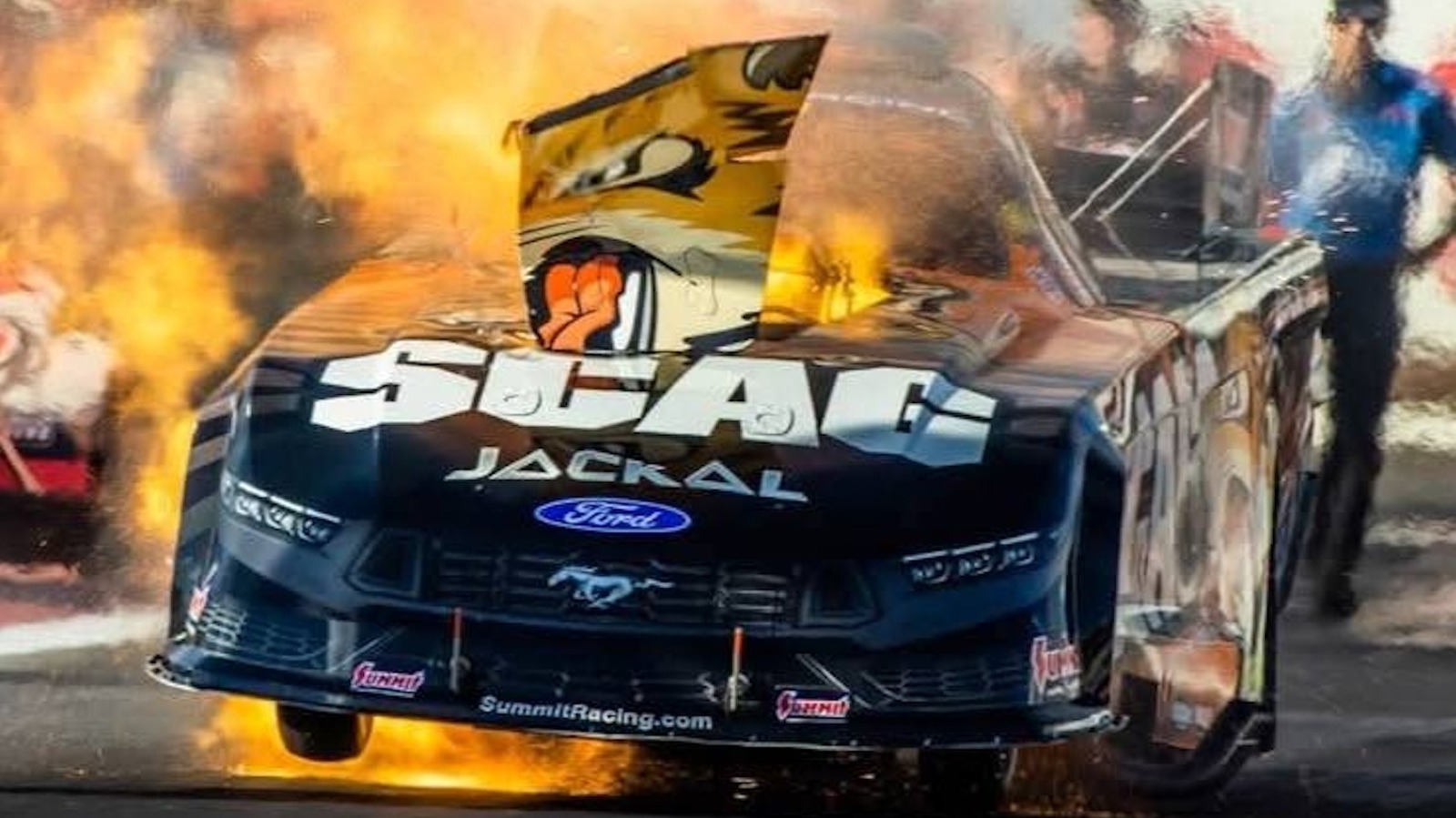


Dan Wilkerson’s funny car engine exploded during a run. His father Tim, who owns the team, was thrilled. Not because of the blast itself, but because the body survived it — and that almost never happens.
The Wilkerson family has been quietly engineering deliberate weak points into their funny car body, designing specific components to fail first and channel explosive energy away from the driver. When the engine let go, those modifications worked. The body didn’t shred. It didn’t deform beyond repair.
Tim Wilkerson told Competition Plus he could have patched it trackside and run it again that same weekend. That’s remarkable, because funny car engine explosions are among the most violent events in motorsport. Thousands of horsepower detonating under a fiberglass shell creates forces that can’t be replicated in a lab.
You only learn what works when something goes wrong at 300 mph.
The backstory here is critical. In 2013, Robert Hight’s funny car body ripped free and landed in the grandstands. The NHRA responded by mandating stronger latches and tethers to keep bodies pinned to the chassis.
Smart move for spectators. Dangerous trade-off for drivers.
Dan Wilkerson laid out the physics to Autoweek last year in terms anyone can understand. A firecracker in an open hand burns you. A firecracker in a closed fist takes your fingers off. Bolting the body down tighter means all that explosive force stays trapped in the cockpit, hammering the driver with a concussive blast that defies description.
The firewall gets shoved toward the driver’s face. Visibility goes to zero.
This is exactly what happened to John Force in 2024. The drag racing legend suffered a traumatic brain injury that ended his career. Force was 75 years old and still competing at the top level when an engine explosion inside a tethered-down body delivered the kind of hit no human skull can absorb forever.
Tim Wilkerson watched all of this unfold and decided the engineering had to get smarter. His solution borrows from one of the oldest principles in automotive safety: the crumple zone. Design something to break on purpose, in a controlled way, so the thing you care about — the driver — doesn’t break instead.
He built a revised burst panel that releases energy more efficiently, functioning like a pressure relief valve for an explosion. He also wanted to weaken the front body latches so they’d give way in a controlled failure sequence, absorbing additional force. The NHRA wouldn’t allow the latch modification, but the burst panel alone proved the concept works.
The sanctioning body is now working with Wilkerson to refine the design within its rulebook. That collaboration matters more than any single race result.
The NHRA has historically been conservative about body-retention rules, and for understandable reasons — nobody wants carbon fiber in the cheap seats. But the Wilkerson explosion demonstrated that you can protect spectators and drivers at the same time if you’re willing to think about failure as a feature rather than a catastrophe.
Funny car racing will always be violent. Eight thousand horsepower strapped to a rail chassis under a body that weighs less than a refrigerator is never going to be gentle. But the gap between “spectacular explosion” and “career-ending injury” can be widened with smart engineering.
Tim Wilkerson just proved it with a bang.


Share this Story