
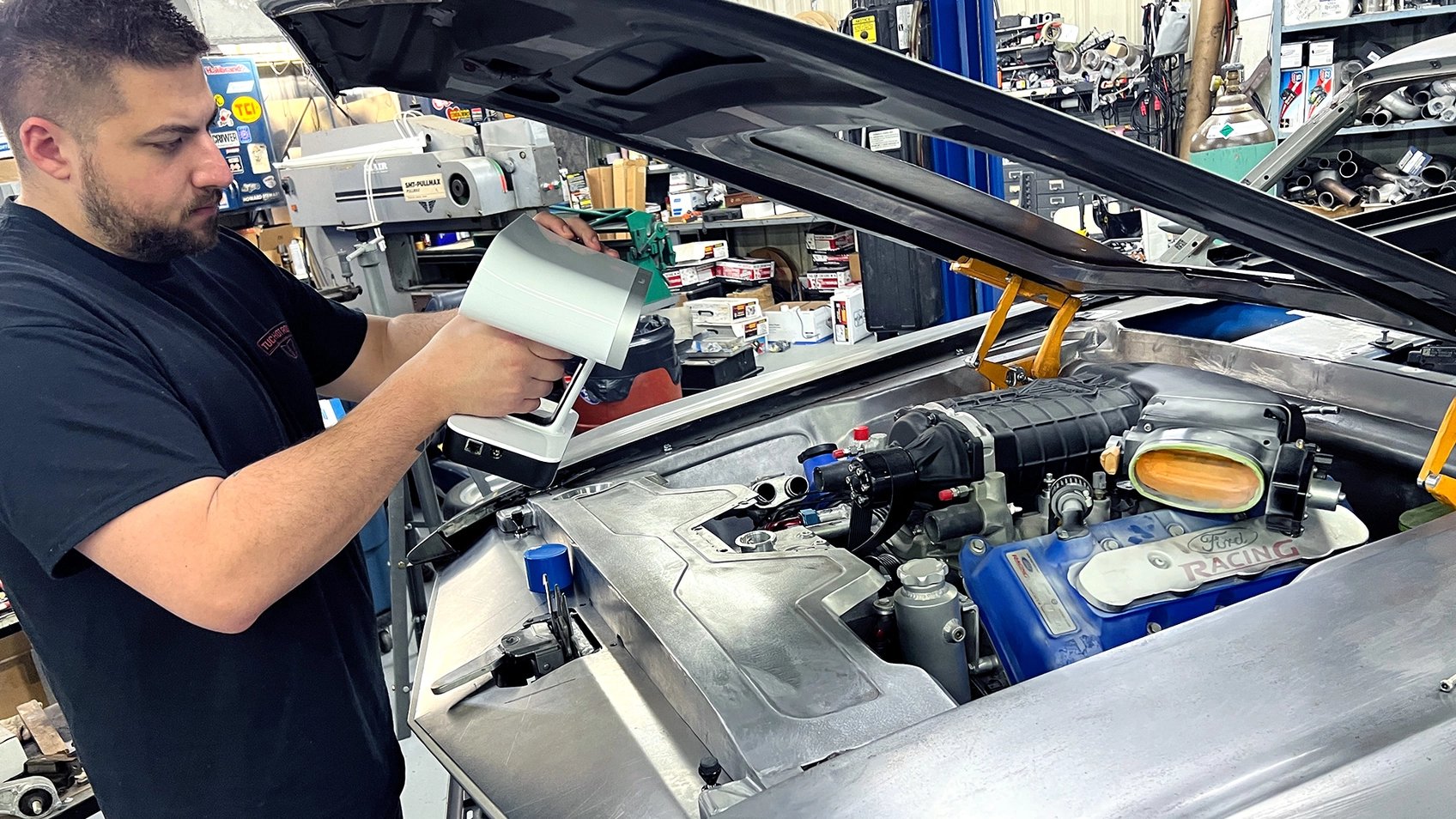


A quarter inch. That’s how far off the headlight covers kept landing on a 1936 Dodge grille when Tucci Hot Rods measured things the old-fashioned way. Cardboard templates, prototype prints, test fits, adjustments, more prints. Three to four days of back and forth for a single part. Now it takes 15 minutes.
The Marcy, New York shop — the same one that built the slammed Ford Maverick SEMA concept that helped ignite the modern street truck craze and influenced Ford’s own Maverick Lobo — has integrated an Artec Leo 3D scanner into its workflow. It’s a handheld unit that captures precise dimensional data from physical objects, feeding it directly into design software. For a shop that regularly 3D prints headlight lenses, taillight lenses, vents, and trim pieces across builds spanning nearly a century of automotive history, the scanner eliminated the most tedious bottleneck in the process.
“We used a lot of cardboard, and there was a lot of printing prototype pieces, seeing what fit, making changes, printing new ones,” said Dominick Tucci, a designer at the shop and son of founders Dave Jr. and Jill Tucci. The old method worked. It just ate time alive.
The scanner has already proven itself on real builds. For a 1931 Ford Model A project, the team needed to design custom motor mounts for a modern engine swap. Instead of measuring frame rails by hand, they dropped the new engine between them and scanned the entire assembly. The software captured every surface, every gap, every angle — data that would have taken hours to collect with calipers and tape measures.
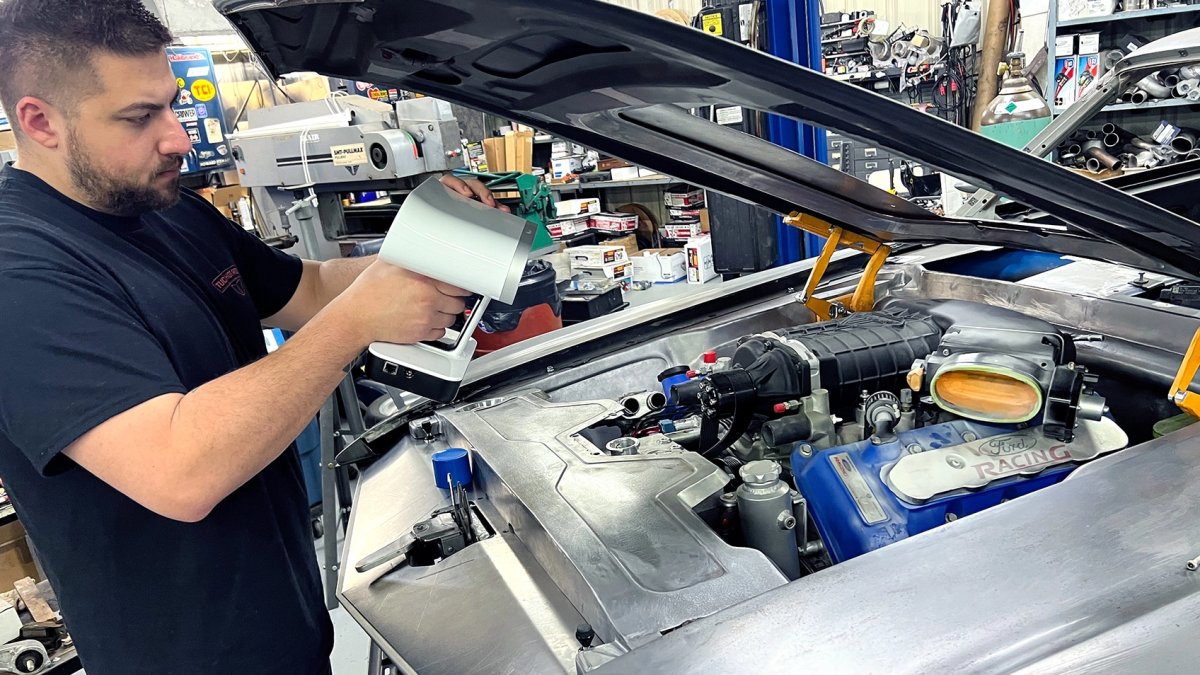
Then there was that 1936 Dodge grille. The complex curves of prewar sheetmetal are notoriously difficult to template by hand. Every printed prototype came back a quarter inch off in one direction or another. The scanner nailed it.
This is the quiet revolution happening in small shops across the country. Not breathless hype cycles, not autonomous driving promises that never quite arrive on schedule, but practical tools solving practical problems for people who actually build things with their hands. A 3D scanner doesn’t replace the fabricator’s skill. It replaces the cardboard.
Tucci Hot Rods is era-agnostic by design. The shop works on brand-new trucks and prewar iron with equal enthusiasm. That range makes dimensional accuracy even more critical — a bespoke part for a 93-year-old Ford demands the same precision as one for a current-generation Maverick, but the reference materials are vastly different.
Factory CAD data exists for new vehicles. For a 1931 Model A, you’re working with whatever is sitting in front of you, warps and all.
The cost of professional-grade 3D scanners has dropped enough that independent shops can justify the investment, especially when it collapses a four-day measurement cycle into a quarter hour. That math works whether you’re building one car a year or twenty.
Hot rodding has always been about using whatever tools and technology exist to make a car do something it wasn’t designed to do. Flathead Ford guys in the 1940s weren’t purists — they were innovators scrounging military surplus parts. The tools change. The instinct doesn’t. A scanner in 2025 serves the same purpose as a cutting torch in 1950: get the job done faster, get it done right, move on to the next build.

Share this Story