
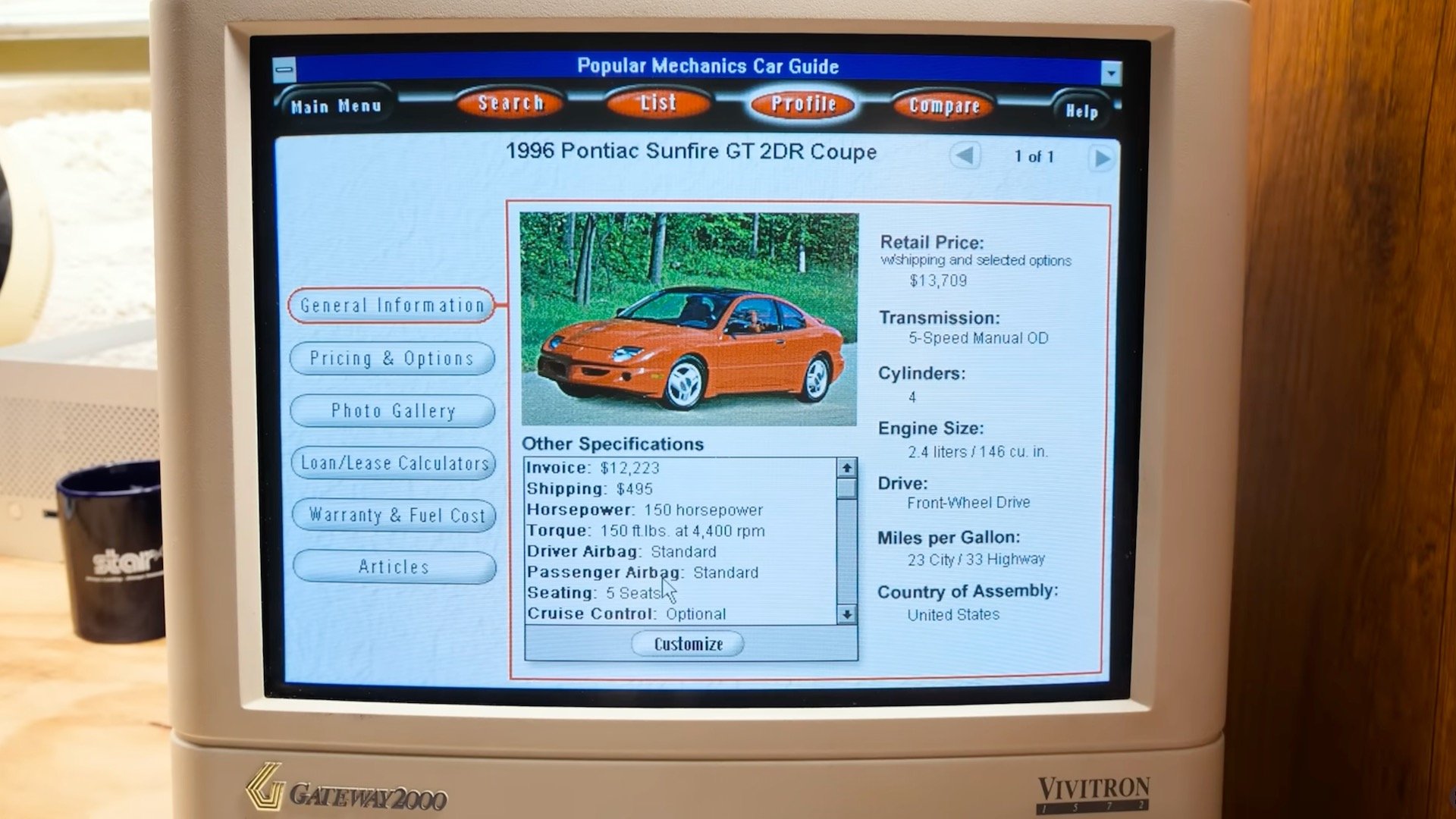


Thirty years ago, Popular Mechanics burned a car-buying guide onto a CD-ROM that let anyone browse, compare, and price out every new vehicle on sale in America. No internet required. No pop-ups begging you to “chat with a specialist.” No lead-generation forms masquerading as helpful tools.
A recent YouTube video from the channel LGR Blerbs walked through the disc in detail, and watching it is an exercise in quiet frustration. The 1996 Car Guide, designed for Windows 3.1, does things that most modern automaker websites and third-party buying guides still struggle with, or actively refuse to do.
The interface is simple. A dropdown menu lists every model and every trim level. Click on one, and you get a clean landing page showing the price including destination charges, powertrain specs, fuel economy, and whether key features like cruise control, air conditioning, and airbags were standard or optional.
That last detail mattered in 1996, when dual front airbags weren’t yet federally mandated for all vehicles and central locking was still considered a luxury on some trims.
From there, you could pull up the full options list, price out a build, and see the car rendered in every available paint color. Some unavailable ones too, apparently. The 1996 Pontiac Sunfire almost certainly never left the factory in a full-body woodgrain wrap, but the CD let you dream.
A comparison tool allowed side-by-side evaluation of specs and features across different models. A fuel cost calculator let you plug in your weekly mileage and local gas prices. The default was $1.25 per gallon.
Even a used car section offered value estimates based on mileage, functioning like a primitive but honest ancestor of today’s valuation tools.
Try doing any of this on a modern automaker configurator. Half of them won’t show you a window sticker. Some bury the engine specs three clicks deep or hide them behind a “build and price” flow designed not to inform you but to harvest your contact information.
Third-party sites are worse, layering every page with dealer ads, financing come-ons, and prompts to submit your phone number before you can see an out-the-door estimate.
The 1996 CD-ROM had none of that because it didn’t need to. It was a product you bought, not a funnel engineered to convert you into a sales lead. The information was the point, not the bait.
That distinction explains why a piece of software designed for a 66 MHz processor with 8 megabytes of RAM can feel more useful than a website running on modern broadband. The technology has improved by orders of magnitude. The incentives have not.
Every major car-shopping platform today is built around advertising revenue and dealer referral fees, which means the user experience will always be subordinate to the business model.
Popular Mechanics figured out car shopping in 1996 with a plastic disc and a sensible layout. The auto industry’s digital apparatus, three decades and billions of dollars later, still can’t match it.
The Viper with yellow wheels on the cover is just salt in the wound.



Share this Story