
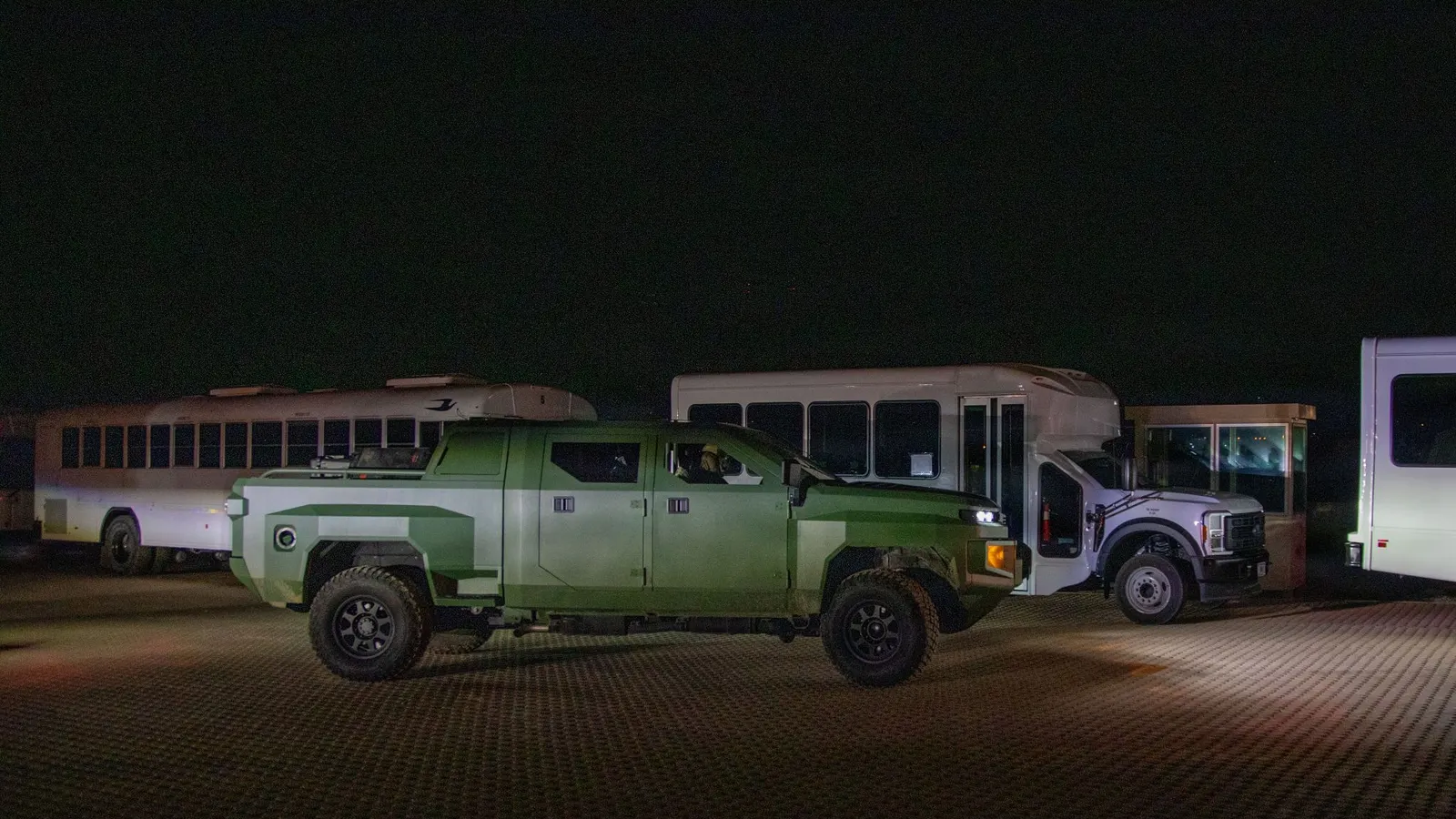


The U.S. Army quietly awarded prototype contracts to Ford, General Motors, and BC Customs on June 30, setting up a three-way brawl over a deal to build more than 600 Heavy Infantry Squad Vehicles. The winner walks away with a contract the Army expects to exceed $1 billion.
Each company must deliver three prototypes by March 30, 2027. The specs are demanding but telling: the ISV-H must travel 62 miles in eight hours on a tank just three-quarters full. The Army also baked in right-to-repair and data provisions, a pointed requirement in an era when manufacturers increasingly lock down vehicle software and diagnostics.
Ford is running its prototype through Industrial Platform, the defense subsidiary it stood up to chase exactly this kind of work. The truck will be based on the Super Duty platform. CEO James Farley mentioned the contract during an earnings call Tuesday but kept details tight.
“We do believe we have a lot to offer, but we’ll think through this as an adjacency,” Farley said. “It has to be a strong business with really good returns and really good capital returns.”
Translation: Ford wants Pentagon money, but not at Pentagon margins.
GM is playing a louder hand. The company paired up with Lockheed Martin in June to jointly strengthen domestic defense manufacturing. Lockheed CEO James Taiclet framed the partnership as a way to plug into the auto industry’s speed and supply chain muscle.
Mary Barra went further during GM’s July 21 earnings call, projecting GM Defense revenue near $700 million in 2026 with a compound annual growth rate above 30% over the next several years, at double-digit margins. That projection includes the ISV-H award. The defense subsidiary is also working with the State Department, Secret Service, and allied governments in Canada, Qatar, and Brazil.
Then there is BC Customs, the smallest player in this fight. A specialty vehicle builder competing against two of the largest automakers on earth for a billion-dollar military contract. The Army clearly sees value in keeping the competition open, and BC Customs has built a reputation for rugged custom platforms, but prototyping three ISV-Hs and scaling to 600-plus units is a different kind of challenge entirely.
The broader context matters. President Trump pushed automakers toward defense work earlier this year, urging them to repurpose factory capacity for munitions production. Those conversations began before the Iran conflict escalated and have intensified since. A June meeting at the White House brought automakers back to the table to discuss weapons manufacturing, and the ISV-H competition is the most concrete outcome of that pressure so far.
GM is simultaneously trimming some legacy defense-adjacent holdings. It is selling HRL Laboratories, the research joint venture it shared with Boeing since Howard Hughes founded it in 1948, to IBM. That move signals GM wants to focus its defense spending on production contracts with clear revenue lines, not open-ended R&D.
The Army Test and Evaluation Command will put all nine prototypes through their paces after the March 2027 delivery. The selection timeline beyond that remains unclear. What is clear is that Detroit’s pivot toward defense contracting is no longer theoretical — it is a prototype competition with a delivery date, a budget line, and three companies that want to win it.

Share this Story