
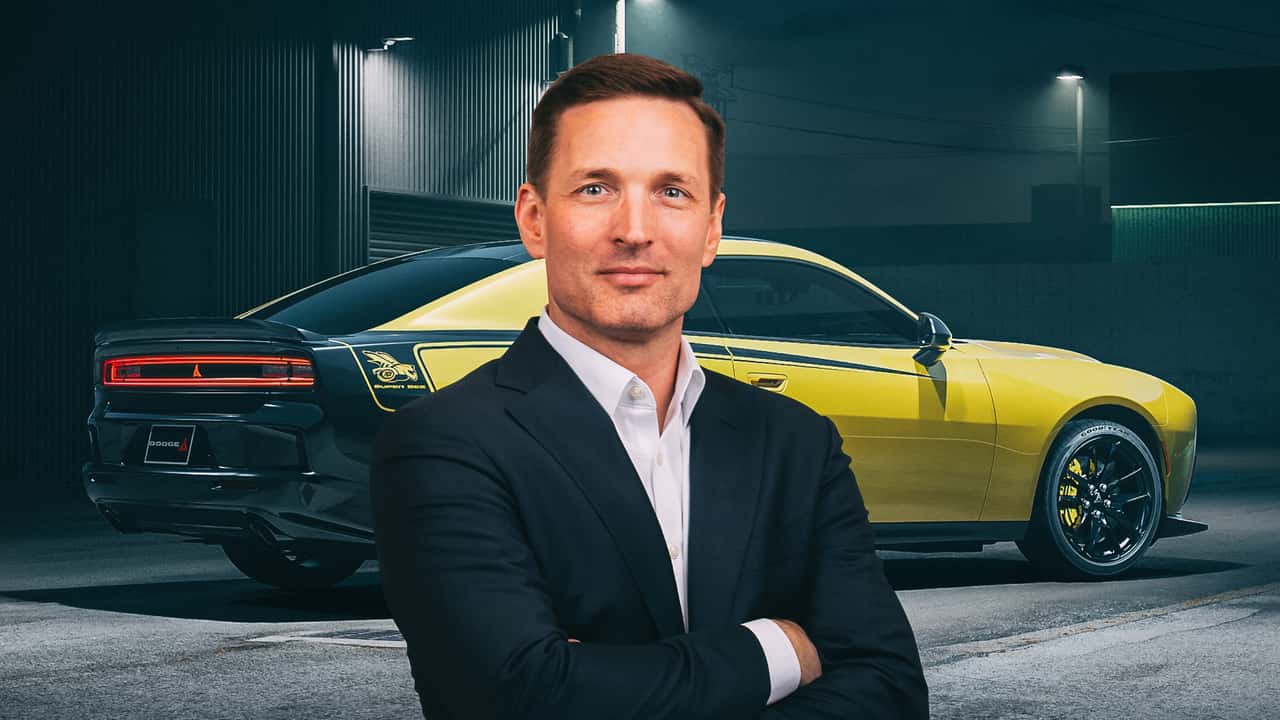


The 2027 Dodge Charger Super Bee makes 600 horsepower from a twin-turbocharged 3.0-liter inline-six. It is not a V8. And according to Dodge CEO Matt McAlear, it is not even close to the ceiling.
In an interview at the Super Bee’s reveal last week, McAlear laid out a roadmap that extends well beyond one hot Charger variant. The Super Bee launches as a limited-production 2027 model, then opens up to the masses for 2028. A smaller performance car called the GLH is coming, and SRT apparently has its own plans that nobody is talking about yet.
“Make no mistake, this isn’t the finish line,” McAlear said. “We’re going to go quicker. We’re going to go faster. We’re going to go bigger.”
That’s a lot of promise from a brand currently selling exactly two vehicles: the Charger and a Durango that turned 16 this year.
The Super Bee itself represents more than a simple power bump over the 550-hp Sixpack. Dodge reworked the cooling system with additional auxiliary radiators and optimized the heat exchangers, intercoolers, and fans for sustained track use. Larger brakes went on, aerodynamics were refined, and all-wheel drive is standard with a rear-drive mode available at the push of a button.
McAlear was candid about the car’s weight. “They’re large cars. They’re heavy cars. No denying it,” he said. But the engineering work, he argued, was meant to show what the platform can handle when the team pushes hard. This was about lap-after-lap cooling, not just quarter-mile bragging rights.
The GLH fills a gap Dodge desperately needs filled. McAlear described it as targeting the “sedan, hot-hatch-type market,” with a lower entry price than the Charger, which starts at $51,990 for the R/T coupe before you add a single option. An SRT version of the GLH is already confirmed, though details remain scarce.
McAlear drew a line in the sand about what Dodge won’t do with the GLH. “We’re not going to just enter a segment with a commoditized product,” he said. “If we go in, we’re going in with the full mindset of having best-in-class performance and capability.”
That’s the kind of talk that sounds great at a reveal event but gets tested hard in showrooms where buyers cross-shop a Golf R, a Civic Type R, and a GR Corolla. All of those cars have years of credibility baked in. The GLH nameplate carries nostalgic weight from the old Omni days, but nostalgia doesn’t win comparison tests.
Then there’s the elephant nobody at Dodge will address directly: the V8. McAlear wouldn’t say when or if a Hemi-powered Charger might arrive. Stellantis’ FaSTLAne 2030 roadmap mentions a Charger SRT in development, but the company hasn’t confirmed its powertrain.
For a brand built on the visceral appeal of big displacement and loud pipes, the silence on that front says something. Whether it says “patience” or “pivot” depends on who you ask.
What Dodge has done is bet heavily on a turbocharged six-cylinder architecture and dared its customer base to follow. The Super Bee is the proof of concept, a 600-hp statement that the I-6 can deliver serious numbers. Whether the faithful buy in at volume is a different question entirely.
McAlear’s confidence is clear and his product pipeline is filling out. But Dodge is still a two-car brand leaning on the promise of what comes next, and the next move from SRT remains behind closed doors.

Share this Story