
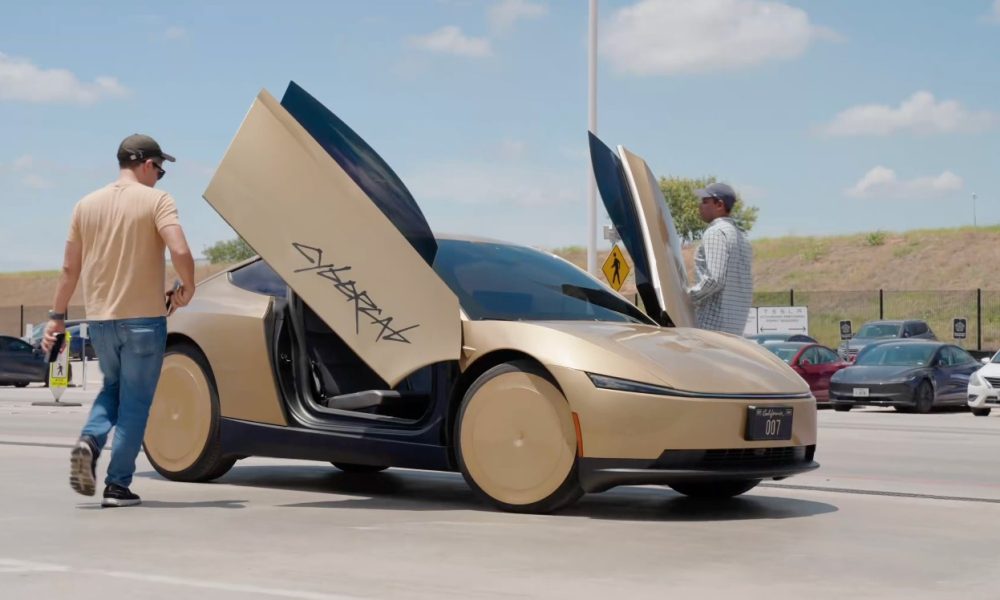


Florida Governor Ron DeSantis climbed into a gold Tesla Cybercab this week at a state-owned test track, sat in a cabin with no steering wheel and no pedals, and watched the vehicle dodge a kid darting into the road, a staged crash with police stopping traffic, and a Model S cutting it off. He called the ride “impressive.”
The demo took place Monday at SunTrax, a 775-acre proving ground in Auburndale that Florida built specifically to test autonomous and connected vehicles before they touch public pavement. The facility’s 2.25-mile oval can simulate rain, pedestrian crossings, hills, and congested urban conditions at highway speed. Tesla, Waymo, and Beep all use it.
DeSantis kept his summary simple. “You go in there and you just sit. You have a screen. There’s no steering wheel, no pedals. Clearly these things could be very beneficial.” He also added the qualifier every politician reaches for when cameras are running near experimental technology: “You don’t want to be in an autonomous vehicle and it drives you into a ditch.
What makes the photo op matter isn’t the governor’s enthusiasm. It’s the backdrop.
Florida’s regulatory framework for autonomous vehicles is among the loosest in the country. The state does not require a human operator inside a fully autonomous car. That puts it in direct contrast with most of the country, where permitting remains cautious, contested, or simply nonexistent.
Tesla has been moving fast to exploit that opening. The company started volume production of the Cybercab at Gigafactory Texas this spring and self-certified the vehicle as SAE Level 4 under Texas law. But its public road testing in Texas still keeps a safety monitor in the passenger seat.
Florida is the state where Tesla has chosen to expand its existing Model Y-based Robotaxi service aggressively, adding Miami in July and then Orlando and Tampa just two weeks later.
A closed-track ride with a governor changes no regulations and grants no new permits. DeSantis did not announce any policy shift, any new testing authorization, or any timeline for Cybercabs on Florida streets. What he did was stand next to the vehicle and praise it on camera in a state that has already signaled it will move faster than its peers.
The Cybercab itself is advancing on a separate track entirely. Tesla confirmed in July that every unit will ship with a Starlink V5 terminal built into the roof, the first satellite hardware in any Tesla production vehicle. The company’s head of AI, Ashok Elluswamy, clarified that the driving stack runs entirely on onboard cameras and compute.
The Starlink connection handles navigation, fleet management, customer service, and, according to Elon Musk, 4K video streaming for passengers. Musk has since said Starlink will eventually extend across Tesla’s full lineup, framing satellite connectivity not as a Cybercab novelty but as a requirement driven by the bandwidth demands of AI systems.
None of that changes the central tension around the Cybercab. The hardware is in production. The software is being tested with safety monitors still present.
The regulatory map is fractured, with a handful of states racing to accommodate the technology and most of the country watching from a distance. Florida wants to be first. DeSantis made that clear without saying it directly.
The question is whether Tesla’s technology is ready to reward that eagerness, or whether a closed-track demo and a governor’s tweet are still the safest version of this story anyone can tell.

Share this Story