
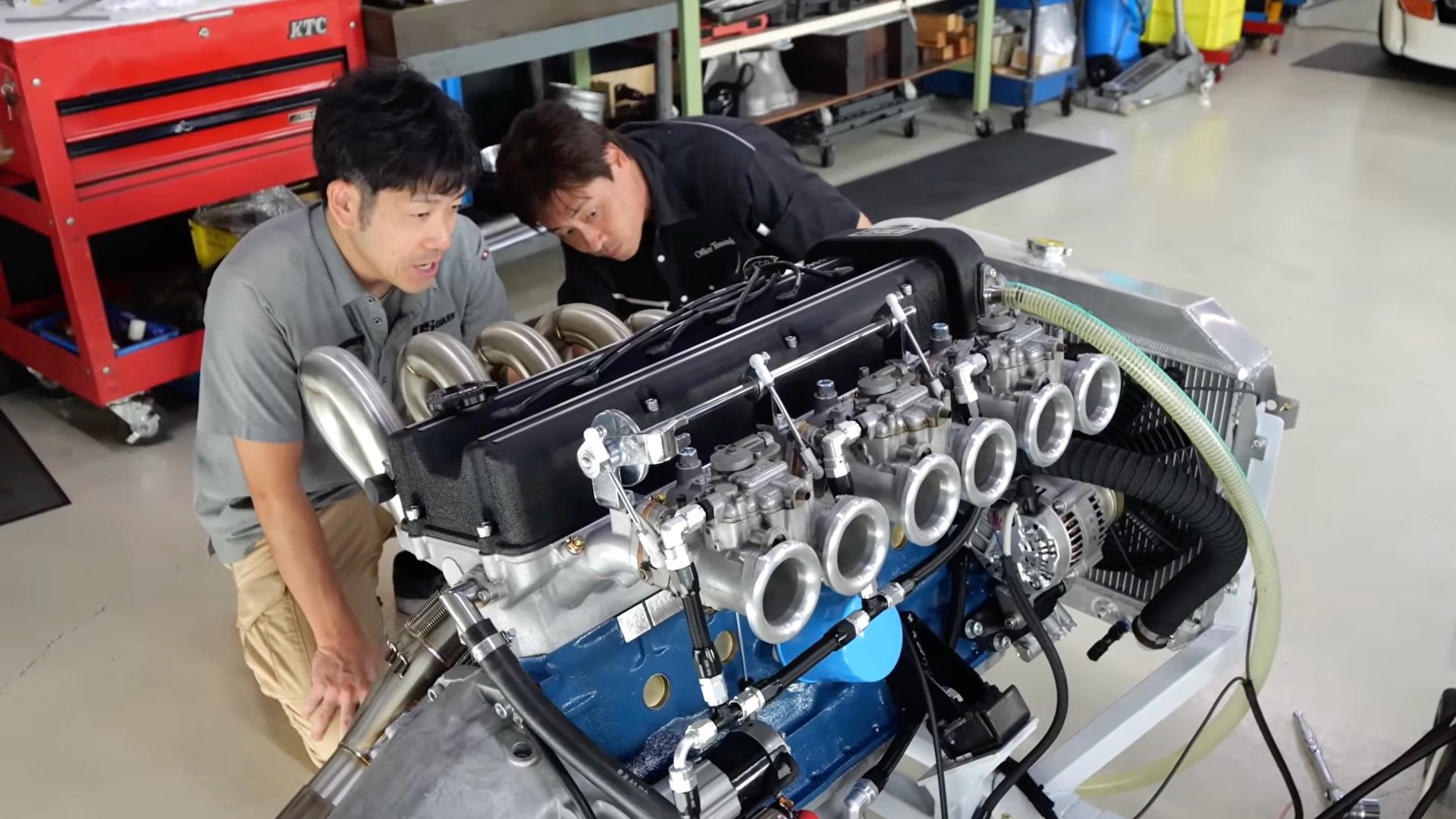


Four months. That’s how long it took a handful of mechanics at OS Giken’s small factory in Okayama, Japan, to assemble a single racing inline-six engine from a cleaned-out block to a screaming, finished product. An hour-long video from the YouTube channel Inside Japanese Factories captures nearly every bolt, bearing, and breath of that process, and it’s the best thing you’ll watch this weekend.
OS Giken has been producing performance parts — clutches, limited-slip differentials, the hard stuff — since 1973. The company isn’t a volume manufacturer. It’s a precision house, the kind of place where a handful of people do the work that robots handle in bigger operations.
The engine at the center of this build is an L-Series inline-six destined for OS Giken’s own S30 Z project car. Sitting on top is the company’s TC24-B1Z cylinder head, a modern reissue of a dual-overhead cam design that founder Masaharu Okazaki originally created in the 1970s. Only nine of those original TC24-B1 heads were ever produced. The updated B1Z version arrived in 2017, incorporating five decades of manufacturing advancements while preserving the essential architecture.
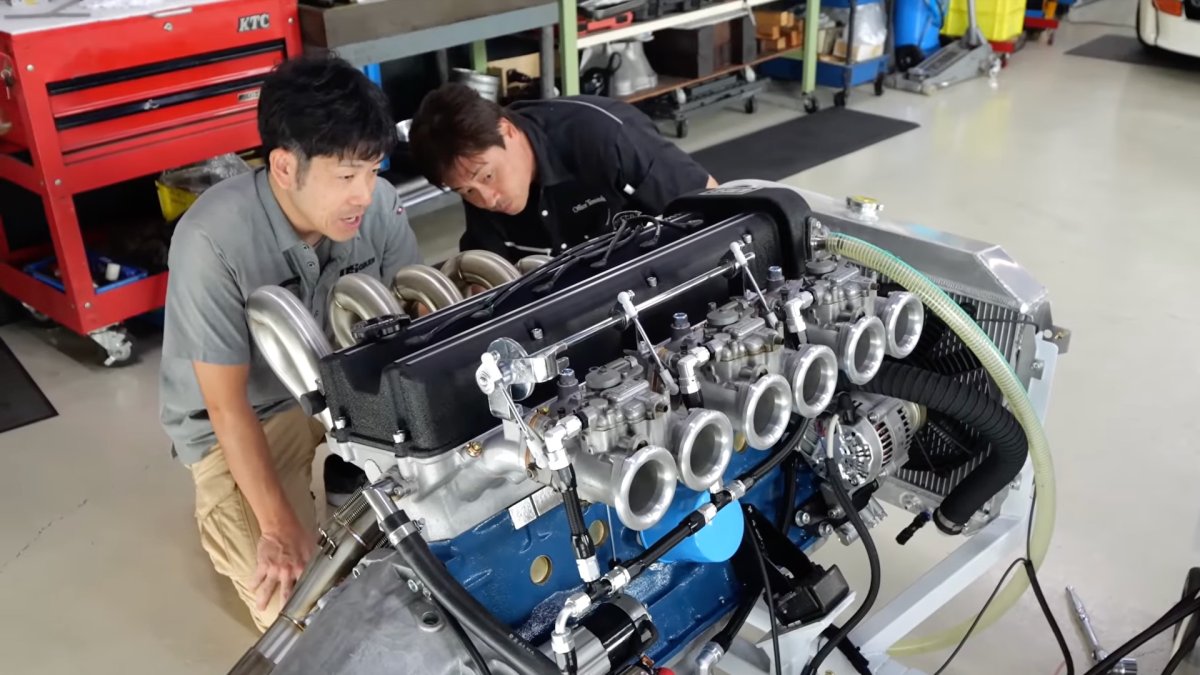
What strikes you watching the footage isn’t the technology. Yes, there are CNC machines and CAD workstations in the background — no serious shop operates without them now. But the assembly itself is profoundly manual. No computerized torque-tracking wrenches, no automated sequences. Just experienced hands, calibrated tools, and patience that borders on meditative.
The video walks through the entire process with an almost surgical lack of shortcuts. The original L-Series block gets a thorough cleaning before a single new part goes in. Then comes the crankshaft, pistons, connecting rods. The head gets ported and polished by hand, every measurement checked and rechecked.
It looks exactly like a small race shop operation because that’s exactly what it is. OS Giken’s main business is manufacturing individual performance components, not complete engines. This build was essentially a side project, which partly explains the four-month timeline.
The most telling moment comes at first startup on the engine stand. Two mechanics stand close, listening intently through the initial minutes of running, ears tuned for anything wrong. No data overlay, no diagnostic screen flashing green — just two people who know what a healthy engine sounds like and what a sick one sounds like, trusting decades of accumulated instinct.
This kind of work exists in an increasingly narrow space. The giant OEMs automated their engine lines years ago. Even boutique manufacturers lean heavily on robotic assembly now. OS Giken operates more like a watchmaker — small batch, hand-fitted, accountable to the individual rather than the production quota.
The channel that produced this video has previously documented similarly small-scale Japanese operations, including the Watanabe wheel factory. There’s a through-line connecting all of them: companies that chose craft over scale and have somehow survived in a market that relentlessly rewards the opposite.
When that L-Series finally fires and the inline-six settles into its voice, you understand why someone would spend four months on a single engine. The sound alone justifies every hour. In an industry obsessed with speed-to-market and units-per-day, OS Giken is building things one at a time, by hand, and daring you to argue with the result.




Share this Story