
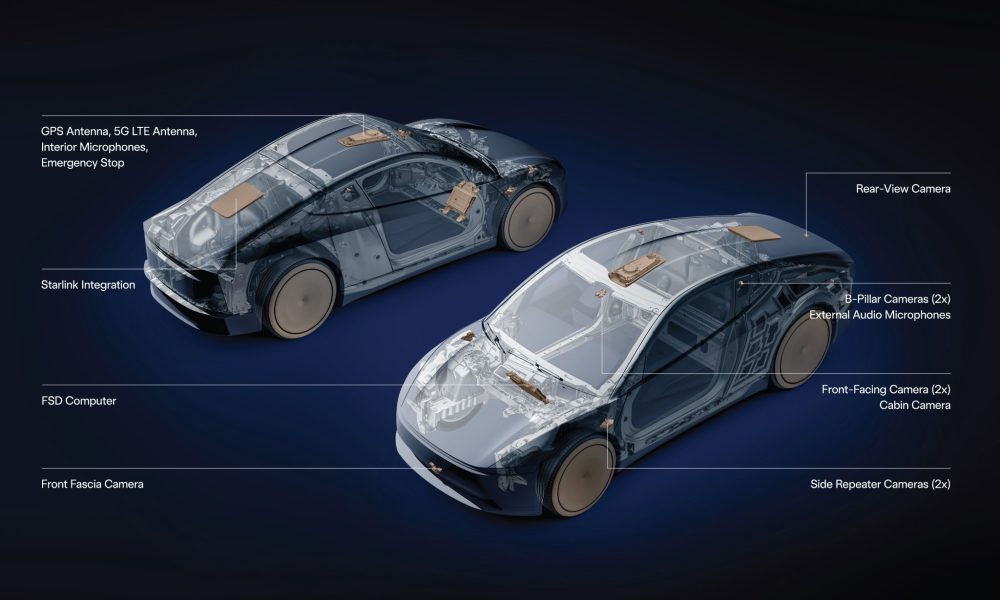


Tesla confirmed Monday it will embed Starlink V5 satellite terminals into every Cybercab rolling off the Gigafactory Texas production line. Most people assumed the move was about giving passengers Wi-Fi so they could scroll TikTok during a driverless ride. They assumed wrong.
Ashok Elluswamy, Tesla’s head of AI, clarified the real purpose hours after the announcement. Starlink isn’t there for passenger entertainment. It’s there so Tesla can maintain a permanent tether to every vehicle in its autonomous fleet.
Troubleshooting, contacting riders, fleet management, navigation — that’s the job. “It is still not required for safe operation of the vehicle,” Elluswamy said. “Connectivity is primarily meant for navigation, customer service and, in general, fleet management.”
Read that again. Tesla is saying the car doesn’t need Starlink to drive safely, but it absolutely needs it to run a commercial robotaxi operation at scale. Those are two very different things, and the distinction matters enormously.
A robotaxi without reliable connectivity is a black box on wheels. If a passenger has a medical emergency, if a vehicle stops in an intersection, if route data goes stale — Tesla needs a way in. Cellular dead zones, underground garages, and rural stretches all threaten that link. Starlink, with its low-earth-orbit constellation, closes those gaps in ways conventional LTE cannot.
The timing is deliberate. Tesla is pushing its Robotaxi program into new territory fast. On Tuesday, the company added Tampa and Orlando to its unsupervised ride-hailing network, joining Austin, Dallas, Houston, Miami, and the San Francisco Bay Area.
Both Florida cities launched with geofences covering core urban corridors — roughly 25 to 45 square miles in Orlando, and a polygon spanning downtown Tampa, Hyde Park, and Tampa Heights. Elluswamy confirmed no safety drivers sit in these vehicles. No one is in the cabin to intervene.
That’s the context that makes Starlink integration less of a tech flex and more of an operational necessity. Every new city, every expanded geofence, every additional vehicle stretches the fleet management challenge. Tesla isn’t just building self-driving cars. It’s building an airline without pilots, and it needs an air traffic control system that never drops a signal.
The Cybercab itself is purpose-built for this world — no steering wheel, no pedals, no pretense of human backup. Production began earlier this year at Giga Texas, and the vehicle is intended to supplement the Model Y units currently running robotaxi routes. Adding Starlink from the factory floor means Tesla bakes connectivity into the platform rather than bolting it on later, a lesson the company learned the hard way with its Hardware 3 debacle, where promises outran capability by years.
Meanwhile, Tesla’s broader software push continues on a parallel track. Elluswamy hinted over the weekend that FSD v14 Lite, the downgraded autonomy stack for older Hardware 3 vehicles, may finally move from early access to wide release. That build brings HW3 cars closer to feature parity with the newer Hardware 4 fleet, though the older machines remain permanently locked out of unsupervised driving. Roughly four million vehicles sit in that limbo.
The Starlink decision reveals where Tesla’s real anxiety lives. It’s not whether the AI can drive. The company has spent years and billions answering that question.
The harder problem is whether Tesla can operate a massive, distributed, driverless transportation network without losing contact with its own cars. Satellite internet is the insurance policy. The Cybercab may drive itself, but Tesla has no intention of letting it wander off alone.
Share this Story