
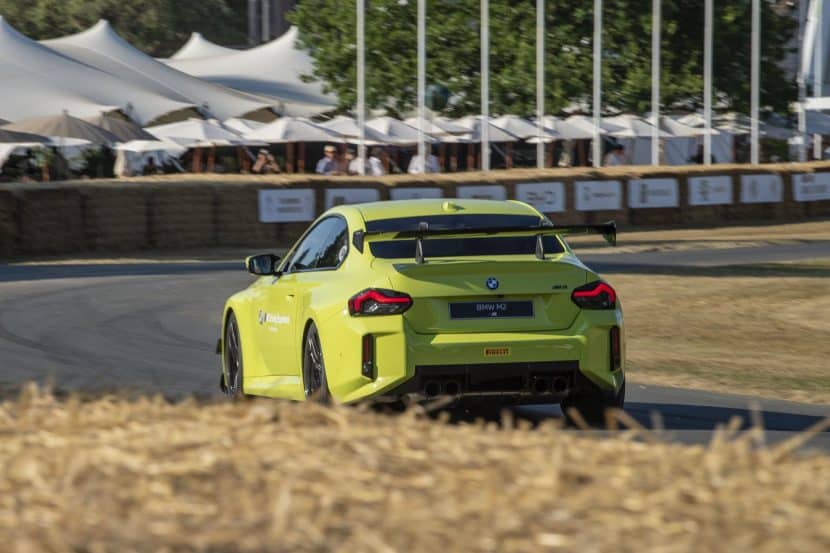


BMW didn’t need more horsepower. It needed better airflow and stiffer springs. That’s the takeaway from the M2 Track Kit’s 7:20 Nürburgring lap, which shaved half a second off the M2 CS record set roughly a year earlier — using a car with less power and more weight than the one it beat.
Twelve days after that Nordschleife run, BMW rolled the same Track Kit-equipped G87 up the hill at Goodwood Festival of Speed. But here’s the thing: it wasn’t timed. BMW entered it as a demonstration car, not a competitor in Sunday’s Timed Shoot-Out. The crowd got the visual — carbon swan-neck wing, adjustable splitter, the whole catalog — without a number to attach to the performance.
The brand’s actual timed entry at Goodwood was the M3 Touring 24H, a one-off race wagon driven by Jordan Pepper. It posted 46.54 seconds, good enough for fifth overall. Romain Dumas and Ford’s Super Mustang Mach-E took the win at 41.97 seconds. Max Chilton’s McMurtry Spéirling fan car record from 2022, a blistering 39.08 seconds, remains untouched.
So why bring the M2 to Goodwood at all if you’re not going to time it? Because the Ring number is the only number BMW needed. The 7:20 lap did its work before the car ever touched English tarmac. Goodwood was the victory lap, and BMW played it exactly that way — letting the car be seen rather than measured.
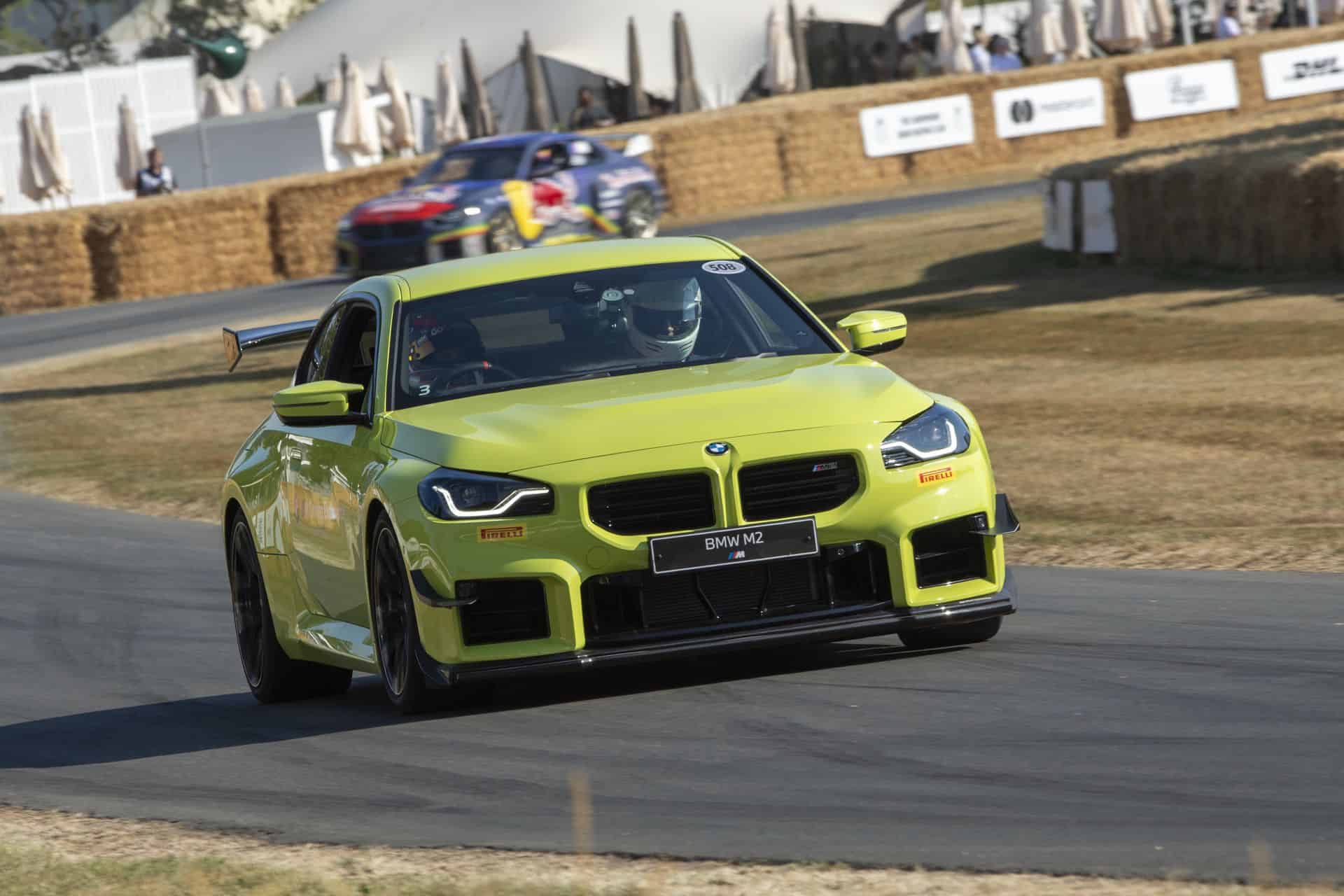
The Track Kit goes on sale this month in Germany at €23,500 before tax and installation. That’s not pocket change bolted onto a car that already starts north of €60,000, but the parts list reads like a greatest-hits compilation from BMW’s racing program. The rear wing is borrowed directly from the M4 GT4 and GT3 customer cars.
The coilover suspension offers four-way adjustable rebound and compression damping, drops ride height by up to 20 millimeters, and stays road-legal under German StVZO regulations. Adjustable support bearings, aero flicks, and wheel arch diffusers round out the package.
The S58 3.0-liter twin-turbo six remains completely stock. Every tenth of a second BMW found at the Nordschleife came from aero load and chassis tuning alone. BMW even acknowledged the conditions weren’t ideal — high ambient temperatures and oil on the track in the T13 section meant there was more time left on the table.
That last detail is the quiet part said loud. If a standard M2 with bolt-on aero and suspension hardware can beat the CS in suboptimal conditions, the obvious next move is to mate the Track Kit to the CS itself. BMW hasn’t confirmed that, but it hasn’t denied it either. The CS already brings more power and less weight. Adding proven aero and damping gains to that equation doesn’t require an engineering leap — it requires a business decision.
The newly launched M2 xDrive seems like a less likely candidate for this treatment. All-wheel drive adds mass, and nothing about the Track Kit’s development arc suggests it was designed for a heavier platform. The G87 M2 is expected to stay in production through the end of the decade, giving BMW M years of runway to keep iterating.
An M2 CSL has been whispered about for a while now. Every lap record the current car sets, especially one achieved without touching the engine, makes that whisper a little louder. BMW has proved that the S58 still has headroom and the chassis can absorb significantly more performance before anything breaks. The only question is how far up the price ladder they’re willing to push a compact two-door.
For now, the Track Kit stands as a remarkably effective piece of evidence that aerodynamics and suspension geometry remain the most undervalued currencies in the street-car performance market. Half a second around the longest, most demanding circuit in motorsport, found without a single extra horsepower. That’s not marketing. That’s engineering making its case.
Share this Story