
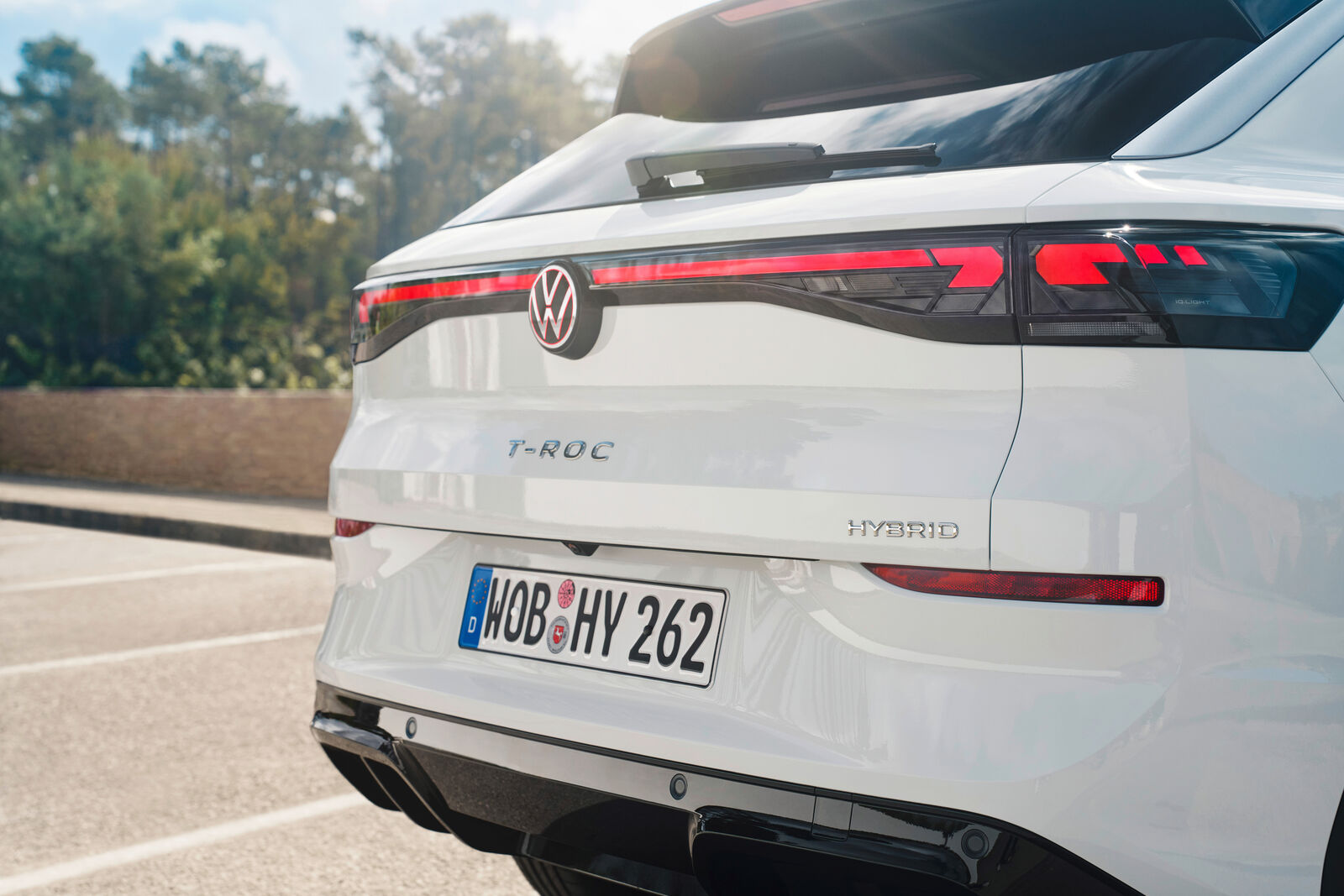


Volkswagen just opened pre-sales on a full hybrid powertrain for the Golf and T-Roc that never needs to be plugged in. Starting at €41,400 for the Golf R-Line and €44,470 for the T-Roc Style, the 125 kW system pairs a 1.5-liter turbo four with two electric motors and a tiny 1.6 kWh battery that charges itself through recuperation and the combustion engine acting as a generator.
No cord. No charging infrastructure. No range anxiety. It’s a deliberate pitch to the millions of European buyers who aren’t ready for a full EV and don’t want to deal with plug-in hybrid charging discipline.
The system operates in three modes that switch automatically. At low speeds, the electric motor handles propulsion alone while the gas engine sleeps. In serial mode, the TSI fires up but only to spin a generator feeding the electric motor, never touching the wheels.
Above roughly 60 km/h, both powerplants work in parallel, with the electric motor acting as a booster during acceleration.
VW claims the Golf Hybrid cuts fuel consumption and CO2 emissions by 10 to 15 percent compared to the existing 110 kW mild hybrid eTSI. In city driving, the advantage stretches to 35 percent. Combined WLTP consumption lands between 4.6 and 5.1 liters per 100 km for the Golf, and 5.0 to 5.6 for the heavier T-Roc.
The zero-to-100 km/h sprint takes 7.5 seconds, with system torque peaking at 309 Nm.
Three driver-selectable profiles shape the experience. Eco caps output at 70 percent and kills the boost function. Comfort opens up full system power, and Sport pushes the drivetrain into serial mode earlier to keep maximum output on tap.
This is Volkswagen threading a needle. The brand already sells mild hybrids at the entry level and plug-in hybrids at the top of the electrified range. The new full hybrid slots neatly between them, targeting buyers who want more electric running than a 48-volt system delivers but refuse to install a wallbox or hunt for public chargers.
Toyota has been printing money with this formula for two decades. Volkswagen arriving here in 2025 with its volume nameplates feels late, but the timing may actually work in the brand’s favor. European EV sales growth has cooled, government incentives are drying up, and charging infrastructure remains patchy outside major cities.
A self-charging hybrid that delivers real electric driving segments, quietly pulling away from traffic lights on electrons alone, answers a very specific consumer frustration.
The 1.6 kWh battery is small enough to tuck under the rear floor without eating into cargo space. That’s a practical advantage over plug-in hybrids that typically carry batteries ten times that size and the weight penalty that comes with them.
Volkswagen confirmed a second, higher-output version of this hybrid architecture is coming soon, though it offered no specifics on power or timing. The compact segment is the brand’s bread and butter. Layering another electrification option across Golf and T-Roc gives dealers one more answer for the showroom browser who keeps asking, “What if I don’t want to plug it in?”
The full hybrid badge on the tailgate reads simply “Hybrid.” No e-prefix, no lightning bolt, no overwrought branding. For a company that has spent five years shouting about its electric future with the ID. family, the quiet simplicity of that badge says plenty about where the volume really lives.

Share this Story