
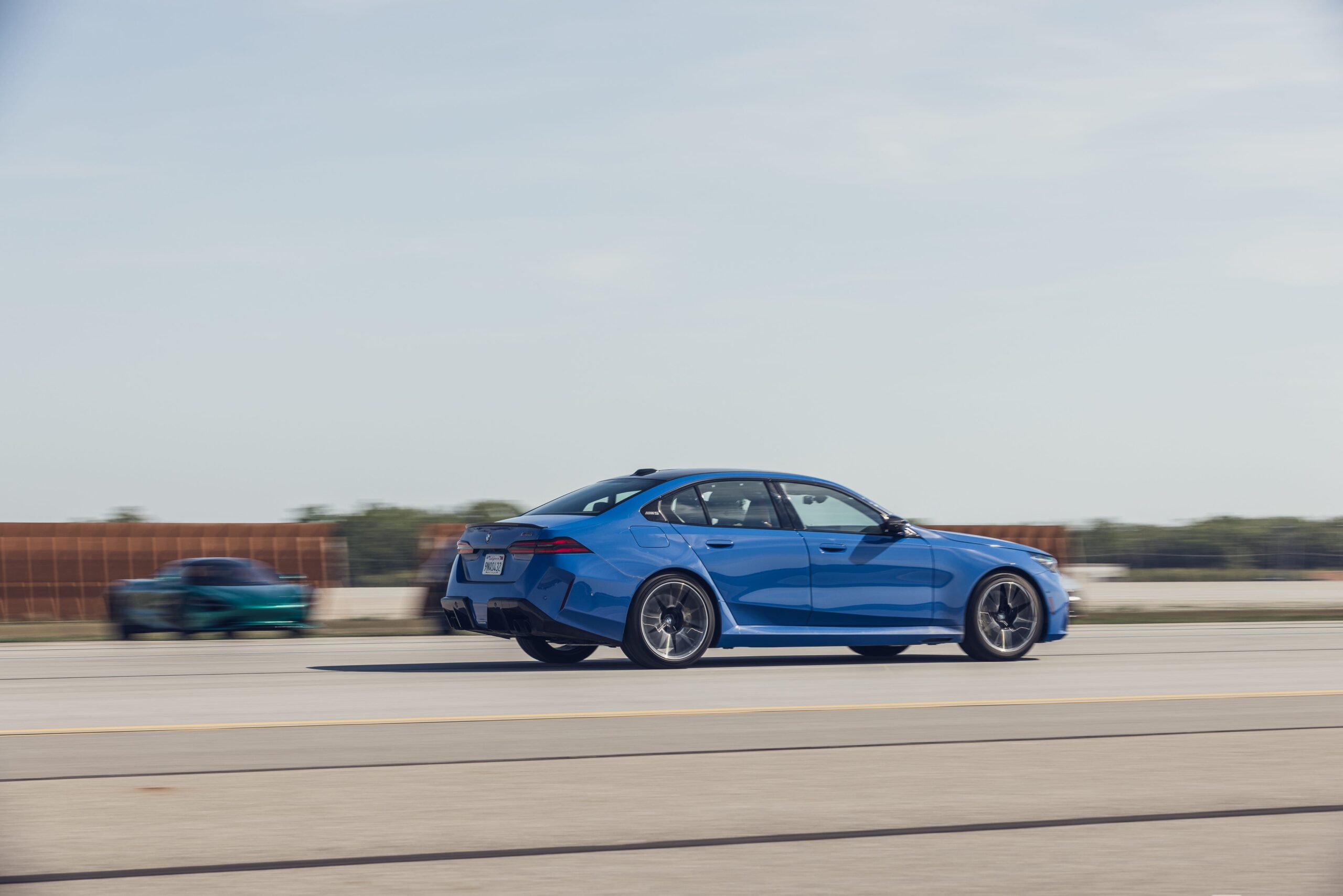


The BMW M5 posted a 43.6-second run in Car and Driver’s 2026 0-150-0 mph speed test, a number that should embarrass cars weighing a thousand pounds less. At 5,267 pounds and $146,500 as tested, this is not the M5 your older brother lusted after. It is a plug-in hybrid land missile that happens to have a back seat.
The recipe reads like an engineering department dare. A twin-turbocharged 4.4-liter V-8 producing 577 horsepower gets paired with a 194-hp electric motor for a combined 717 horses. All-wheel drive puts that output to the pavement.
The power-to-weight ratio lands at 7.3 pounds per horsepower, which is competitive territory for a sedan that weighs more than some full-size pickup trucks.
Getting there requires patience with BMW’s layered digital cockpit. Sport Plus drive logic, stability control toggled to ESC Off or M Dynamic Mode, then hold the brake and throttle together until “Launch Control” appears in the instrument cluster. The tester on duty reported the big sedan barking its tires off the line, and on Michelin Pilot Sport S5 rubber with staggered 20-inch fronts and 21-inch rears, the M5 clawed forward with the kind of violence you do not associate with hybrid powertrains.
The M5 gained roughly a second on its smaller sibling, the M2, on the way to 150 mph. That gap matters because the M2 is supposed to be the sharper, lighter tool. But four driven wheels and 717 combined horsepower do not care about your preconceptions.
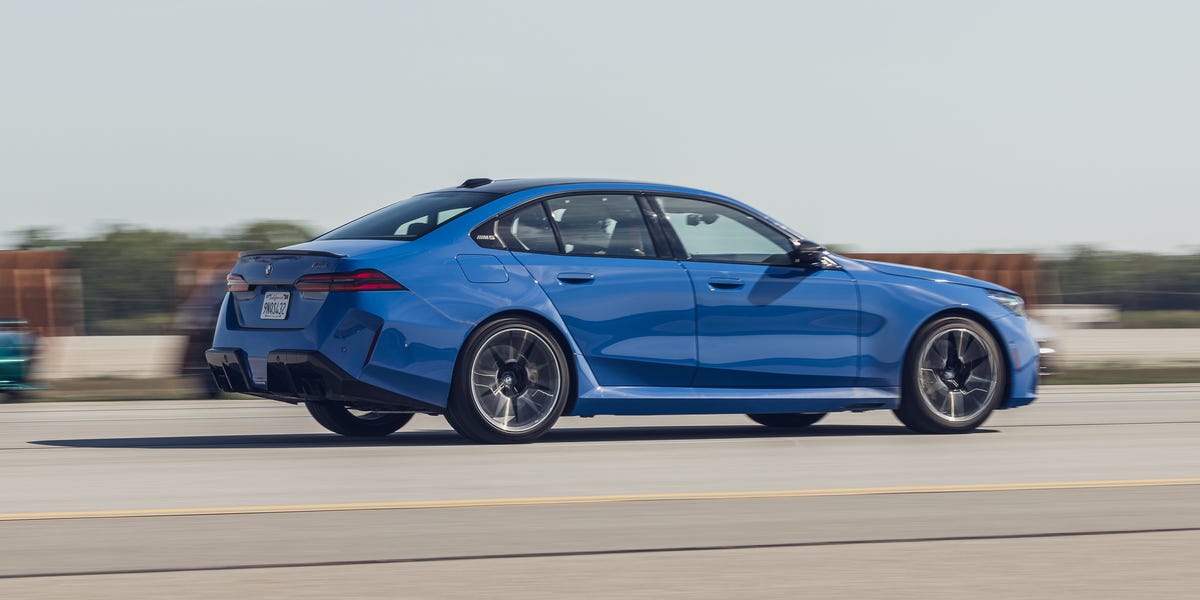
Stopping told a similar story. The M5’s 16.5-inch front and 15.7-inch rear carbon-ceramic brakes hauled the car from 150 mph to a standstill in 609 feet. The lighter M2 needed 634 feet. A car carrying an extra battery pack, an electric motor, and all the structural reinforcement those components demand stopped shorter than the two-door behind it.
The $132,050 base price puts the M5 in direct competition with cars that wear very different badges. At $146,500 as tested, it overlaps with the Porsche Taycan Turbo GT and nudges against Bentley Continental GT territory. The M5’s 0-150-0 time forces a conversation about value per second that BMW has not always won.
Car and Driver’s test included a broad field this year. The Porsche 911 Turbo S, Chevrolet Corvette ZR1X, McLaren 750S, and Lucid Air Sapphire all participated. The M5 was not the fastest in that crowd, and nobody expected it to be. But it was arguably the most versatile car on the runway, the one you could drive to dinner with four adults after spending the afternoon at 150 mph.
BMW’s decision to make the M5 a plug-in hybrid drew skepticism when announced. A performance sedan gaining hundreds of pounds of electrification hardware seemed like compromise dressed up as progress. The 43.6-second result does not fully silence that criticism, but it redirects it.
The weight is real. The speed is also real. And the braking distance suggests BMW engineered around the mass penalty rather than ignoring it.
The M5 sits in a strange place in 2026. Too heavy to be a purist’s car, too fast to dismiss, too expensive to be mainstream, and too practical to be exotic. BMW seems comfortable with that tension, and the numbers from the speed test suggest they should be.



Share this Story