
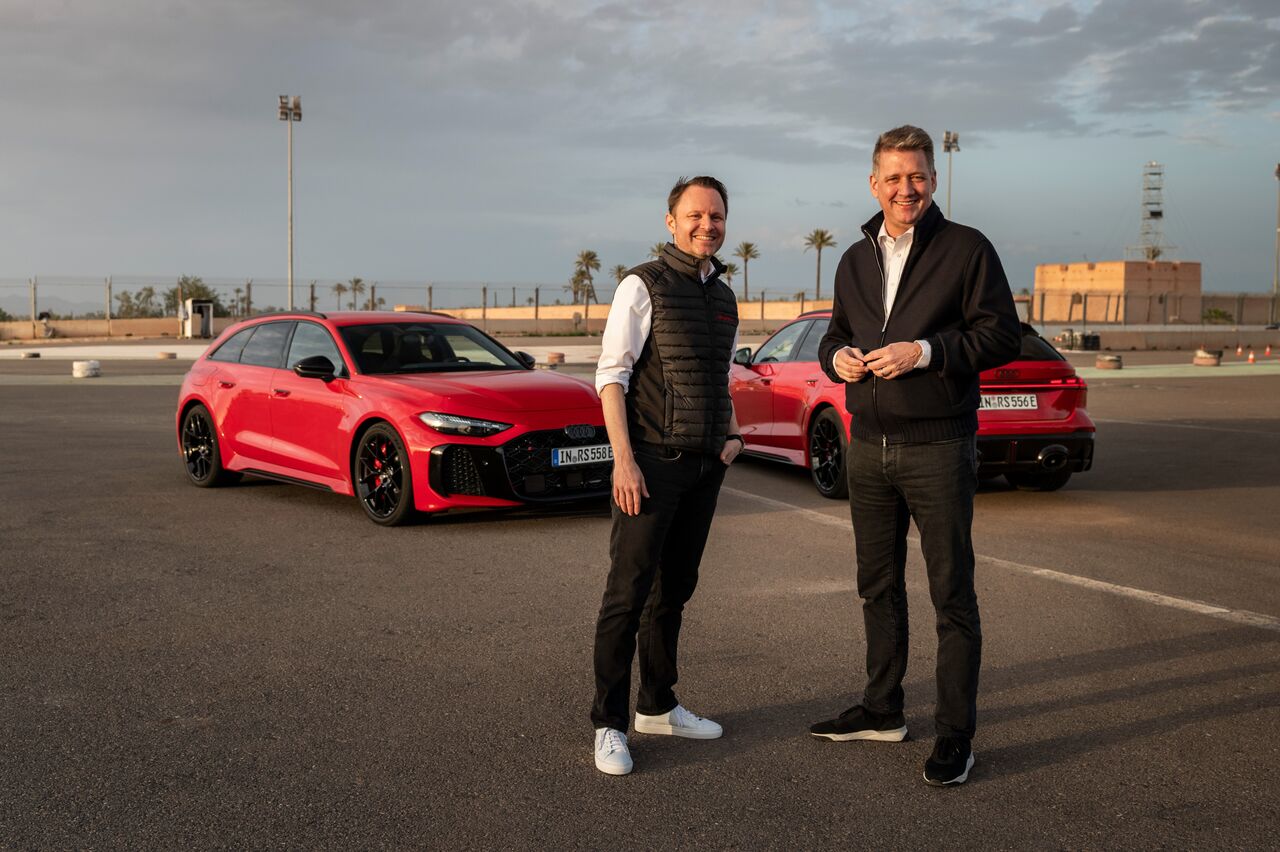


The tail is out, the tires are screaming, and Rolf Michl, the man who runs Audi Sport, is grinning from the passenger seat. “I see you smiling,” he tells the journalist behind the wheel. “This is good.”
That scene, repeated across a Marrakech racetrack and through the Atlas Mountains last week, is Audi’s answer to anyone who thought a plug-in hybrid RS car would be a neutered appliance. The 2027 RS5 pairs a revised 2.9-liter twin-turbo V6 making 510 PS with a 130-kW electric motor stuffed inside an eight-speed torque converter automatic. Combined output: 630 horsepower and 608 lb-ft of torque, nearly 200 horses more than the car it replaces.
The price of admission is steep, and not just financially. At 5,192 pounds, the RS5 is more than 1,000 pounds heavier than the outgoing model. The 22-kWh battery pack and its associated hardware account for roughly 880 pounds of that gain.
Audi’s engineers aren’t apologizing for the weight. They’re arguing it enabled something the brand has never done: genuine rear-biased handling in an RS sedan. A new electromechanical rear differential called Dynamic Torque Control uses a dedicated 8-kW motor to shuffle torque between the rear wheels in five-millisecond increments.
The system exists only because the 400-volt PHEV architecture made it possible. Without the hybrid hardware, there’s no torque vectoring. Without torque vectoring, there’s no controllable power oversteer.
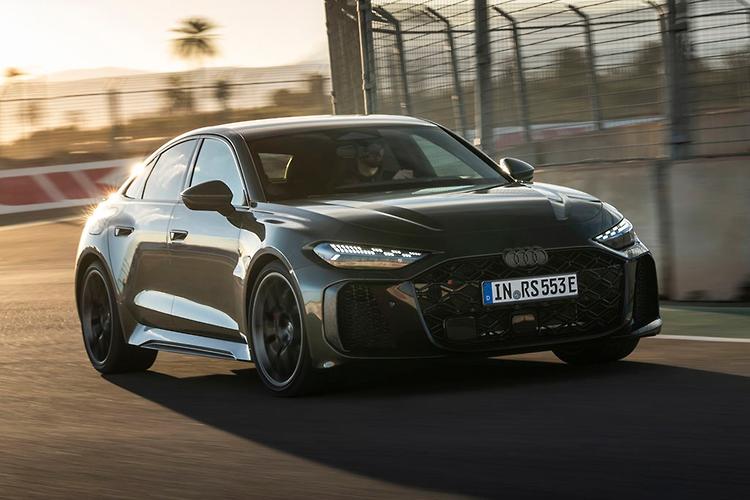
The old RS cars were clinical, point-and-shoot machines — devastatingly fast but emotionally distant. The new RS5, multiple reviewers noted, rotates eagerly into corners with a quicker 13:1 steering ratio and pushes out of them with authentic rear-drive shove. A near-perfect 51/49 weight distribution, courtesy of the rear-mounted battery, helps the cause.
RS Torque Rear mode allows full drift capability on closed courses, though one tester shredded a rear tire in under sixty seconds doing exactly that.
There’s a quieter trick up the RS5’s sleeve too. It can drive 54 miles on electricity alone, making it an emissions-compliance gift in markets where CO2 regulations are tightening fast. In Australia, that electric range drops the car’s official emissions to as low as 86 g/km, which makes a 630-hp super sedan look downright virtuous on paper.
Run the battery flat, though, and you’re staring at 10.2 liters per 100 km from a 48-liter fuel tank. Combined touring range hovers around 500 km. That’s not great.
The elephant on four wheels remains the BMW M5, which adopted its own PHEV system and swelled to similar proportions. Mercedes-AMG took a different path with the C63, going plug-in hybrid but dropping to four cylinders — a decision that has aged about as well as milk in the Moroccan sun. Audi kept the V6, the sound, and the twin exhaust outlets that make passersby stop and stare.

Inside, the RS5 borrows its architecture from the standard A5, which means a crisp 14.5-inch OLED center screen and an 11.9-inch gauge cluster. The RS-specific sport seats are genuinely comfortable, but reviewers flagged an overreliance on piano black trim and cabin materials that don’t quite match the car’s six-figure price tag. Boot space suffers too — just 361 liters in the Avant thanks to the battery floor — and there’s no spare wheel.
German pricing starts at €106,200. Australian estimates land south of $200,000. North American deliveries won’t begin until 2027, and the Avant wagon stays in Europe.
Audi’s gamble is clear: bolt on the batteries, add the weight, then engineer your way out of the consequences. On a Moroccan racetrack, sideways and howling, the math checks out. Whether it holds up over 50,000 miles of daily driving is the question no first drive can answer.

Share this Story