
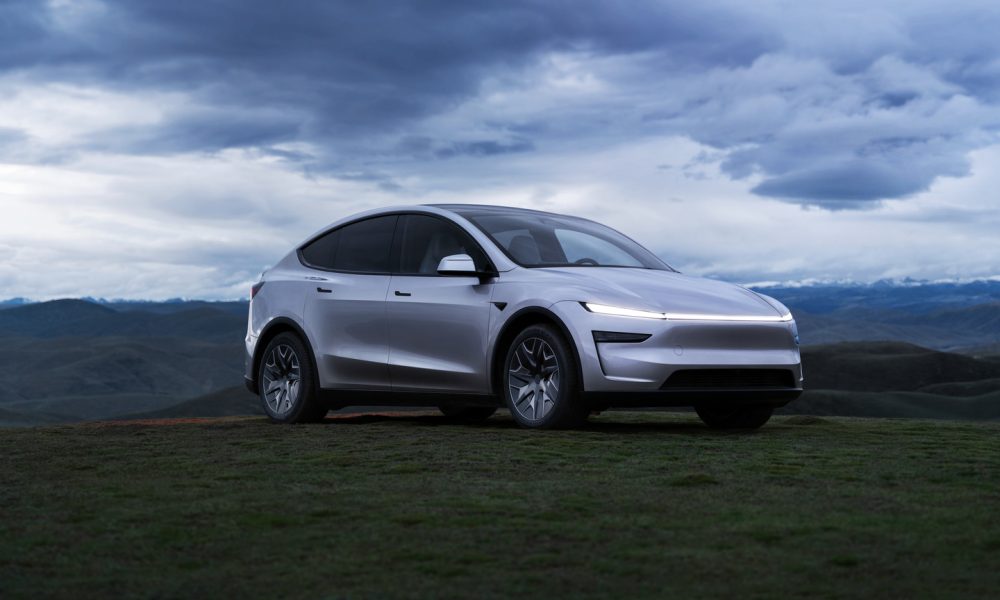


Seven years after Elon Musk first promised Tesla would “definitely” develop pothole avoidance, the feature is finally close to shipping. Musk confirmed late Friday that the capability is “coming soon” as part of the Full Self-Driving v14 suite, arriving at a moment when Tesla can no longer afford to have its software flinch at a hole in the pavement.
The timing is not accidental. Cybercab, Tesla’s purpose-built robotaxi with no steering wheel and no pedals, launches Thursday. Every occupant in that vehicle is a passenger.
There is no backup driver to swerve around a crater in the asphalt. If FSD cannot handle potholes, the entire Cybercab premise has a problem.
Pothole avoidance has lived in Tesla’s release notes as a planned improvement for months, perpetually listed under “upcoming.” The gap between promise and delivery stretches back to April 2019, when an owner first asked for it and Musk agreed on the spot. By August 2020, he said Tesla was actively labeling bumps and potholes so vehicles could slow down or steer around them.
Five years later, the feature still was not in production software.
FSD has proven capable of dodging visible obstacles like cardboard boxes, fallen car parts, and horse droppings on rural roads. But potholes present a different challenge. They are negative space, not positive objects.
A cardboard box sits above the road surface and reflects light. A pothole is a dark absence in the pavement, often filled with shadow or water, and the depth can range from cosmetic to catastrophic. Training a vision-only system to reliably detect that kind of surface disruption, in every lighting condition and at highway speed, requires a volume of labeled data Tesla has apparently spent years accumulating.
The engineering difficulty partly explains the delay. What does not explain it is the confidence with which Musk has repeatedly treated the feature as imminent. That pattern, announcing capability long before delivery, has defined Tesla’s autonomy timeline since the company first sold a $7,000 Full Self-Driving package in 2019 with the promise of city-street navigation that did not arrive until 2023.
The stakes this week are different from anything before. Tesla’s 2026 Summer Update, also rolling out now, gives the Grok AI assistant direct control over vehicle hardware, from headlights to mirrors to climate systems, all through natural speech commands that can be stacked in a single sentence. Tesla is clearly building toward a cabin experience where the driver’s hands are off everything, not just the wheel.
That vision only works if the car can read the road as well as a human does. A pothole that bends a wheel rim or blows a tire is not just an inconvenience. In a vehicle with sleeping passengers and no manual override, it is a liability event.
Every Cybercab ride that ends with a flat tire or a jarring impact becomes a story that undermines public trust in autonomy itself.
Musk said the fix is coming soon. He has said that before, about this exact feature, at least three times since 2019. The difference now is that a driverless vehicle launches in four days, and soon is no longer soon enough.
Share this Story