
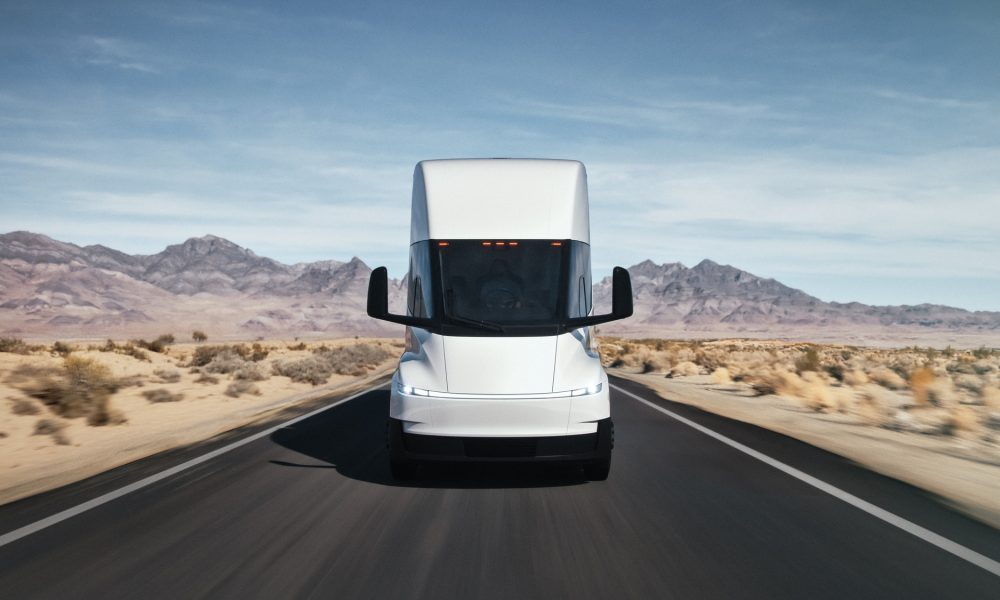


Nine years after Elon Musk first rolled a prototype across a stage in Hawthorne, California, the Tesla Semi is finally going to Europe. The company confirmed it will bring full specifications and market-launch details to the IAA Transportation trade fair in Hannover, Germany, running September 15 through 20. That is a long gestation period for a truck that was supposed to start production in 2019.
The American ramp-up itself only recently got serious. High-volume manufacturing began April 29, 2026, at a dedicated plant next to Gigafactory Nevada. Tesla targets 50,000 units annually from that facility, though the company’s own language hedges toward “many thousands” by year’s end.
Limited deliveries to PepsiCo started in late 2022 and have trickled out since. Real commercial momentum is just now building, with 500 units ordered by Einride for Amazon logistics and additional hundreds from WattEV.
The production truck that emerged from all those delays is, on paper, a serious machine. Two variants handle the full 82,000-pound gross combination weight that Class 8 trucking demands. The Standard Range gets roughly 325 miles from a 548 kWh battery and weighs under 20,000 pounds.
The Long Range stretches to about 500 miles with an 822 kWh pack, though curb weight climbs to 23,000 pounds. Three independent rear-axle motors put down 800 kW, roughly 1,073 horsepower. Megawatt-class charging at up to 1.2 MW recovers about 60 percent of range in half an hour.
Pricing sits at $260,000 for Standard Range and $290,000 for Long Range before incentives. Those numbers land in a range where total cost of ownership arguments against diesel start to hold up, assuming the charging infrastructure exists.
Europe presents a different puzzle. Cab-over-engine configurations dominate the continent’s trucking market, not the long-nose American layout Tesla has built. Lighting standards differ, regulatory approval processes vary by country, and sleeper cab options would be essential for long-haul operators running across borders.
None of these adaptations have been confirmed in detail. That is presumably what Hannover is for.
The timing of this European push is worth watching alongside Tesla’s other large bets. The company is simultaneously scaling Cybercab robotaxi production, preparing FSD version 15 for wide deployment, and telling JPMorgan analysts it is deliberately holding back Model Y robotaxi conversions because it is so confident in near-term Cybercab manufacturing. Nevada regulators just approved a 5,000-vehicle robotaxi fleet across Clark County. Tesla is stretching itself across consumer vehicles, autonomous ride-hailing, humanoid robots, and intercontinental heavy trucking all at once.
European competitors are not standing still. Daimler Truck, Volvo, and MAN have their own battery-electric programs in various stages of customer deployment. They know European roads, European regulations, and European fleet buyers intimately.
Tesla will arrive as the outsider, selling a truck designed first for American highways and American loading docks. The Semi’s domestic order book suggests fleet operators are willing to place bets. Whether European haulers, who run different routes at different weights under different rules, show the same appetite is the open question Tesla has to answer in Hannover.
Announcing a European launch is easy. Executing one with a truck that was originally promised nearly a decade ago will be something else entirely.

Share this Story