
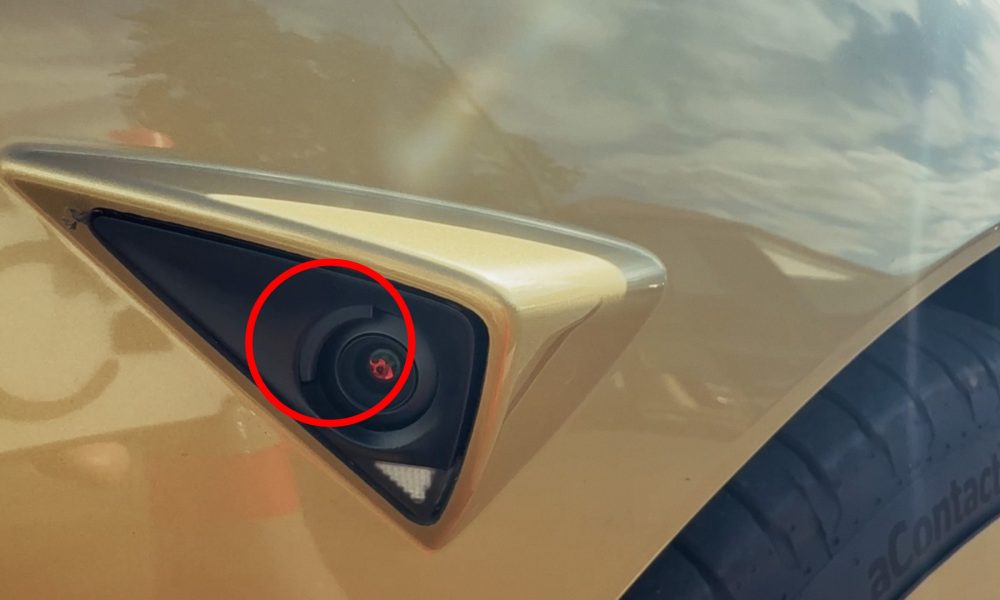


A tiny triangular camera housing spotted on a Cybercab engineering vehicle in Peabody, Massachusetts, tells you everything about where Tesla’s autonomy ambitions collide with physics. The housing contains an integrated washer mechanism for the side repeater camera. A squirt nozzle, basically, and it might be the most consequential piece of hardware on the entire vehicle.
Here’s the problem Tesla has been dancing around for years. FSD runs on cameras alone. No lidar, no radar backup. When those lenses get hit with road spray, mud, snow, or even a well-aimed bird dropping, the system goes partially blind.
Every Tesla owner who’s driven through a rainstorm knows the alert: camera obstructed. You pull over, wipe the lens with your sleeve, and move on. That works fine when there’s a human in the driver’s seat. It does not work when there is no driver’s seat.
The Cybercab has no steering wheel, no mirrors, no fallback human. It has to see, all the time, in every condition, or it stops being a robotaxi and becomes a very expensive paperweight blocking a lane. The washer system spotted on the side repeater delivers targeted cleaning bursts to keep the cameras clear during merging, lane changes, and blind-spot checks.
Early sightings suggest similar hardware covers the rear cameras too, creating a full-perimeter cleaning architecture. This is not a luxury feature. It is a prerequisite for unsupervised driving in the real world.
And that raises an uncomfortable question for the roughly half-million Tesla owners already running AI4 hardware. Their cars have better compute and sharper cameras than anything Tesla sold before, but they don’t have dedicated side or rear camera washers. The Model Y units Tesla has been deploying in its own robotaxi testing fleet do have them, but the company quietly added the hardware to those specific vehicles. Your personal Model Y almost certainly doesn’t have it.
Software can compensate to a degree. Neural nets can learn to interpret partially obscured images, fill in gaps, lean harder on unaffected cameras. But software cannot remove a chunk of frozen slush plastered across a lens at highway speed in a Minnesota February.
The gap matters because Tesla is pushing toward unsupervised FSD approval for consumer vehicles, not just purpose-built Cybercabs. If the regulatory and technical bar for removing human oversight includes all-weather reliability, and it will, then production AI4 cars face a hardware deficit that no over-the-air update can fix.
Speculation among owners and analysts has turned to whether Tesla might offer washer retrofits or introduce an AI4.5 hardware revision that includes integrated cleaning systems. Neither option is simple. Retrofitting camera housings across an existing fleet is a service nightmare.
A new hardware tier means another round of upgrades for owners who already paid thousands expecting their current setup would be the last one they’d need. Tesla has been here before. The jump from HW3 to HW4 left older owners feeling stranded.
The company recently signaled that HW3 owners could be “made whole,” language that usually means either credits or swap programs, not full parity. Adding camera washers to the must-have list for unsupervised FSD would create another tier of haves and have-nots.
The Cybercab’s little triangular nozzle is a concession to something Tesla’s software-first culture sometimes resists: the physical world doesn’t care how good your neural net is if it can’t see. Rain is not a software problem. Mud is not a software problem. And a robotaxi fleet that pulls over every time conditions get messy is not a business.
Tesla clearly knows this. The washer hardware on the Cybercab proves it. The question now is whether the company will extend that same pragmatism to the millions of Teslas already on the road, or whether unsupervised FSD will remain, for existing owners, perpetually one hardware revision away.
Share this Story