
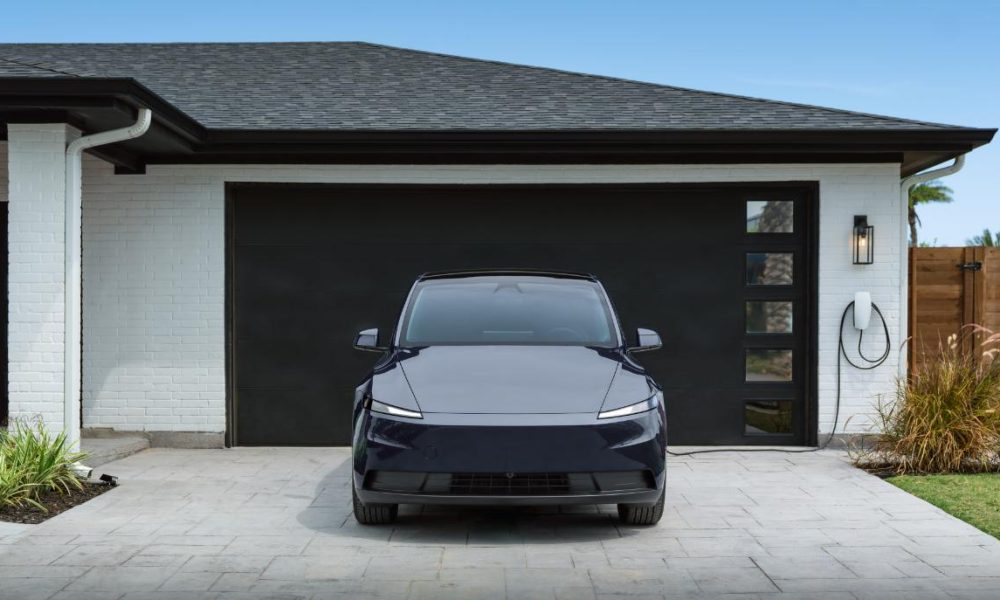


Parking has been Full Self-Driving’s most persistent embarrassment. Elon Musk just admitted as much, calling destination parking “by far” the biggest reason drivers grab the wheel during FSD operation.
The fix, Musk says, is a system that learns your parking preferences from past behavior. Instead of diving into the first open spot it detects, FSD will remember that you always back into the third spot in the third row at work. Or that you prefer the far end of a grocery store lot where nobody’s flinging doors into your quarter panels.
No timetable was given. But Tesla has been pushing new FSD builds every few weeks, so the feature could surface quickly.
This is an overdue correction to a problem that’s been hiding in plain sight. FSD can navigate freeway interchanges and dense urban intersections, but the moment it rolls into a parking lot, it turns into your sixteen-year-old with a learner’s permit. It lunges at the first available space regardless of size, proximity to other vehicles, or whether you’d actually want to leave your car there.
Experienced FSD users have developed a reflex: the second the lot appears, hands go to the wheel. Some owners have tried workarounds, dropping a pin at a preferred spot within the destination. More often, FSD ignores the pin and parks wherever it pleases.
What Musk is describing is a behavioral learning layer, one that watches your takeover patterns and adjusts. If you consistently override FSD in the same lot and park in the same area, the system would internalize that preference and replicate it. It’s a machine-learning approach rather than a menu of manually selected preferences, which is what many owners have been requesting for years.
The distinction matters. A preference menu would be simpler and more predictable. A learning system is more ambitious but introduces its own risks.
What happens when you change jobs? When a lot gets reconfigured? When you’re visiting a place for the first time and there’s no behavioral history to draw from? These are edge cases Tesla will need to address if the feature is going to work as promised rather than just demo well.
The acknowledgment itself is telling. Parking is one of the most mundane driving tasks, and the fact that it remains FSD’s weakest link exposes a gap between highway-level competence and the low-speed, high-judgment decisions that define the last hundred feet of every trip. Autonomous driving companies have long known that parking lots are deceptively difficult — pedestrians walking unpredictably, cars reversing without warning, narrow lanes, poor signage.
Tesla’s approach to FSD has always been to ship fast and iterate. That philosophy has produced rapid improvement on open roads. Parking has lagged because it requires a different kind of intelligence — not just obstacle avoidance but intent matching.
The car needs to understand not just where it can park, but where you want to park, and why.
If Tesla can crack preference-based parking through behavioral learning, it removes one of the last routine reasons drivers intervene. Every takeover is a data point that undermines the case for full autonomy. Every unnecessary one is a failure of design, not capability.
Musk framing this as a major upgrade is honest for once. It is major — not because the technology is exotic, but because the problem it solves is the one FSD users encounter most often. The best autonomous systems aren’t the ones that handle the hardest scenarios. They’re the ones that stop failing at the easy ones.
Share this Story