
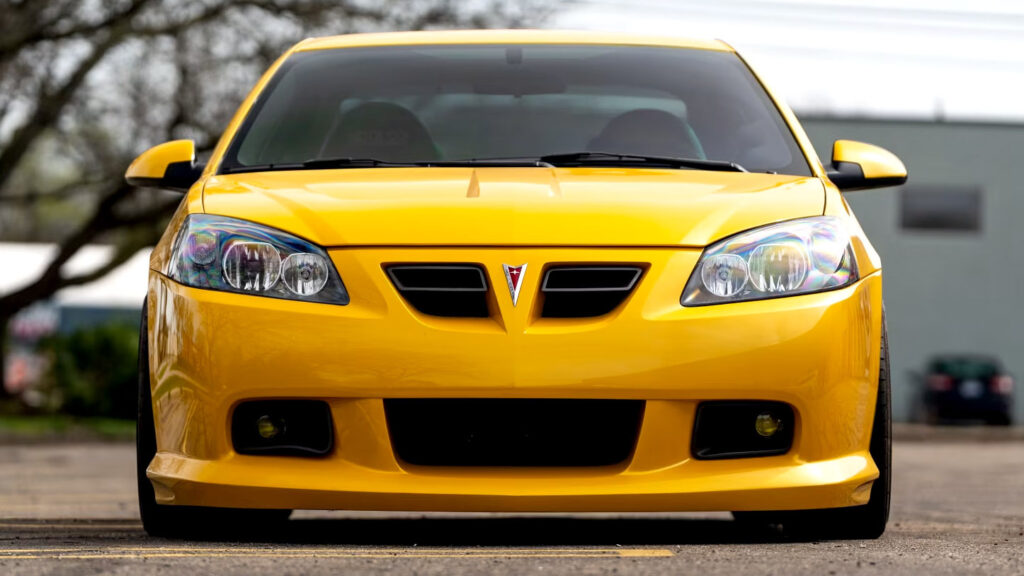


Twenty years ago, Roush Industries walked into the SEMA Show in Las Vegas — a temple of big-block Mustangs and supercharged trucks — and unveiled a tuned Pontiac G6 sedan. Let that sink in for a moment.
The car is now heading to Mecum’s Nashville sale on September 26, dragging with it a strange little chapter of automotive history that says more about the mid-2000s aftermarket scene than any corporate retrospective ever could.
Roush, a name synonymous with Ford performance for the better part of four decades, took a 3.5-liter V6 Pontiac — a car destined for rental fleets and first-time buyers with mediocre credit — and gave it the full SEMA treatment. AEM cold air intake, dual-tailpipe exhaust, 19-inch wheels wrapped in Bridgestone Potenza rubber, Eibach lowering springs, Sparco seats in black and yellow leather, and a coat of Merles Opus Orange Yellow paint that practically screams for attention the car itself could never command.
The G6 lasted roughly six years in production before General Motors killed the Pontiac brand entirely in 2010. Most examples have since dissolved into the great used-car digestive tract — Craigslist listings, buy-here-pay-here lots, and eventually the crusher. This one survived, preserved in amber like a mosquito from an era when tuners would modify literally anything if it meant a booth at SEMA.
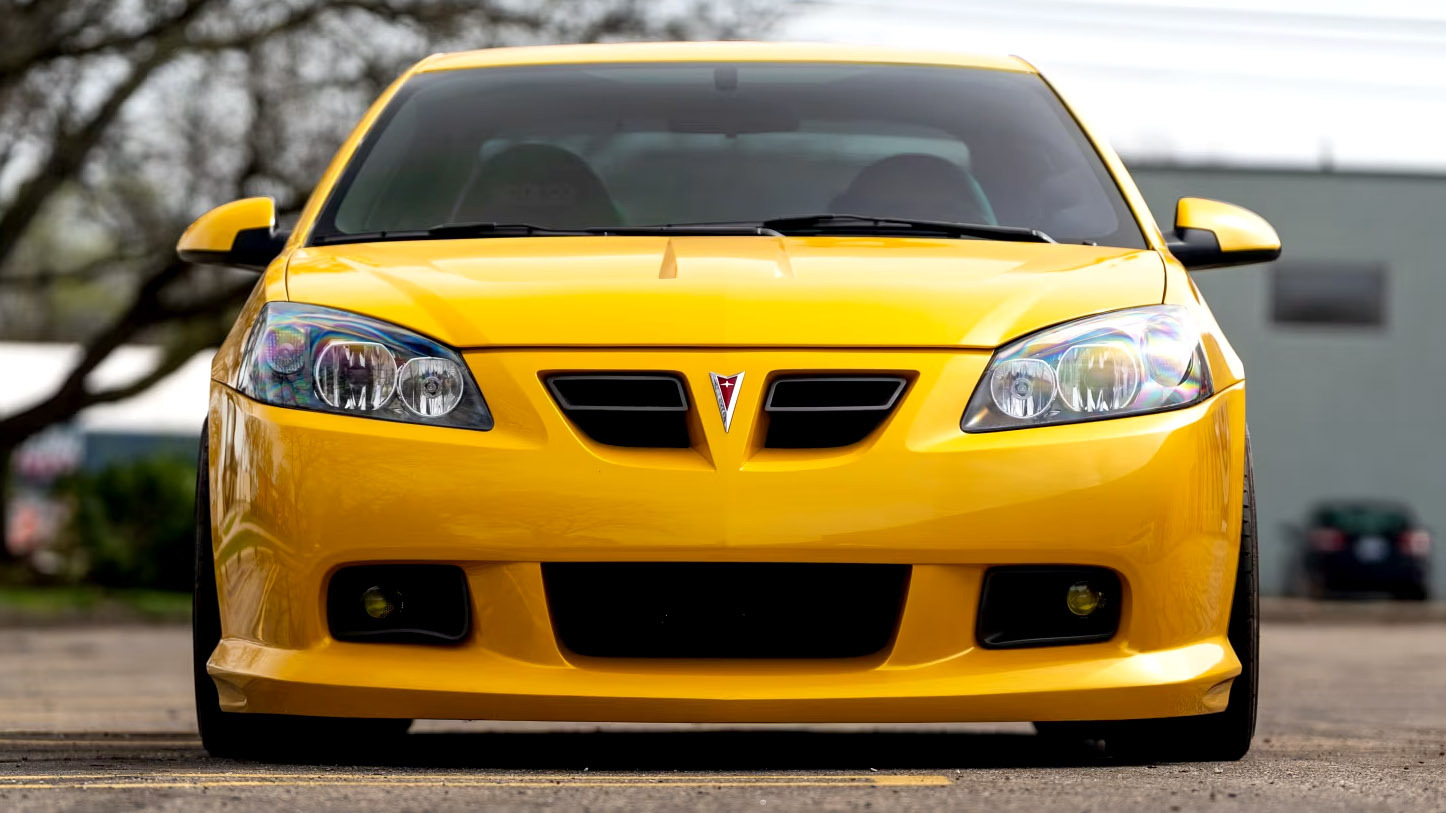
Mecum hasn’t disclosed the car’s ownership history since the show, and the mileage remains a question mark. Photos show 90 miles on the odometer, though the auction house hedges that it could be a trip reading. The exterior, at least, looks like it just rolled off the convention floor.
The interior tells the same story. A-pillar-mounted oil pressure and temperature gauges, Roush floor mats, a DC Sports front strut bar — all the period-correct accessories that defined aftermarket credibility in 2004. It’s a time capsule of a very specific moment when bolt-on parts catalogs were king and brand loyalty was apparently optional, even for a company built on the back of Ford racing.
Roush isn’t just clearing out the oddities, either. The same Nashville auction includes a 1995 Shelby Cobra Mustang SVT Cobra R, a 1997 Ford Mustang Cobra SCCA Trans-Am race car, and a 1926 Ford Model TT. That’s the kind of company this G6 is keeping, which only makes its presence more surreal.
The real question isn’t what this car will sell for — it could go for five figures or fall flat — but why Roush built it in the first place. In 2004, GM was spending heavily to position the G6 as something more than the Grand Am’s forgettable successor. Oprah famously gave away 276 of them on her show that same year. The aftermarket push was part of GM’s broader strategy to inject cool into a car that had none organically.
Roush, apparently, was happy to take the contract. The result is a car that exists at the intersection of corporate marketing ambition and aftermarket hustle — a sedan nobody remembers, built by a tuner everybody does, for a brand that no longer exists.
If you’re the kind of collector who values the deeply weird over the conventionally desirable, Nashville awaits.




Share this Story