
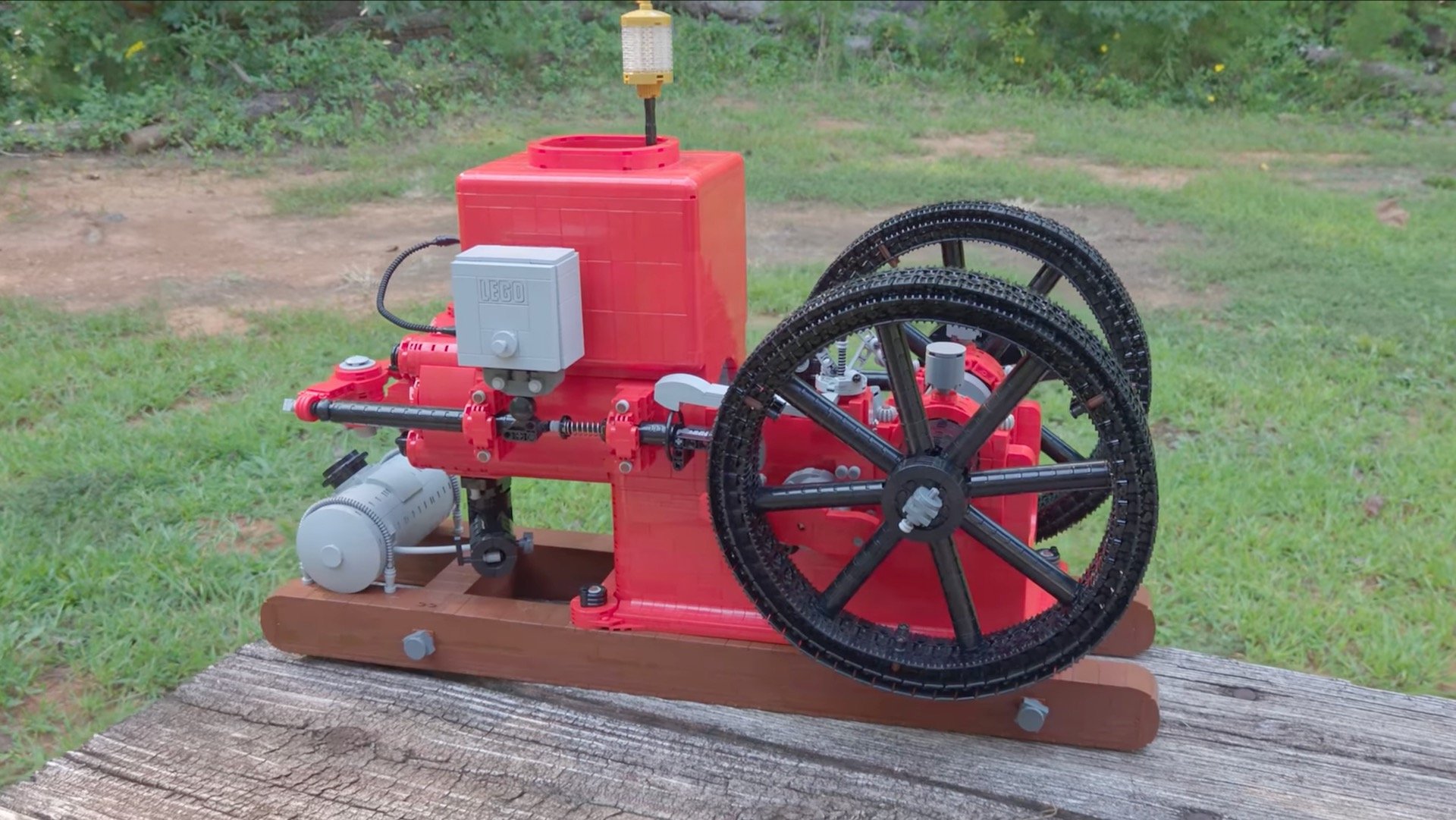


A YouTuber named Delton Adams built a working hit-and-miss engine entirely out of Lego bricks. It produces .12 watts of power. That’s roughly 1.5 “studpower,” a real unit of measurement in the Lego engine community, which is apparently a thing.
Hit-and-miss engines disappeared from practical use by the 1930s. They were stationary workhorses, powering farm equipment and small industrial operations in the early 20th century before electric motors and more refined internal combustion designs made them irrelevant. The name describes their operating principle: the engine only fires when speed drops below a set threshold, then cycles without ignition until it’s needed again.
A governor mechanism holds the exhaust valve open during the “miss” strokes.
Adams didn’t just stack bricks into the shape of an engine and call it a day. He solved a genuine engineering problem. Real hit-and-miss engines run on a four-stroke cycle, but Lego vacuum power, which substitutes for combustion in these builds, operates on a two-stroke cycle.
Attempting a four-stroke replication would pull the piston out of position under vacuum. So Adams moved the camshaft out of the way instead of holding the exhaust valve open, bridging the gap between toy physics and antique mechanical design.
The details are where this build separates itself from typical Lego engine projects. Adams replaced the standard camshaft and pushrod arrangement found in other Lego vacuum engines with an inverted cam and rocker system, adding a spring to operate the valve against vacuum pressure. The governor is a period-correct fly-ball mechanism driven by centrifugal force.
The crankshaft rides on friction-reducing roller bearings. The piston connects to the rod with tiny wrist pins. The cylinder head bolts down with long studs, just like the real article.
It’s an obsessive recreation of a machine most people have never heard of, built from a medium that wasn’t designed for it.
The Lego freestyle engine community occupies a peculiar corner of the internet where mechanical literacy meets plastic bricks and an almost unreasonable amount of patience. Builders in this space don’t chase horsepower or practical output. They chase fidelity.
Adams chose his subject well. Hit-and-miss engines were never elegant. They were crude, slow-turning, and loud, producing that distinctive “pop… pop… pop” firing pattern that collectors of antique engines love. They represent a branch of internal combustion development that simply stopped evolving.
Electric power and more efficient engine designs killed them off before they had a chance to mature.
Building one from Lego is a strange act of preservation. The original engines survive mostly at agricultural shows and in private collections, where enthusiasts keep them running on decades-old castings and hand-machined parts. Adams kept the spirit alive with ABS plastic and a vacuum pump.
The finished engine runs. It sounds nothing like the real thing, but it moves with the same halting rhythm, firing only when the governor allows it. At .12 watts, it couldn’t power a nightlight.
Then again, the point was never output. It was proof that the mechanism works, even when the materials are absurd.
Adams is already fielding requests for his next build.





Share this Story