
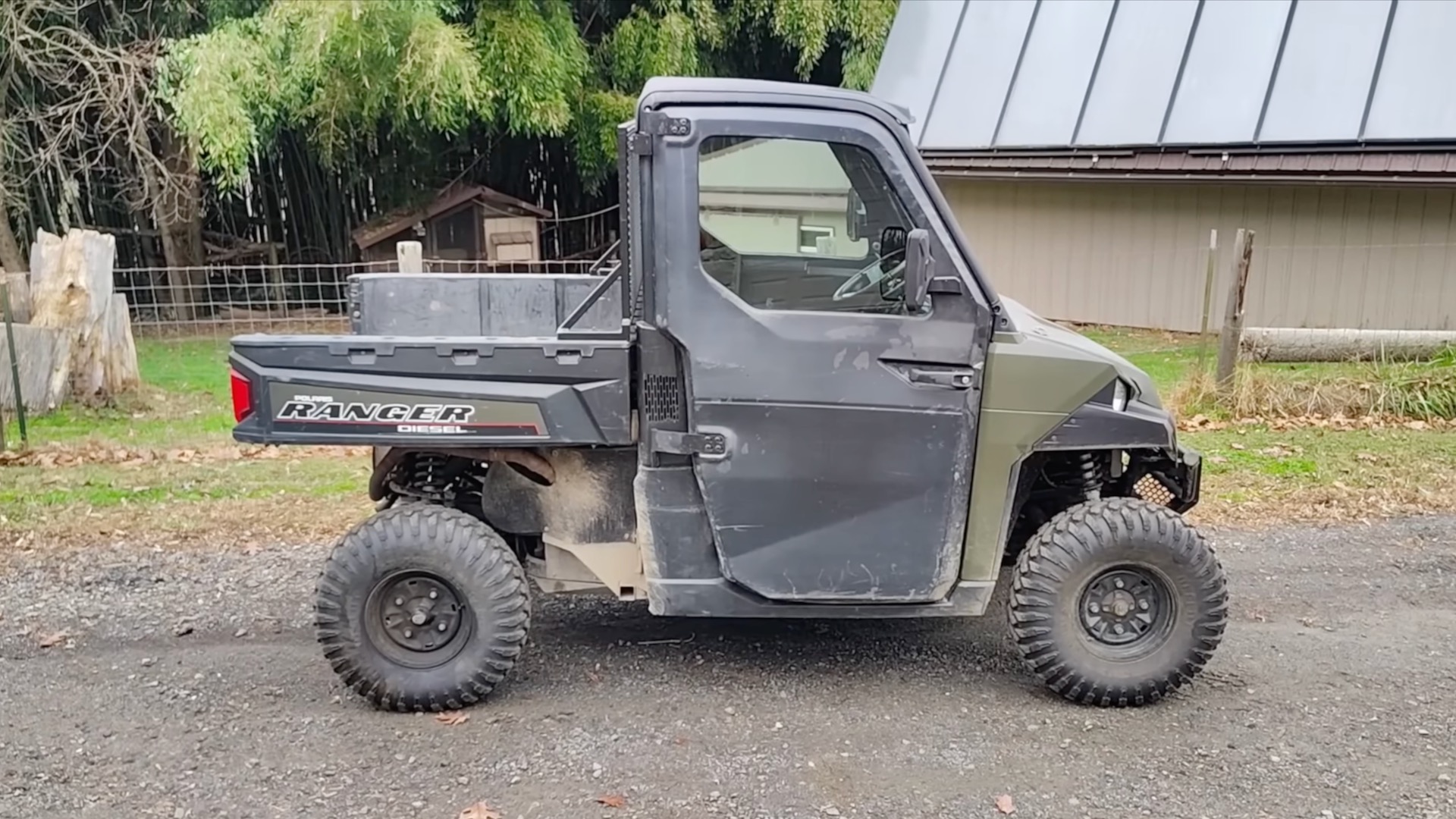


The Chevrolet Spark’s 1.4-liter inline four made 98 horsepower and 94 pound-feet of torque. In a subcompact city car, those numbers were a punchline. In a Polaris Ranger, they’re a revelation.
Mad Goat Customs stuffed that wheezy little Ecotec four-cylinder into a 2016 Polaris Ranger UTV for a customer build, and recently posted a video walkthrough on YouTube. The shop chose the Spark engine not for its power — nobody ever has — but for its physical footprint. As car engines go, it’s tiny, which made packaging it into the Ranger’s tight frame more manageable than a Subaru flat-four or anything else with real shoulders.
The execution is where this gets interesting.
In the Spark, the engine sits sideways, driving the front wheels through a transaxle. Mad Goat flipped the whole assembly longitudinally and repurposed the transaxle’s output shafts to feed both a front and rear differential — 3.84 and 3.70 gearing, respectively. The rear diff was mounted upside down so it would spin the correct direction.
Elegant? Not exactly. Functional? Completely.
The transaxle isn’t even from a Spark. It’s an AW50-42LE four-speed automatic pulled from a Saab 9-5 Turbo, controlled by steering-wheel paddles borrowed from a Honda Pioneer. Three manufacturers, zero blood relation, all made to cooperate.
Fitting this Frankenstein drivetrain required stretching the Ranger’s frame seven inches and widening it in spots to clear the engine and transmission. A bed from a Ranger Diesel HST was grafted on to disguise the longer wheelbase. From the outside, the whole package looks close enough to stock that you’d never suspect a car engine lives behind the cab.
Getting the electronics sorted was its own project. The stock Polaris ECU was ditched in favor of an Arduino controller and CAN bus network. The Spark engine itself was reflashed with manual-transmission software — the second-gen Spark offered a five-speed stick from the factory — and then deliberately detuned.
The builder wanted drivability and axle survival over peak output. Even so, the shop claims the Ranger can cruise in fourth gear all day without complaint.
That last detail says everything about how mismatched this little engine was in its original application. Nearly 100 horsepower is genuinely excessive for a side-by-side that weighs a fraction of the Spark. The same engine that felt anemic hauling 2,300 pounds of subcompact through traffic now has authority over a machine built to crawl trails and haul across ranch land.
Engine swaps usually celebrate excess — LS motors crammed into Miatas, Hellcat mills dropped into everything with a hood. This one goes the other direction. It takes the most forgettable engine in GM’s recent lineup and gives it a context where its modest output actually matters.
The Spark four-cylinder was always adequate. It just never had the right dance partner.
Mad Goat’s build also raises a fair question. Chevy sold the gasoline Spark for a decade in the U.S., through two generations, from 2013 to 2022. Junkyard cores will be cheap and plentiful for years. If the engine fits a Ranger this well, it’ll fit other things too.
Somewhere out there, a Spark donor car is sitting with an empty engine bay, waiting for someone to fill it with something that actually deserves the name.


Share this Story