
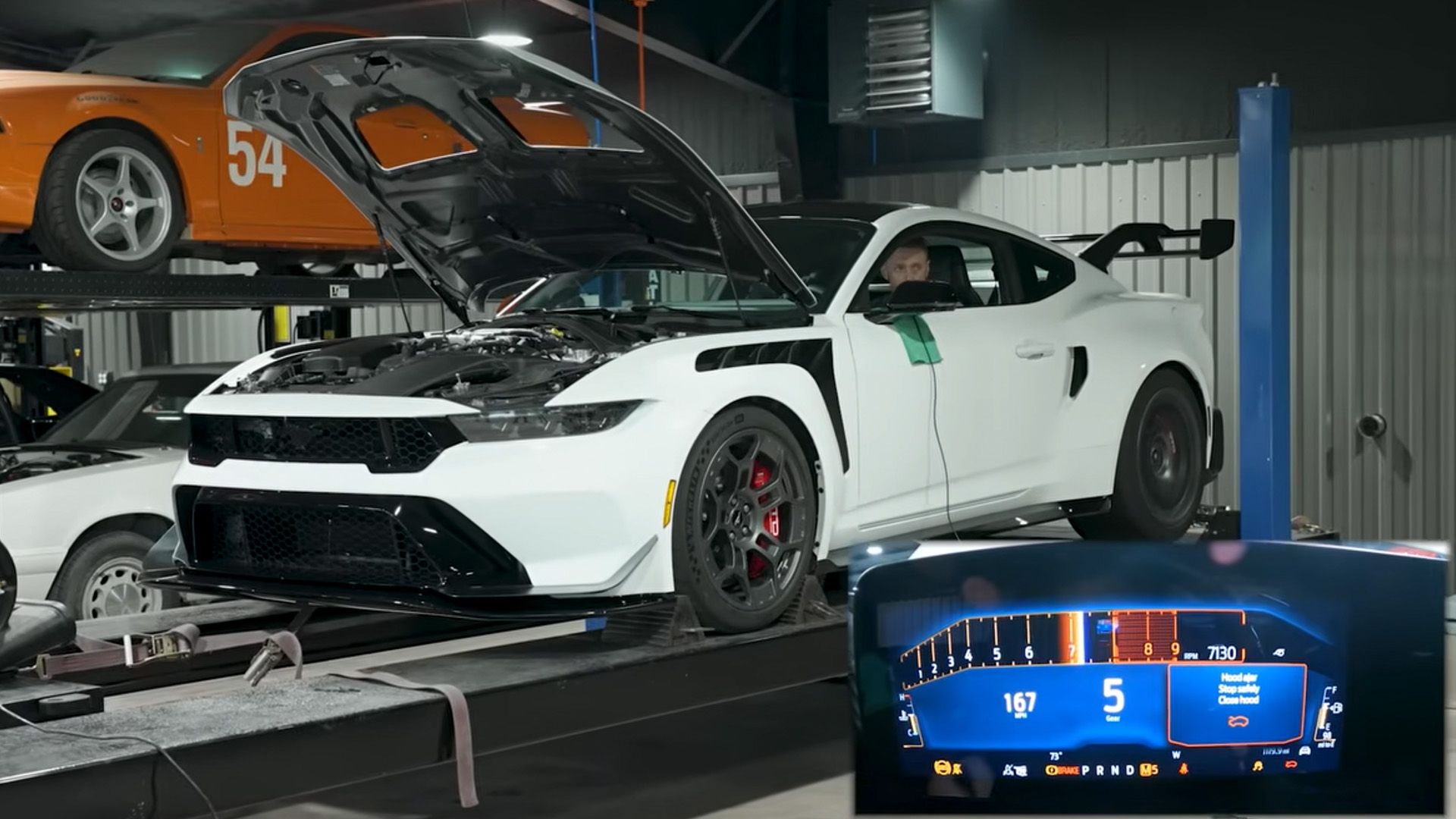


Ford stamped 815 horsepower on the Mustang GTD’s spec sheet. The dyno says that number is conservative — possibly by a wide margin.
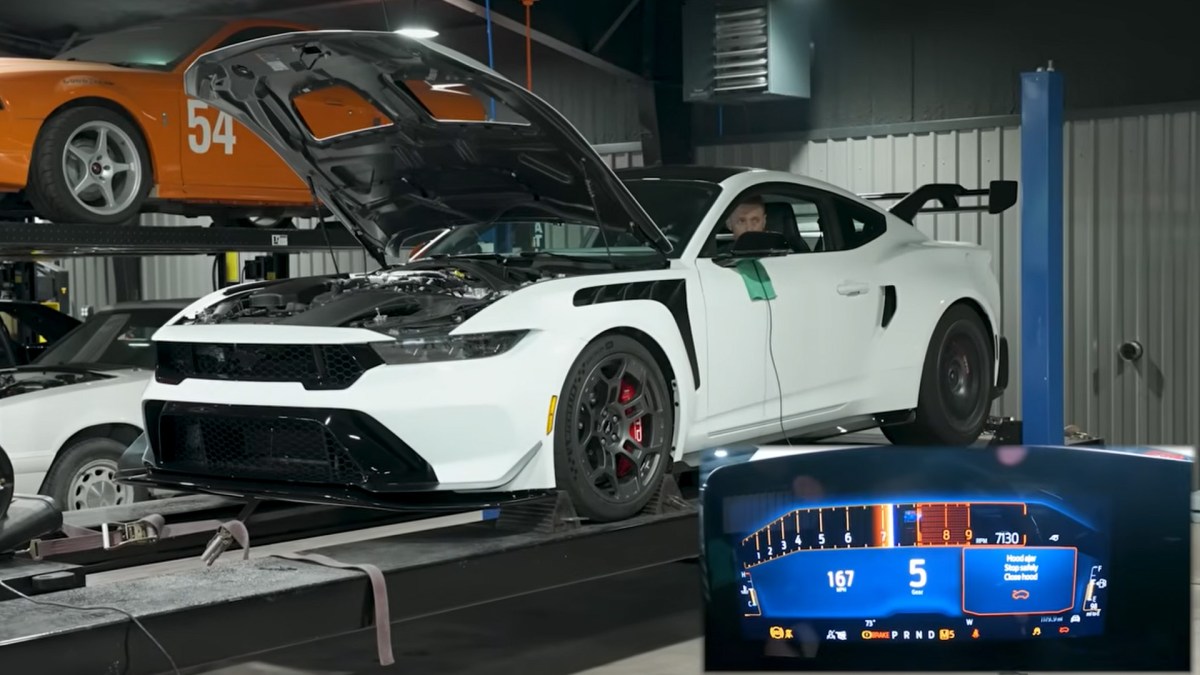
Late Model Restoration, the Texas-based Mustang specialists, strapped a white-and-carbon GTD with just 1,100 miles on the clock to its rollers and let the supercharged 5.2-liter Predator V8 scream. The results landed well above what simple drivetrain-loss math would predict.
First pull: 740 horsepower at the rear wheels at 7,100 rpm, with 605 lb-ft of torque at 4,600 rpm. Second pull: 753 whp at 7,400 rpm and 609 lb-ft at 4,500 rpm. Both runs were conducted in fifth gear rather than the transaxle’s 1:1 seventh gear, which is the traditional dyno standard for minimizing parasitic losses.
Here’s why those numbers raise eyebrows. The accepted rule of thumb for drivetrain loss on a rear-wheel-drive car is 12 to 20 percent, with 15 percent being the lazy industry default. The GTD’s power has to travel from the front-mounted engine all the way back to a Tremec eight-speed dual-clutch transaxle, a layout closely related to what sits behind the C8 Corvette ZR1.
That’s a long mechanical path. Yet LMR’s numbers suggest only about 8 percent loss, which would be remarkably efficient. The more likely explanation is that Ford’s 815-hp crank rating is sandbagging.
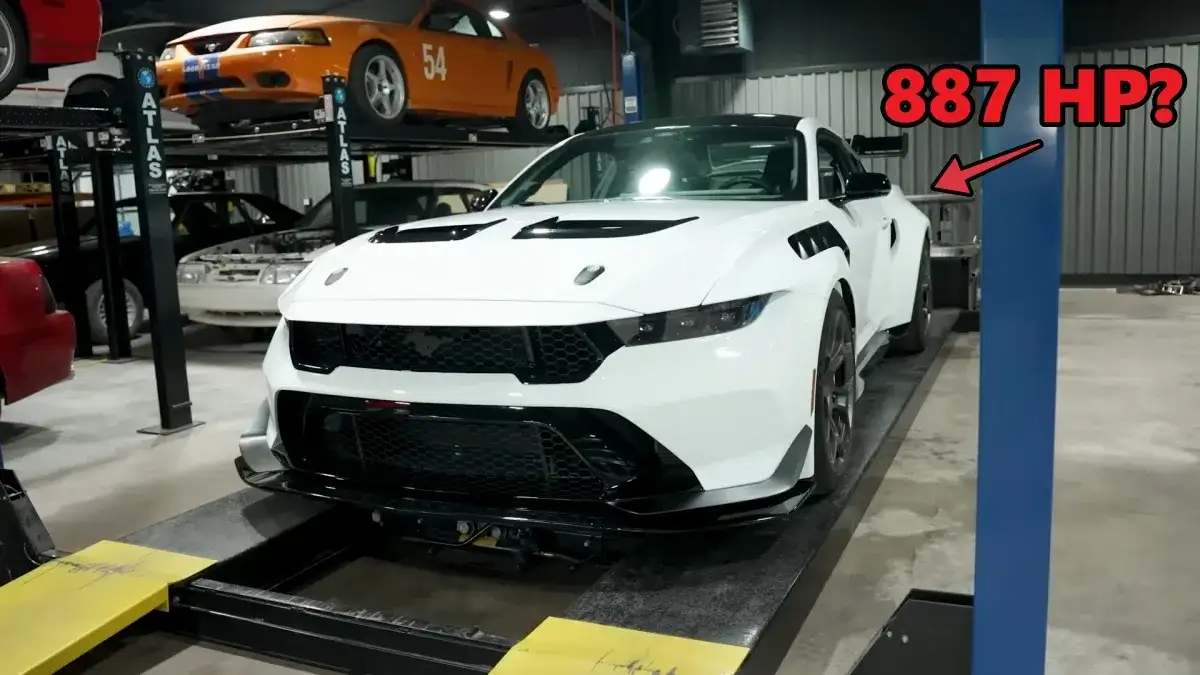
Back-of-the-envelope math using standard loss assumptions puts the actual crankshaft output somewhere between 870 and 890 horsepower. Ford has done this before. Automakers frequently underrate flagships to manage warranty claims, underpromise on performance, or simply keep a card up their sleeve for future special editions.
The second run being stronger than the first is its own quiet statement about the GTD’s engineering. Heat soak typically murders repeat dyno pulls. The fact that this car picked up 13 wheel horsepower on its second pass suggests the cooling package, designed for sustained Nürburgring-pace lapping, is doing serious work even in a static dyno environment.
Other GTD dyno videos have surfaced on YouTube showing roughly 740 whp on the low end, making LMR’s 753-whp pull the highest recorded so far. The consistency across multiple cars and multiple shops tells a clear story: every GTD tested is overdelivering against Ford’s published numbers.
That matters for a car with a $327,960 base price and production capped at roughly 1,700 units, only 271 of which were allocated for 2025. Ford has received more than 7,500 applications. The GTD already set a Nürburgring record for an American production car, and now dyno evidence confirms it’s packing more punch than its résumé advertises.
The used-market premium on these cars, already building before deliveries have barely begun, isn’t going to soften anytime soon.
Ford built the GTD to take on Porsche and Ferrari at their own game on their own turf. Understating the horsepower is a move straight from the old-school muscle car playbook, the same trick Chevrolet pulled with the original 427 Corvette and Chrysler ran with the 426 Hemi. Rate it low, let the stopwatch and the dyno do the real talking.
The Predator V8, already the most powerful engine Ford has ever bolted into a street Mustang, appears to be making nearly 900 horsepower at the crank. Ford just doesn’t want to say so. The dyno doesn’t care what the brochure claims. It measures what the tires receive. And the tires are receiving more than anyone was promised.


Share this Story