
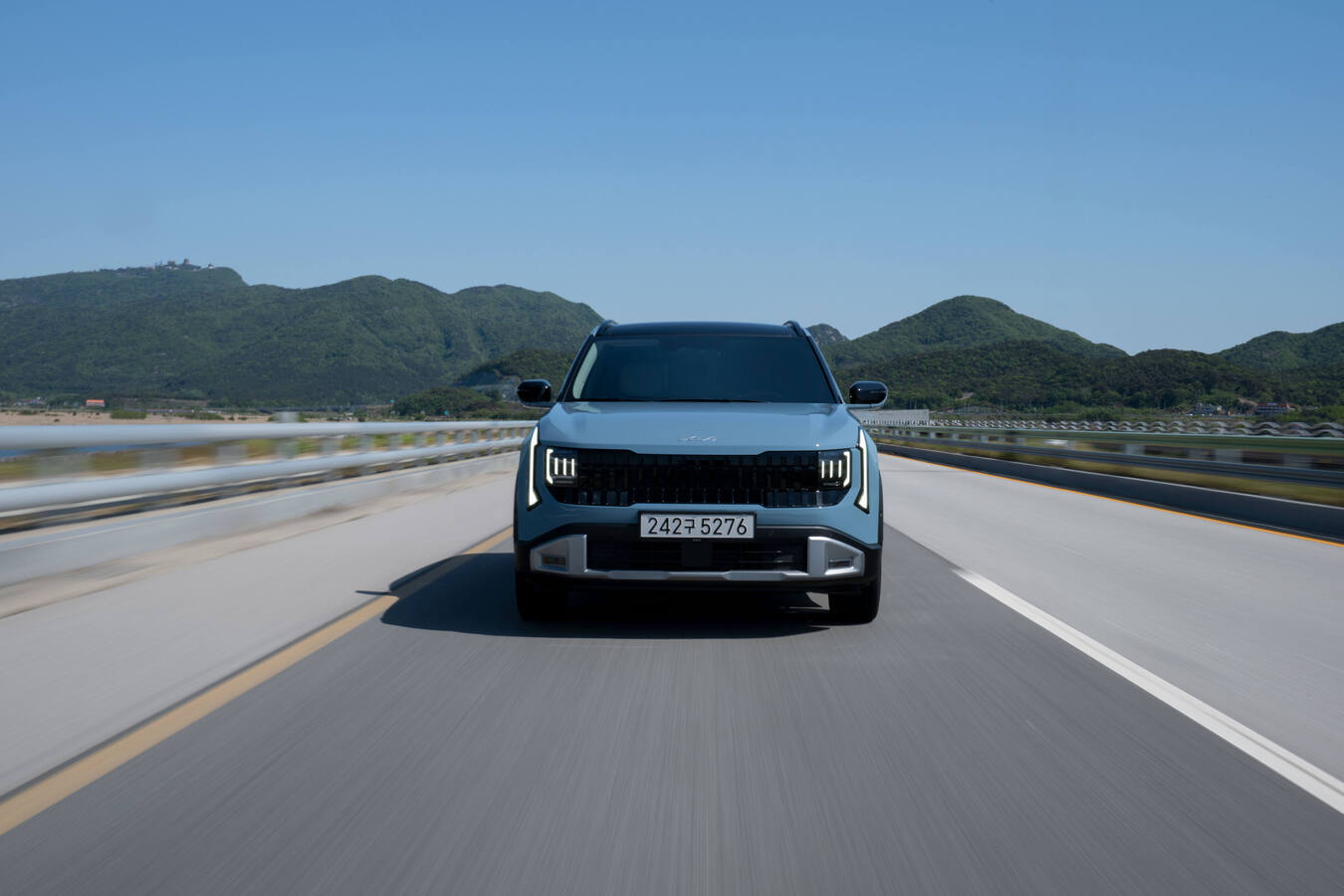


Kia didn’t just facelift the Seltos. It killed it and started over.
The all-new subcompact SUV rides on an entirely different platform, Kia’s K3 architecture, with a longer wheelbase, wider body, new powertrains including a first-ever hybrid, and enough technology to make you forget this thing starts well under $30,000. Global production began quietly in December 2025 at Kia’s India plant, with Korean and Chinese factories now rolling units. Sales span 189 countries through 2026.
The new Seltos stretches to 4,430 mm long and 1,830 mm wide, 45 mm longer and 30 mm wider than the outgoing model. A 60 mm longer wheelbase buys rear passengers 25 mm more legroom and pushes cargo volume to 536 liters VDA, a 38-liter gain. Body rigidity jumps hard, with ultra-high-strength and hot-stamped steel making up as much as 60 percent of the Korean-built structure.
The drag coefficient drops from 0.33 to 0.31.
Three powertrains serve North America and Korea: a 2.0-liter naturally aspirated four-cylinder, a 1.6-liter turbo making 193 horsepower, and the new 1.6-liter hybrid producing a combined 157 horsepower in front-drive form or 181 horsepower with e-AWD. That electric all-wheel-drive system is a first for any Kia ICE or hybrid vehicle, though it’s limited to export markets for now.
The hybrid introduces Kia’s Smart Regenerative Braking System 3.0, which reads traffic flow, road gradient, navigation data, and upcoming hazards like intersections and speed bumps to automatically adjust regen intensity. Vehicle-to-Load capability lets the Seltos power external devices from the cabin, a feature that until recently lived exclusively in the EV lineup.
Inside, Kia went after cognitive load the way engineers typically chase horsepower. A column-mounted shift-by-wire selector clears the center console entirely. Dual 12.3-inch screens sit alongside a dedicated climate panel, running Kia’s latest connected car navigation cockpit.
A 12-inch head-up display projects driving data onto the windshield. The AI assistant, powered by ChatGPT, handles voice commands for navigation, entertainment, vehicle settings, and general questions.
Digital Key 2 with ultra-wideband tech enables walk-up unlock and walk-away lock without fumbling for a phone. Over-the-air updates cover both infotainment and vehicle control modules. The Kia Connect Store sells downloadable features and display themes, including 17 FIFA World Cup 2026 skins, because apparently nothing sells SUVs like soccer branding.
Kia tuned the chassis differently by region. European models prioritize sharper handling and high-speed stability. Korean-spec cars focus on ride comfort and pitch control for urban driving.
Both the two-wheel-drive and all-wheel-drive hybrid variants get multi-link rear suspension, a meaningful upgrade over the torsion beam that serves base models.
Safety targets are aggressive: five-star North American NCAP, IIHS Top Safety Pick, Grade 1 KNCAP, and five stars from India’s BNCAP. The ADAS suite includes Highway Driving Assist 2 with hands-on/off detection, expanded forward collision avoidance operating between 10 and 85 km/h, surround view monitoring, and safe exit warning.
Kia CEO Ho Sung Song called it “a significant advance,” language that undersells the scope of work here. The original Seltos was a competent if unremarkable entry that sold on value and packaging. This second generation plays a different game entirely, borrowing technology and structural engineering from vehicles two segments above it.
The subcompact SUV category has become the most viciously competitive space in the global market. Everybody from Toyota to Volkswagen to Chinese newcomers is fighting for the same budget-conscious buyer who still wants a modern digital experience. Kia just made that fight considerably harder for everyone else.


Share this Story