
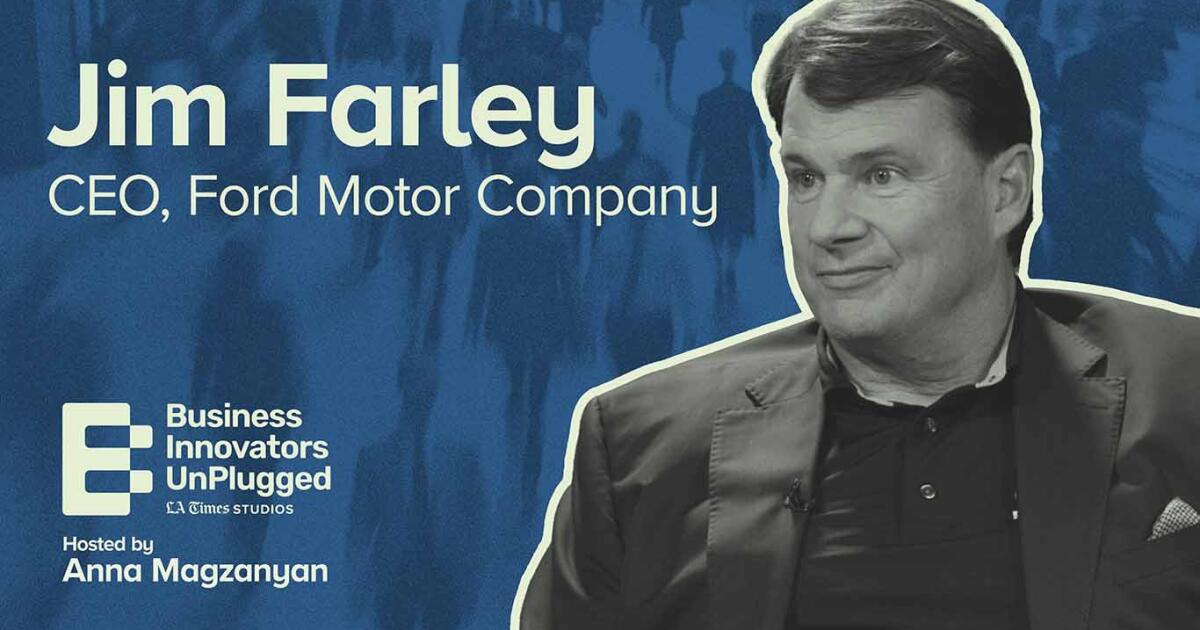


Ford CEO Jim Farley has been quietly lobbying senior Trump administration officials on a framework that would let Chinese automakers build vehicles in America — with guardrails to protect domestic manufacturers. The Detroit News broke that story, and it landed like a grenade in an industry already rattled by tariff whiplash and an EV transition that nobody in Detroit seems to want but nobody can afford to ignore.
Farley has spent the better part of two years publicly praising Chinese vehicles. He’s talked about being humbled by their in-vehicle technology. He’s compared the innovation gap to the kind of existential threat that should keep every Detroit executive awake at 3 a.m. Now he’s trying to turn that admiration into policy.
The timing is surreal. President Trump told business leaders in Detroit back in January that he’d “love” to see Chinese carmakers build plants in the U.S., hiring “your friends and your neighbours.” That comment spooked the entire domestic industry. Farley apparently decided to get ahead of the chaos rather than get buried by it.
This isn’t the first time an American automaker has tried to absorb a foreign competitor’s playbook. In the early 1980s, General Motors partnered with Toyota at a plant in Fremont, California, under the NUMMI joint venture. GM’s Fremont workforce was widely considered the worst in the American auto industry.
Toyota flew those workers to Japan, taught them a new way to build cars, and for a brief, shining moment, it worked. Then GM’s leadership fumbled the transfer. The lessons learned at NUMMI never penetrated the rest of the company. The Fremont plant eventually closed. Tesla builds cars there now.
The parallel is uncomfortable. Farley is arguing that Ford can do what GM couldn’t — learn from a superior foreign competitor without losing its identity or its market. But the obstacles are different and arguably worse. The Chinese auto industry didn’t creep up slowly. As one observer put it, paraphrasing Hemingway, they got better very slowly, then all at once.
BYD, Geely, and others aren’t just building cheap cars anymore. Their factories are robotic cathedrals with barely a human in sight. Their EVs are technologically sophisticated, aggressively priced, and already dominating markets across Europe, Southeast Asia, and South America. The idea that they’d come to America and politely play by Detroit’s rules requires a kind of optimism that history doesn’t support.
Industry analyst Michael Dunne doesn’t mince words about how the U.S. got here. The harder truth is that Detroit’s retreat from EVs is the result of a spectacular cascade of failures: by automakers who never took the transition seriously, dealers who actively undermined it, and a political environment that turned the simple act of buying an electric car into a toxic political statement.
Ford itself already discontinued the electric Lightning pickup. Farley once compared it to the Model T for its innovation. That truck now looks like a relic, and it’s barely cold in the ground.
The administration’s posture on Chinese vehicles changes by the week. Tariffs are sky-high one day, and the president is courting Beijing automakers the next. Trump is expected to visit China in April, where he’ll see firsthand the manufacturing firepower that has every Western automaker scrambling. What he does with that information is anyone’s guess, but consistency hasn’t been a hallmark.
Farley is making a calculated bet that controlled engagement beats denial. He wants Ford to be the company that shapes the terms of Chinese entry into the American market rather than the company that gets steamrolled by it.
Whether Ford’s board, its unions, its dealers, and an unpredictable White House will let him execute it is another question entirely. GM had the NUMMI recipe forty years ago. The secret sauce didn’t save them. It didn’t even slow the bleeding.

Share this Story