
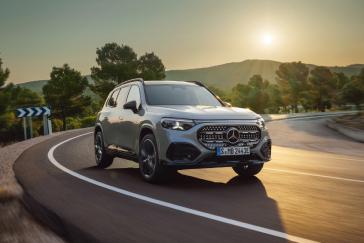


Mercedes-Benz wants you to know the electric GLB is 21 percent cleaner in its supply chain than it would have been without intervention. Read that again. Not 21 percent cleaner than the gas-powered GLB it replaces, and not 21 percent cleaner than the competition. Twenty-one percent cleaner than its own hypothetical dirty twin.
That’s the kind of math automakers love, and the kind buyers should scrutinize.
The Stuttgart automaker dropped its 360° Environmental Check for the all-new electric GLB this week, built on the company’s new Modular Architecture platform, or MMA. The headline numbers sound impressive: up to 3 tons of CO₂ saved per battery pack through renewable energy in cell production, more than half the vehicle’s 359 pounds of aluminum sourced from smelters running on renewables, and 99 pounds of recycled thermoplastics scattered across components from the frunk tub to the bumper substructure.
Independent auditors verified the data. Mercedes has published these lifecycle assessments since 2005, longer than most rivals have bothered pretending to care about supply chain emissions. Credit where it’s due.
But the framing matters. Every reduction figure is measured against a baseline of doing nothing — using conventional energy, virgin materials, standard production. That’s technically honest and strategically generous. A 40 percent reduction in battery cell emissions sounds transformative until you remember lithium-ion cell manufacturing remains one of the most energy-intensive processes in the auto industry, period. Cutting 40 percent of a massive number still leaves a massive number.
The steel story is even more telling. Steel and ferrous materials make up roughly 46 percent of the GLB’s material weight, yet only about 44 pounds of that steel qualifies as CO₂-reduced, produced in electric arc furnaces on renewable power. Mercedes acknowledges that green hydrogen and electric steelmaking could someday enable “virtually CO₂-free” production. Someday. For now, 44 pounds is a rounding error on a vehicle that likely weighs north of 4,500 pounds.
Production at the Kecskemét plant in Hungary is labeled “net carbon-neutral,” a term Mercedes helpfully footnotes: emissions that can’t be avoided or reduced get offset by certified projects. Carbon offsets remain the most contested currency in climate accounting. Planting trees in one hemisphere to justify burning energy in another has drawn sustained fire from environmental scientists. Mercedes isn’t alone in leaning on offsets — virtually every automaker with a net-zero pledge does — but the asterisk deserves the same font size as the claim.
Where Mercedes genuinely leads is transparency. Publishing product-specific environmental data for two decades, subjecting it to third-party audits, and breaking down component-level contributions is more than most competitors offer. Volkswagen and BMW publish similar lifecycle data, but Mercedes has been at it longer and with more granularity. The 360° Environmental Check gives informed buyers actual numbers to chew on rather than vague sustainability slogans.
The electric GLB itself sits in a fiercely competitive compact luxury EV segment where Volvo’s EX40, BMW’s iX1, and Audi’s Q4 e-tron are all fighting for the same environmentally conscious dollar. Lifecycle emissions data could become a genuine differentiator — if customers learn to read it critically.
Mercedes is investing in photovoltaic expansion across the Kecskemét site and targeting 70 percent renewable energy in production by 2030, with full renewable operations by 2039. Those are real commitments with real timelines. The trajectory is legitimate.
But a 21 percent supply chain reduction measured against your own worst-case scenario is a progress report, not a victory lap. The electric GLB is cleaner than it could have been. The question customers should ask is whether it’s clean enough — and whether any automaker, Mercedes included, is moving fast enough for the math to matter.


Share this Story